





HOUSTON - The six-astronaut crew of NASA's shuttle Atlantis had little timeto rest after reaching the International SpaceStation (ISS) Monday, and immediately began delivering massive new piecesof the orbital laboratory.
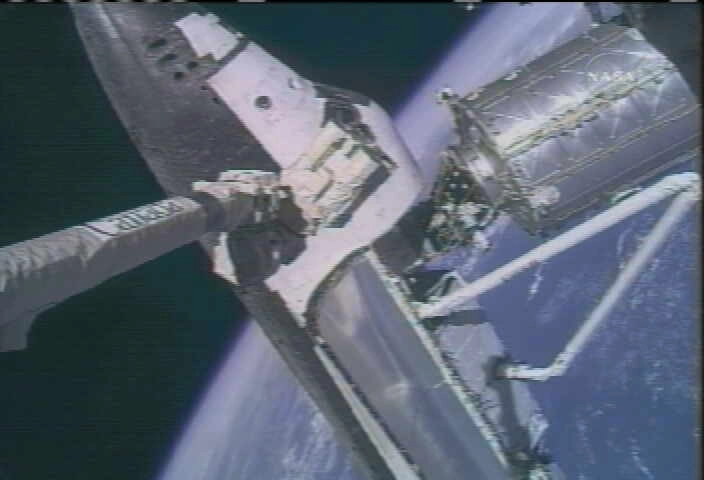
Atlantis' STS-115 astronauts boardedthe ISS by 8:30 a.m. EDT (1230 GMT), with mission specialists DanielBurbank and StevenMacLean jumping into tasks to move a $372million pair of trusses and solar arrays from the shuttle's cargo bay tothe end of the ISS robotic arm.
"This is an extremely busy day,"Paul Dye, Atlantis' lead shuttle flight director, said during a status briefinghere at NASA's Johnson Space Center. "It's one of the busiest days I'veever put together on paper for a mission, and they're handling it very well."
Typically, a shuttle docking is thehighlight of a day's work, but the Atlantis astronauts still had more on theirplate after joining Expedition13 commander Pavel Vinogradov and flightengineers JeffreyWilliams and ThomasReiter aboard the ISS.
"This crew has been training longerthan any crew I've ever worked with and they're very flexible," Dye said of theSTS-115 astronauts' schedule.
Burbank and shuttle pilot Chris Fergusoneased the 35,000-pound (15,875-kilogram) Port 3/Port 4 trusses out of Atlantis'payload bay, at one time wrangling with clearances of just inches between thestation segments and orbiter hardware, shuttle officials said.
By 10:30 EDT (1430 GMT), the two joined trusssegments were parked at the end of the space station's nearly 57-foot(17-meter) robotic arm under the direction of MacLean and Williams. MacLean, aveteran shuttle flyer representing the Canadian Space Agency, is the first fromhis country ever to control the space station's Canadian-builtrobotic arm.
The robotic arm handoff has sincebecome a standard training exercise for astronauts, Dye said.
"We've done this P3/P4 unberth and handoff hundreds of times in simulations, overand over and over," Dye told reporters while watching the orbital arm ballet onNASA TV. "It's wonderful to see it happening for real."
With the P3/P4 truss segments nowhanging in space, the thermal clock is ticking to attach them to the end of thePort 1 (P1) truss in a Tuesdayspacewalk, the first of three extravehicular activities (EVA) planned forthe STS-115 mission.
MacLean and Williams positioned thenew ISS hardware to keep it warm overnight, but the segments must be connectedto vital power and heaters - to be attached in tomorrow's 6.5-hour spacewalk -before it can double the station's power grid capability.
The trusses will be connected to theend of P1 via four motorized bolts before STS-115 spacewalkers JosephTanner and Heidemarie Stefanyshyn-Piperstep outside the ISS to attach the vital cables. Only three bolts are requiredfor a good connection, and the astronauts can manually drive the bolts in aswell - which would add at least 45 minutes to the spacewalk schedule - shouldthe automatic system fail, Dye said.
"We want to get the umbilicals hooked up on the EVA tomorrow in order to makesure that we can keep that thing alive and in good shape," Dye said ofTuesday's planned spacewalk. "We've got margin to that, of course, it won't bea disaster if we don't make it there. But it is going to be a very aggressiveday."
NASA's STS-115mission is the agency's first dedicated ISS construction flight since late2002. Orbital construction stalled pending NASA's recovery from the 2003 Columbia accident. The11-day mission will deliver the second of four planned U.S.-built solar arraysto the station.
- VIDEO: First Tasks of NASA's STS-115 Mission
- Gallery: Prepping Atlantis
- Complete Space Shuttle Mission Coverage
- NASA's STS-115: Shuttle Atlantis to Jump Start ISS Construction
- The Great Space Quiz: Space Shuttle Countdown
- Complete Coverage: ISS Expedition 13
