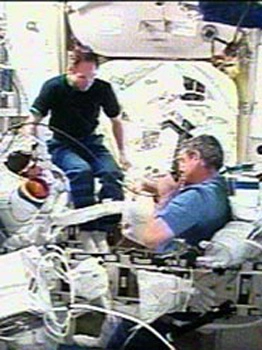
For thefirst time in more than two years, the astronauts aboard the International SpaceStation (ISS) will step outside their spacecraft clad in U.S. spacesuits duringtheir mission's first spacewalk, NASA officials said Thursday.
ISS Expedition12 commander Bill McArthur and flight engineer Valery Tokarev are scheduledto exit the station at 9:30 a.m. EST (1430 GMT) on Nov. 7 for a 5.5-hour spacewalkto revamp tools on the outpost's exterior.
"It'spretty exciting," Tokarev told ABC News Wednesday of the spacewalk, whichwill be a career for the Russian Federal Space Agency cosmonaut. "I've beenasking Bill a lot about his experience."

McArthurhas conducted two spacewalks - both during the shuttle Discovery's STS-92mission to the ISS in 2000 - to support the station. He and Tokarev will leavethe ISS empty while they toil in space, leaving station control in the hands offlight controllers on Earth.
"It is thefirst time we've done a U.S. EVA without anyone inside," said Pete Hasbrook,NASA's Expedition 12 increment manager, Thursday during a press conference atthe agency's Johnson Space Center in Houston, Texas. "We've been able to use alot of the lessons that we've learned from our preparations for the RussianEVAs...[but] it certainly has not become routine for us."
Thespacewalk will also mark the first time since April 2003that ISS astronauts left the station from its U.S.-built Quest airlock and wornU.S. spacesuits. In the interim, ISS crews were limitedto two astronauts per flight after the Columbia accident and spacewalkersrelied on Russian-built Orlanspacesuits for two-person EVAs.
Contaminationto both the airlock and the station's U.S. spacesuits - dubbed ExtravehicularMobility Units (EMUs) by NASA - prevented the equipment from being usedearlier, though the portal has since been repaired and new spacesuits deliveredto the orbital platform.
Straightforwardtasks
McArthurand Tokarev have two primary tasks to complete for their spacewalk, thoughflight controllers do have some bonus chores waiting for them if there's time.
"The tasksthemselves are not overly challenging," explained Anna Jarvis, Expedition 12EVA director, during the press conference. "We have not trained them in thisexact sequence, but they [require] very generic skills."
Afterleaving the ISS airlock, McArthur and Tokarev will pull themselveshand-over-hand to the leftmost edge of the space station - the tip of its P1truss - to install a camera, lights and stand. The camera, which McArthursaid would weigh a couple of hundred pounds on Earth, will provide ISS viewsduring future station assembly spacewalks.
"As we sayon the farm, it would take two men and a boy to carry this around," McArthurtold CBS News Wednesday while Tokarev appeared to effortlessly tote the cameraequipment in microgravity.
TheExpedition 12 crew will then retrace their steps across about 60 feet (18 meters)to the Quest airlock, retrieve tools then climb another 60 feet (18 meters) orso the pinnacle of the space station - a solar array tower dubbed the P6truss, Jarvis said.
Once there,McArthur will remove a device called the Floating Potential Probe, which monitorsthe electric potential of the station as it flies through Earth's magneticfield, and cast it into space.
The probehas failed and appears to be backing out of its berth in photographs, soMcArthur will jettison it aft and above the ISS to prevent it from breakingfree on its own, Hasbrook said, adding that the probe will burn up after 100days or so.
If theExpedition 12 crew has extra time after completing those tasks, they may alsoretrieve a broken radiator rotary joint motor controller and replace a faultycircuit breaker attached to station's railcar-like mobile transporter.
Ascientific beginning
After afull month aboard the ISS - McArthur and Tokarev boardedthe orbital lab on Oct. 3 - the two astronauts are just beginning theirsix-month science program.
In additionto repairs and other science studies, McArthur has worked with the station's HumanResearch Facility rack 2 (HRF-2) and performed the first of three kidney stoneexperiment measurements alongside Tokarev. The kidney stone experiment studieshow spaceflight increases the risk of kidney stones, NASA's Expedition 12 leadscientist Julie Robinson said.
More than9,400 students on the Earth tapped into an Earth-watching camera - convenientlynamed EarthKam- to observe their home planet remotely, while meteorologists are using theExpedition 12 crew's photographs of Hurricane Wilma to better understand themassive storms, NASA officials said. Meanwhile McArthur awaits additionalscience experiment equipment slated to launch toward the ISS aboard an unmannedRussian cargo ship on Dec. 21, the added.
"We'rereally just getting started on the research for this expedition," Robinson said.
- ISS Crew Dons U.S. Spacesuits in Spacewalk Rehearsal
- ISS Astronauts Settle in for Six Months in Orbit
- Complete Coverage: ISS Expedition 12
