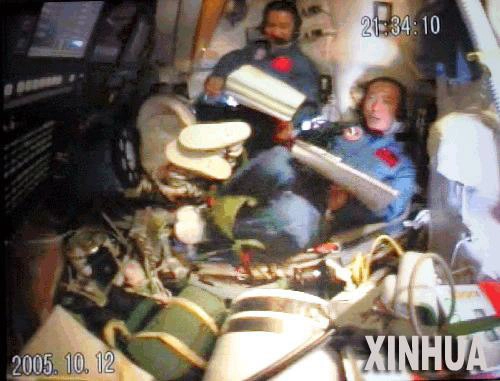
China's Shenzhou6 spacecraft and its two-astronaut crew prepared Sunday for their return toEarth after a five-day spaceflight, though Chinese space officials said theexact landing site will be decided hours before the planned touchdown.
Shenzhou6 astronauts Fei Junlong and Nie Haisheng will land in the early hours ofOct. 17 Beijing Time in either the Siziwang Banner region of Inner Mongolia innorth China, the mission's primary landing are, or at a backup site in the northwesternJiuquan region, state media reported, adding that weather forecasts predictfavorably landing conditions through Oct. 18.
"Decisionwill be made six hours before the spacecraft's return whether the re-entrycapsule will land at the primary landing site in Inner Mongolia or thisnorthwestern standby site," Zhu Yabin, chief of the land search and rescueteam, told China's official Xinhua News Agency.

Sixhelicopters, 14 special vehicles and more than 200 recovery workers have beenmobilized for Shenzhou 6's return at its primary landing site, according to SuiQisheng, chief commander in charge of landing, Xinhua reported.
"We have drawn out detailed plans to ensurethat rescue workers and equipment will arrive at where the capsule lands,"Sui told Xinhua.
Fei and Nie have orbited the Earth since launchingspaceward atop a Long March 2F rocket on Oct. 12 Beijing Time (Oct. 11 GMT).Their mission marks China's second manned spaceflight since the launch ofastronaut Yang Liwei aboard Shenzhou5 in 2003, as well as the country's first two-astronaut mission. China isthe third country to independently launch astronauts into Earth orbit afterRussia and the U.S. Its Shenzhou- or "Divine Vessel" - series spacecraft borrow a basic design from Russia's Soyuzspacecraft, but are heavily modified and modernized.
TheShenzhou 6 crew have flown nearly 1.8 million miles (2.8 million kilometers)and orbited the Earth more than 71 times during their spaceflight, China'sstate media reported.
Fei and Niehave performed a series of physical experiments to test the integrity of theirspacecraft, as well as cytology, earth observation and human physiology tests, Xinhuasaid.
The twoastronauts - also known as "taikonauts" - said Sunday that they appreciated thesupport of their country, state media reported.
"We're grateful for the deep love andconcern by all Chinese people, the Hong Kong, Macao and Taiwancompatriots," Nie said in a space-to-ground transmission, according to Xinhua.
Fei reportedly added that he and Nie were "feelinggood" and "happy" in Earth orbit and planned to "do our utmost to fulfill themission," the news agency added.
The Shenzhou 6 spaceflight is designed to furtherChina's human spaceflight experience as it works toward developing a mannedspace station and serve as a symbol of national pride while demonstratingthe country's technological prowess.
State media reports also cited China's plans toselect femaleastronauts for future missions.
China's Air Force Aeronautics Universityaccepted its eighth group of female pilot trainees in July, and may prove thesource of the country's first female fighter pilots and first female astronaut,Xinhua said Saturday, adding that some students are hopeful they'll makethe cut.
"Mydream is to become China's first female fighter pilot and first femaletaikonaut," Tao Jiali, a student from southwest China's Sichuan Provinceto the university, told Xinhua Saturday.
- Shenzhou Rising: China's Second Manned Spaceflight
- Special Report: Emerging China, Engaging China
- ZOOM View: Close in on Shenzhou 6 on its Launch Pad
