


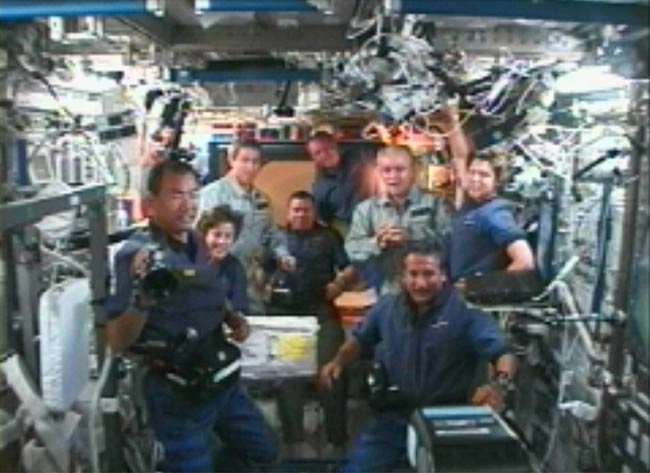
HOUSTON - NASA officiallyextended the flight of its first space shuttle mission since the Columbiadisaster, giving astronauts an extra day at the International Space Station(ISS) to move spare equipment and water into the orbital facility.
The space shuttle Discoverywill stay docked while its STS-114 crew cobbles together excess shuttle suppliesfor transfer into the station, mission managers said during a Saturdaybriefing.
"We'll sure appreciategetting that extra day," said NASA space station program manager William Gerstenmaierduring the briefing here at Johnson Space Center (JSC).
The extra timewill allow Discovery's crew to gather a few hundred pounds of items from aroundthe spacecraft - including laptop computers, tools, pens, paper, printers andan additional 20-day supply of water - for use on the ISS since the STS-114mission may be the last shuttle flight to visit the ISS until NASA solves an externaltank foamshedding problem seen during the orbiter's July 26 launch.
But that debris issueshould not affect Discovery's Earth return, now set for the early morning hoursof Aug. 8.
During the briefing, NASAdeputy shuttle program manager Wayne Hale also said that Discovery'sheat-resistant ceramic tiles and a loose thermal blanket have been given aclean bill of health.
That clears 90 percent ofDiscovery for the return flight to Earth, with the final analyses of its wingleading edges expected Sunday to be followed a day later by aerodynamicsreports on a pair of gap fillersjutting out from between the orbiter's belly-mounted tiles, he added.
"The orbiter is performing nearlyflawlessly," Hale said. "The crew is performing in just an awesome manner...wehad an outstanding EVA."
Earlier today, STS-114mission specialists Soichi Noguchi and Stephen Robinson performed a six-hourand 50-minute spacewalkto test heat shield repair methods and perform ISS maintenance.
Discovery's STS-114 flightis NASA's first shuttle mission since the loss of the seven STS-107 astronautsaboard Columbia, which broke apart over Texas on Feb. 1, 2003.
- Fixing NASA: Complete Coverage of Space Shuttle Return to Flight
