


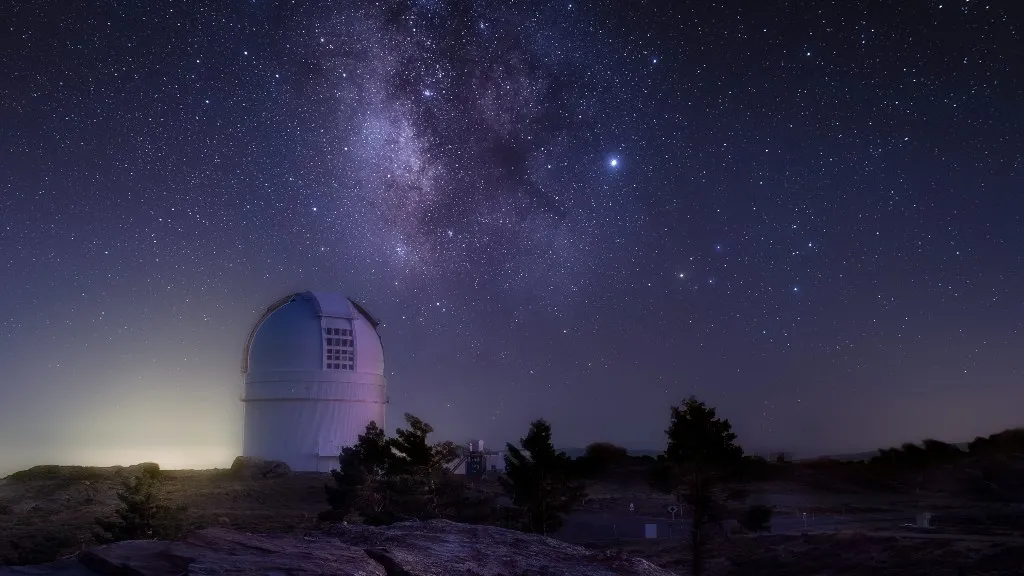
The biggest telescopes in the world are often the most successful at making new space discoveries, due to their ability to collect more light and delve into the universe's history from impressive distances.
Despite space observatories such as the Hubble Space Telescope (HST) and James Webb Space Telescope (JWST) being closer to the action, ground-based telescopes can achieve greater dimensions and are far less restricted by weight. When telescopes on Earth are built in a good location, with wide sky views, they can focus on a range of specific areas or events — unlike space telescopes which need to be in the right place at the right time.
Some of the largest telescopes are serving as Earth's eyes to explore supernovas, galaxies and other distant objects. Here are the ten biggest telescopes in action and in progress today.
Related: 15 stunning places on Earth that look like they're from another planet
10. Hobby Eberly

Location: Texas, United States
Type: Optical
Diameter: 32 feet (10 meters)
Before its success as one of the world's largest optical telescopes, Hobby Eberly's design was unique. One element that helped make it stand out from existing telescopes was that its mirror is always tilted 55 degrees up from the horizon. This might sound restricting, but its rotating mechanism means it can still observe 70 percent of the visible sky. The telescope's mirror has 91 hexagonal segments to collect visible light.
The most noteworthy discovery captured by Hobby Eberly was light that originated from a quasar so far away that the Earth was only an eighth of its current age when this light began traveling towards Earth. A quasar is an incredibly bright object that gains its energy from a supermassive black hole.
9. Keck telescopes

Location: Maunakea, Hawaii
Type: Optical and Infrared
Diameter: 32.8 feet (10 meters)
Despite being Earth-based, the twin telescopes at the Keck Observatory can see farther into space than the famous Hubble Telescope. This means that around a quarter of the observations made by U.S. astronomers are achieved using Keck, and it is considered the most scientifically productive of all land telescopes.
By incorporating optical and infrared telescopes, the observatory produces clear images in the visible light spectrum, but also allows astronomers to see deeper into space using infrared. Some of the incredible imagery uncovered by this combination of apparatus include the birth of stars, which can produce a visible glow and also heat up surrounding gas that can be detected using infrared.
The observatory is positioned near the equator and at the top of the dormant Hawaiian volcano, Mauna Kea. There are 36 mirrors that make up each telescope, joined together to make one large panel. Concealed in insulated domes, the two telescopes operate at temperatures slightly below freezing to prevent heat from interfering with the infrared images.
8. Gran Telescopio Canarias (GTC)
Location: La Palma, Spain
Type: Optical-infrared
Diameter: 34.1 feet (10.4 meters)
This telescope discovered the most densely populated galaxy cluster.
7. South African Large Telescope (SALT)

Location: Karoo, South Africa
Type: Optical
Diameter: 36 feet (11 meters)
The design of SALT appears almost identical to Hobby Eberly because it was inspired by the success of its predecessor. SALT has the same number of hexagonal panels as Hobby Eberly but was redesigned to improve its field of view and image quality. The mirrors of SALT also have a higher sensitivity to short wavelengths, due to additional layers of metal being added to them. Among SALT's top discoveries is the first white dwarf pulsar. This is a fast-spinning star remnant of a white dwarf.
6. Atacama Large Millimeter Array (ALMA)

Location: Atacama desert, Chile
Type: Radio
Diameter: 39.4 feet (12 meters)
ALMA consists of 66 radio telescopes, with 54 measuring 39.4 feet (12 meters) in diameter and the remaining 12 just 23 feet (seven meters). Collectively known as an astronomical interferometer, each of these antennas works together to create one image. When this array is used in different combinations, the range of visibility varies. This is essential for targeting the desired galactic areas.
One of the groundbreaking discoveries made by ALMA was the most distant oxygen in space. This is a record that the telescopes have broken more than once. The furthest detection of oxygen in space was 13.28 billion light-years away and evidence of this was picked up by ALMA in 2018. Due to the expansion of the universe, the infrared light that had been emitted from this oxygen was converted into microwaves as it stretched. The signal came from ionized oxygen in the galaxy MACS1149-JD1.
5. Giant Magellan Telescope (GMT)
Location: Atacama desert, Chile
Type: Optical
Diameter: 80 feet (24.5 meters)
The GMT, set to be complete in 2029, could produce images 10 times clearer than Hubble.
4. Thirty Meter Telescope (TMT)

Location: Mauna Kea, Hawaii
Type: Optical-infrared
Diameter: 98 feet (30 meters)
This project is currently in progress, as part of a collaboration between Japan (the National Institutes of Natural Sciences and National Astronomical Observatory), the U.S. (Caltech and the University of California), Canada (National Research Council Canada), China (National Astronomical Observatories of the Chinese Academy of Sciences), and India (the Department of Science and Technology of India).
Its name gives away the measurement of the large primary mirror which will consist of 492 hexagonal panels. Between each 56.6-inch (1.44-meter) tessellated mirror is a gap of just 2.5 millimeters (0.1 inches). The site of this telescope is at an altitude of 13,163 feet (4,012 meters) and will be used to analyze black holes at the heart of the Milky Way and other galaxies.
3. Square Kilometre Array (SKA)

Location: Australia and South Africa
Type: Phased array, radio
Diameter: 512 x 49.2 feet (512 x 15 meters)
Although the individual size of each of these telescopes isn't as grand as some of the previous entries, the anticipated scale of this construction is much greater. Chosen for their extremely remote lands, the Karoo region of South Africa and Murchison Shire of Western Australia are due to host the massive radio telescope arrays. In Australia, which is planned to be home to the largest of these sites initially, there will be 512 telescope stations, while 200 will be situated in South Africa.
Scientists estimate that the result of this project will be telescope arrays that are 100 times more sensitive than today's top sites and a sky surveying time that is around one million times faster. The targeted completion date is in 2028 and the arrays are expected to be used for around five decades.
Related: SKA Observatory (SKAO): A guide to the soon-to-be largest radio telescopes in the world
2. Extremely Large Telescope (ELT)

Location: Atacama desert, Chile
Type: Optical-infrared
Diameter: 128 feet (39.3 meters)
Designed by the European Southern Observatory (ESO), the Extremely Large Telescope (which is due to be completed in 2027) also holds extremely lofty goals. These include discovering Earth-like planets and searching for life beyond the Solar System.
Due to its significant mirror surface area of 10,527 square feet (978 square meters), the ELT will be able to collect 100,000,000 times more light than the human eye. The telescope will be encased in a huge, 262-foot (80-meter) tall rotating dome, which will weigh approximately 6,000 tonnes. The strong foundations for this telescope were completed at the beginning of 2022.
1. 500-meter Aperture Spherical Telescope (FAST)
Location: Guizhou, China
Type: Radio
Diameter: 1,640 feet (500 meters)
The FAST opened in 2020 and is currently the world's largest single-dish ground telescope.
Additional resources
To stay up to date with the latest news from the FAST telescope, visit the FAST website. Alternatively, to read more about the Thirty Meter Telescope, you can visit the TMT International Observatory website.
Bibliography
"Up Above the World so High". W.M. Keck Observatory (2022).
"Introducing the Gran Telescopio CANARIAS". Gran Telescopio CANARIAS (2020).
"South African Telescope, Patterned After Hobby-Eberly Telescope, Sees First Light". Penn State Eberly College of Science (2005).
"ALMA, In search of our cosmic origins". European Southern Observatory (ESO) (2020).
"ALMA Finds Most-Distant Oxygen in the Universe". ALMA (2018).
"TMT (Thirty Meter Telescope)". National Astronomical Observatory of Japan (NAOJ) (2022).
"The SKA Project". SKA Telescope (2022).
"£5M grant awarded to Cavendish Astrophysics to build "brains" of the world's largest radio telescope". University of Cambridge (2022).
"The Extremely Large Telescope: The World's Biggest Eye on the Sky". European Southern Observatory (ESO) (2022).
