
SEARCH:

advertisement

TECH WEDNESDAY
Visit SPACE.com to explore a new technology feature each Wednesday.
>>Go to Tech Wednesday archive page

   Images

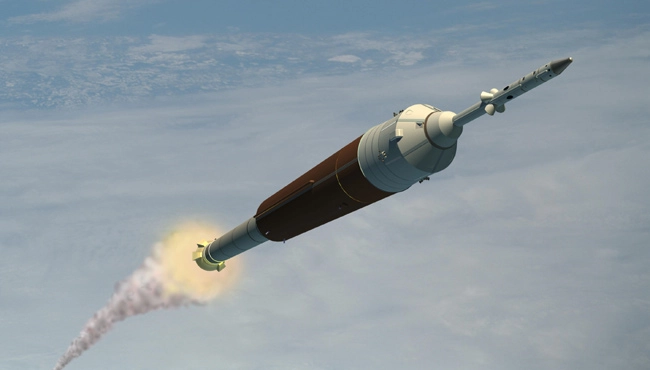
Boeing efforts are under way to develop the Orbital Space Plane (OSP) System. An artist's rendition of an Apollo derived capsule version of the OSP is shown. The OSP will seat 4 to 6 space travelers and will serve as a crew rescue vehicle and crew transfer vehicle for the International Space Station. Boeing is pursuing a variety of configuration alternatives for OSP including winged and capsule versions. CREDIT: Boeing


An artist's rendition of an Apollo-like capsule version of the Orbital Space Plane (OSP) reenters the atmosphere. This Boeing-designed OSP will seat 4 to 6 people and will serve as a crew rescue vehicle and crew transfer vehicle for the International Space Station. Initial capability of the OSP System to take on these duties is targeted for the decade's end. CREDIT: Boeing


Lockheed Martin's Orbital Space Plane (OSP), billed as "safe, simple, soon", will be launched on top of an existing Atlas or Delta expendable launch vehicles. CREDIT: Lockheed Martin


Lockheed Martin's design boasts a Thermal Protection System (TPS) and durable Micro Meteoroid and Orbital Debris (MMOD) shielding to ensure safe on-orbit and return operations. CREDIT: Lockheed Martin


An artist's representation of a winged Orbital Space Plane (OSP) proposal from Boeing. CREDIT: Boeing


A winged Boeing Orbital Space Plane (OSP) is positioned to the International Space Station. The 58-foot robotic arm on the ISS can grapple and move the OSP into position to one of the docking stations to transfer the crewmembers from the spacecraft. As a Crew Return Vehicle, the OSP would be docked to the ISS for extended periods and used only to return the crew to Earth should there be a medical emergency or the ISS needs to be evacuated. Image is not to scale. CREDIT: Boeing

   Related SPACE.com STORIES

U.S. Rep Boehlert: NASA Needs Clarity of 'Vision' to Gain Support


Cargo-Only Shuttle Still Possible in NASA's Future


O’Keefe Says OSP Plan Consistent With 2004 Budget Request


House Committee Urges NASA To Halt Work on Orbital Space Plane


Northrop Grumman, Lockheed Martin to Collaborate on Orbital Space Plane

   TODAY'S DISCUSSION
What do you think of this story?
>>Uplink your views


Defining, Designing and Defending NASA's Post-Shuttle Spacecraft

By Leonard David
Senior Space Writer
posted: 06:12 am ET
19 November 2003

NASA Brings Back Plans To Fly X-37 Demonstrator In Orbit for 270 Days


NASA's Orbital Space Plane is touted as the nation’s next space vehicle aimed at providing crew rescue and transfer for the International Space Station (ISS). If given a go-ahead, the project may well serve as needed backbone, quite literally, to spearhead the rekindling of human space venturing beyond low Earth orbit.

Whether the Orbital Space Plane (OSP) is a winged craft, a capsule, or some sort of cross between the two remains on the table. Regardless of whatever approach is taken, the concept has already come under criticism.

For supporters, OSP is a fast-track way to assure safe flight of astronauts to and from the ISS and to help maximize the scientific output of the costly orbiting complex. Others see OSP as merely an expensive ploy not to buy Russian Soyuz capsules.

Head-to-head competition

Major aerospace firms, Boeing and a team led by Lockheed Martin -- involving Northrop Grumman and Orbital Sciences Corporation -- are now in head-to-head competition to win the NASA contract to build OSP.

The OSP system is being pursued to provide a crew rescue capability for the space station by 2008, or sooner, and two-way crew transfer capability no later than 2012. The OSP is to be compatible with both of the United States' Evolved Expendable Launch Vehicle (EELV) systems, Atlas 5 and Delta 4.

On arrival at the ISS, the OSP is to remain at the Earth-circuiting facility for up to 9 months, able to provide safe and quick return of crew to Earth.

The OSP system is planned to have abort capability during the entire ascent flight regime; act as an on-orbit safe haven during ISS emergencies; and provide the ability to enter Earth's atmosphere without any active control via ballistic reentry. This combination meets NASA's requirements for safe human space flight.

Milestones ahead

"We're making progress, a lot of good progress," said Dennis Smith, Orbital Space Plane program manager at NASA's Marshall Space Flight Center in Huntsville, Alabama. "The contractor teams are performing well and they are working hard. We are treating this as a kind of partnership, and we're working well together," he said.

"We want them to focus in on making the safest, most cost-effective solution that they can find," Smith said.

Projected cost of the OSP effort, through 2009, is $11 billion to $13 billion. That spread of a price tag emerged after over nine months of preparing estimates and studying an array of factors, Smith said. "We're the first program that is being implemented under full-cost accounting," he added, and that makes comparing it to previous programs in earlier years tough to do.

There are several key OSP milestones coming in the months ahead, Smith advised. A final request for proposal, one that takes into account industry feedback, is targeted for a November 26 release, he said. The ultimate selection of a winning design and builder is now anticipated to be in August of next year.

Since OSP remains a work in progress, Smith said it's too early to scope out how many vehicles might be required. Furthermore, even the number of missions an OSP vehicle can undertake is not now known. Industry has been asked to come back and tell NASA whether an OSP is a one-flight vehicle or not, as well as what elements are fully expendable or reusable.

The OSP Program is committed to strategic support of the ISS, the initial OSP System customer, Smith said. Beyond that, the vehicle can also provide a bridge to the future by serving as a foundation for future exploration missions, he added.

"It's not a mystery…at least we hope it hasn't been one. One of OSP's objectives is that we are a pathway to future NASA missions," Smith explained.

Next logical step

Even though today's space shuttle is viewed as a "fantastic flying machine," good things have to come to an end, said Volker Roth, Deputy for Boeing's Office of Orbital Space Programs in Huntsville, Alabama.

Roth said OSP is the next logical step in human spaceflight.

"The key with getting humans to space is the first 100 miles of the journey and the last 100 miles of the journey," Roth told SPACE.com . "We're focused on providing a safe, reliable system that will get us there and back," he said.

One challenge with OSP, Roth said, is having the vehicle careen back through the atmosphere with no active control to provide lift and help steer to a desired landing. The approach being taken is the old pilot's adage: "Any landing you can walk away from is a good landing".

"Almost all of our vehicles in the past have had some level of active control. So that's a bit of a challenge, but certainly one that we can rise to," Roth explained.

Retrofire to the 1960s

OSP certainly has its critics. There are those who suggest the program is a virtual retrofire of space expertise to the 1960s, back to stuffing astronauts into cans.

"It's a giant leap backwards," complains one space industry analyst. "NASA has an open checkbook right now to get the shuttle flying. The problem is that they are looking for the cheapest solution in terms of a backup, and that would be the OSP…but even that's not cheap."

Roth said that the thing to remember is providing a vehicle that's safe and robust. "Everybody likes sleek and beautiful, but is that safe and robust? That's the question you've got to ask yourself. We're thinking hard about the right answer," he said.

NASA has told Congress that the OSP program is in the range of $11 billion to $13 billion.

Roth said that figure is likely a correct ballpark number. "Correct because we are very sensitive to the fact that in the past NASA has taken on programs that have had significant cost growth. We believe that we can't afford to do that anymore. The Congress is not tolerant of that approach," he said.

Human access to space is expensive contrasted to projects undertaken in earlier years, driven in part by inflation, Roth said. "It's a hard business no matter how you look at it. You are putting a system on the pad that is basically a huge explosion waiting to happen. And you're trying to control that explosion and get some people to space with it," he said.

Still under deep discussion is what's needed to "human-rate" an Evolved Expendable Launch Vehicle to safely power an OSP and its crew into orbit.

The EELV/OSP combination means that the largest number of people ever would ride into space via a throwaway rocket.

Trouble on takeoff

There is no doubt that crew escape from a future OSP is demanding top priority attention.

By way of a $53 million NASA contract, for example, Lockheed Martin has initiated work on the reusable Pad Abort Demonstration (PAD) vehicle, a way to test hardware and ideas for OSP crew escape and survivability systems.

The roughly 15-ton PAD vehicle -- some 34 feet long, with a diameter of 10 to 15 feet -- is being fabricated to study how best to protect and safeguard OSP passengers in the event of trouble on takeoff, regardless of whichever OSP concept is selected to be built.

The demonstrator comes complete with space-age crash test dummies strapped into the crew cabin. The mannequins are there to measure acceleration and motion resulting from off-the-pad abort forces, popping of parachutes, and a full-stop landing. Video cameras trained on the dummies inside the two-seater cabin are to help engineers evaluate crew restraint systems.

Desert tests

First test of the PAD vehicle is scheduled for mid-2005.

Tests will take place at the U.S. Army's White Sands Missile Range (WSMR) near Las Cruces, New Mexico. The vehicle will be hurled high into the air using a cluster of liquid oxygen and ethanol fueled engines supplied by Boeing's Rocketdyne Division. The demonstrator is scheduled for three flights in 2005 and four test shots in 2006 at the WSMR.

Once airborne, the PAD flight profile consists of a five-second powered phase, racking up acceleration forces to upwards of eight times gravity force. This would mimic the vehicle's rocketing away from an OSP booster after a launch pad mishap. An un-powered coast follows, with the vehicle slowing from Mach 0.9 (660 miles per hour) down to Mach 0.3 (220 miles per hour) where the recovery system deploys.

"Crew safety is our number one priority," said former shuttle astronaut, Michael Coats, now vice president of Advanced Space Transportation at the Lockheed Martin Space Systems Company in Denver, Colorado. "Our PAD flight demonstrations will provide a wealth of data as future vehicle designs develop."

"As somebody that sat on the launch pad in the shuttle and had a pad abort, and wished we had a way to get off that thing, the PAD demonstrator is a big deal to me, personally, Coats told SPACE.com . "I'm determined that whatever vehicle we end up building, it's going to have the ability get the crew off the launch pad if there's a problem."

Safe, simple, and soon

"We take the crew motto to heart: safe, simple, and soon," Coats said. "They believe that simplicity is the key to safety…and they want it right away."

Coats said that his team's four-person OSP configurations have narrowed down options to wingless craft. "A winged vehicle would take a long time to develop," he said.

Coats admitted: "We're worried as much as keeping the program sold at NASA Headquarters and on Capitol Hill as we are about winning the program."

"NASA has started a number of programs over the last 10 to 12 years and cancelled them. We're anxious to make sure this one comes to fruition as soon as possible. OSP is something that is doable in a relatively short period of time, and affordable," Coats said.

Several key lawmakers in Congress, however, have expressed concerns about OSP.

House Science Committee Chairman, Sherwood Boehlert, along with Ranking Democrat of the Committee, Ralph Hall, have repeatedly chided NASA about how OSP fits into an overall vision for the human space flight program. They have also questioned whether OSP costs are credible.

"Mr. Hall and I have called on NASA not to move ahead yet with a Request for Proposals for the Orbital Space Plane," Boehlert stated November 18 at a forum on NASA vision. "We're not, by the way, calling for a complete halt to the program, but we don't want to start taking steps that seem irrevocable," he advised.

Capsule approach

Dale Myers, a key manager that led work in the 1960s on the Apollo spacecraft program at then North American Rockwell, contends that the capsule approach is decidedly a speedier way to go.

An Apollo-based system, without aerodynamic controls, wings, and landing gear "is clearly simpler," Myers noted in testimony before the House Subcommittee on Space and Aeronautics early this year.

"It appears to me that the robust launch escape system of Apollo, which worked over a wide range from the launch pad to high altitude, will be hard to beat in a winged vehicle," Myers said. The new Evolved Expendable Launch Vehicles have been designed for high reliability, and first flights look good. A robust launch escape system would reduce risk even further," he added.

There is a key factor that must be considered, Myers senses.

"Will the United States or the world decide to go back to the Moon or Mars in the next 20 to 50 years?," he asked. If so, "an eventual plan to return to the Moon would favor choosing a capsule approach," Myers suggested, as a crew return vehicle/crew transfer vehicle.

Long-term value

Can OSP fit into a grander space strategy for the United States?

At present, for some experts, there appears too much focus on the OSP as a vehicle as opposed to what the mission is.

Matt Bille, a space historian based in Colorado Springs, Colorado, shares that view.

"The great successes, like Apollo, have come when we had a clear mission and objectives and then designed hardware to fit," Bille said. "In that case, the hardware also turned out to be able to do some other things," he said, pointing to NASA's Skylab, an experimental space station that flew in the 1970s concocted from Apollo and Saturn 5 booster hardware.

"I think that's likely to be true any time we move technology forward as we did in that program," Bille explained.

If the OSP's mission is only to ferry astronauts to the ISS, Bille said, then NASA should go ahead and build the simplest possible vehicle. If the mission is to build an infrastructure in low orbit capable of supporting outreach to the L1 point far from Earth, the Moon, and beyond, that's another matter. Then it makes sense to have a broader technology program, where the vehicle to transport people to the ISS can be a stepping stone toward more capable vehicles, he said.

"This approach might take longer and cost more than a simple OSP, but the resulting long-term value would be much greater. Either way, strategy and mission should come before a choice of hardware designs," Bille suggested.

The 'unobtainium' factor

For Roger Launius, Chair of the Division of Space History at the Smithsonian Institution's National Air and Space Museum in Washington, D.C., OSP is like a dream machine from visions past.

"We have been down this road several times before with such programs as the National Aerospace Plane and X-33 offering a promise for the future of space access. Unfortunately, we tried to build those vehicles from 'unobtainium.' I certainly hope OSP proves to be a successful program and leads to a replacement for the space shuttle," Launius said.

There are also space strategists who warn that OSP's tie to the space station and beyond is a shaky link.

Other than crew rotation, and small payloads for minimal ISS resupply, and modest research instrument change-out, the OSP would not have the mass throughput, or volume required, to meet even the current requirements for ISS. Furthermore, they argue, OSP is not designed to meet longer-term goals for either ISS -- like completing station assembly -- much less handle future human exploration goals.

Rise to the challenge

In the end, how well the OSP effort plays out also signals how NASA is shaping up after being traumatized by the Columbia accident, said John Logsdon, Director of the Space Policy Institute at George Washington University’s Elliott School of International Affairs. He recently served as a member of the Columbia Accident Investigation Board (CAIB).

"The OSP program is extremely important in terms of reflecting, first of all, whether NASA's really going to change its behavior and not try to pursue a project that's driven by [NASA] center interests and contractor interests…but is driven by national interests," Logsdon said. "I fall back on what the CAIB said. Crew transfer to and from the space station, maximized for safety, period. There's no reason in the world that should cost $12 billion," he said.

Logsdon said it is "worrisome", absent any focusing goal of where NASA is headed, that there are so many opinions about OSP. "That would make me nervous as a decision maker…if thoughtful people were all over the place on what OSP should be, or whether it should be. That's not a very good basis for a major decision," he added.

The true test is how OSP fits into whatever longer-range space vision the White House is expected to articulate in the near future, Logsdon said. "Then it's up to NASA to demonstrate that it has the capability to rise to the challenge."


     about us | FREE Email Newsletter | message boards | register at SPACE.com | contact us | advertise | terms of service | privacy statement      DMCA/Copyright

     © Imaginova Corp. All rights reserved.