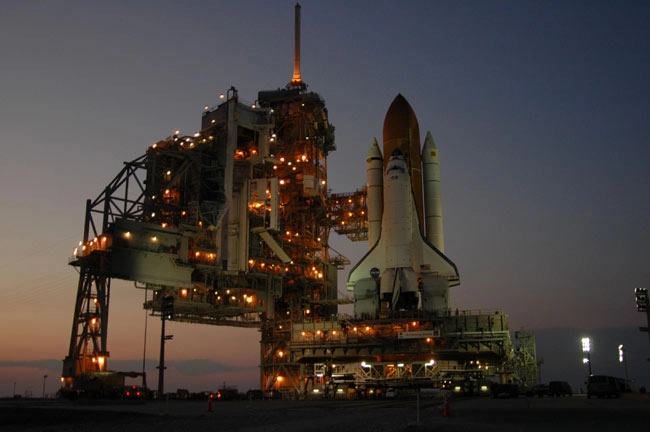
Injust a few days, it's flying time again for America's space shuttle.
Thelast shuttle trek, Discovery's July 2005 mission, marked both a return toflight and then a grounding of the fleet to grapple with problems of fallingfoam from the shuttle's huge external fuel tank--the issue that was flagged asleading to the tragic loss of Columbia and its crew in 2003.
Buteven before Discovery on its STS-121 mission roars skyward, this next flightfinds itself in a swirl of controversy--with NASA and its contractor team still doggedby technical issues of dealing with foam loss.
Furthermore,NASA'sown director of Safety and Mission Assurance and the space agency' chiefengineer voted no-go for the July 1 launch. While they called for a delay to makefurther design changes to the shuttle system, they also stated that thestill-unresolved issues do not represent a threat to safe return of the shuttlecrew.
Ina press briefing earlier this month, NASA's chief, Mike Griffin, noted thehigh-stakes in play with Discovery's imminent liftoff.
"Ifwe were to lose another vehicle, I would tell you right now that I would bemoving to figure out a way to shut the program down," Griffin said. "I think atthat point, we're done. I'm sorry if that sounds too blunt for some, but that'swhere I am. We're trying to navigate some very difficult waters ... to get thestation assembled. I think that's worth doing. I've stated that on multipleoccasions, but it's not easy."
Glass spacecraft
Thereis no doubt the shuttle system is an engineering marvel. Still, given itsdelicate nature--thousands of easily damaged ceramic tiles--the space plane hasbeen dubbed the "glass spacecraft", said Scott Hubbard a former member of theColumbia Accident Investigation Board (CAIB) and past director of NASA's AmesResearch Center. He is now a visiting scholar at Stanford University and CarlSagan chair at the SETI Institute.
Andbeing the aging, exceedingly complicated space ship it is, the shuttle is alsoa troubled craft.
"Ithink the concern by many members of the CAIB, myself included, is that thereare other failure mechanisms ... other types of aging going on that may appear atany time," he told SPACE.com. "You have this uneasy feeling of what elsemight show up in such an incredibly complex vehicle ... any vehicle that is thatcomplex has failure modes that are difficult to predict or anticipate."
Everyshuttle launch "is a holding of the breath," Hubbard said.
Meanwhile,the clock is ticking on the aging fleet of three remaining shuttles--with thehands of that clock sweeping toward retirement of the vehicles in 2010, andwith 16more shuttle liftoffs to go.
Going-out-of-business trajectory
"NASAhas laid out a schedule for the space shuttle between now and 2010 that iscertainly achievable ... if the shuttle can be operated safely over its remaining16 or so flights," said John Logsdon, Director of the Space Policy Institute inthe Elliott School of International Affairs at George Washington University in Washington, D.C.
All the changes that have been introduced since 2003 are intended to make this possible, he added "so it is reasonable to plan for suchsuccess." Also a member of the CAIB, Logsdon said the space shuttle remains a riskyvehicle. So at any point between STS-121 and its final flight "there is apossibility of a major problem, one that could lead to permanent grounding ofthe remaining shuttle fleet," he told SPACE.com.
Theripple effect from such the grounding would have major impacts in the shortterm, meaning that the International Space Station (ISS) could not becompletely assembled, Logsdon explained. For the long term, the shuttle is on a"going-out-of-business trajectory," he added, with the development of its replacement--theCrew Exploration Vehicle and its Crew Launch Vehicle--soon underway.
"Soit makes sense to me to make a best effort to fly the shuttle to assemble ISS,while recognizing that a decision that this cannot be done with acceptable riskcould come at any point in the next four years," Logsdon noted. "Whenever theshuttle program ends, there will be a replacement means for taking Americans tospace on the near horizon."
Good news/bad news
Thesoon-to-depart shuttle mission evokes a good news/bad news comeback from JosephPelton, a research professor with the Institute for Applied Space Research at George Washington University.
"Thegood news is that the shuttle is still a relatively safe experimental spacevehicle with a 1-in-60 to 1-in-100 chance of a category one failure--loss ofvehicle, loss of crew. The bad news is that after $2 billion in expendituresfor the reflight effort--and now many years after the Columbia failure--criticalobjectives set by the CAIB have not been accomplished," Pelton told SPACE.com.
Peltonwas lead investigator for Space Safety Report: Vulnerabilities and RiskReduction In U.S. Human Space Flight Programs anindependent assessment prepared and released last year by the Space andAdvanced Communications Research Institute (SACRI) of George Washington University.
Peltonsingled out several remaining key issues: the stiffening of the shuttle outerhull; the ability perform repairs to the shuttle's thermal protection system inspace; and correction of the foam-shedding problem.
"Themantra that NASA developed after Columbia that said 'find it, fix it and flysafely again' rings hollow after so much time and money has been spent withsuch limited results," Pelton explained.
NASA credibility and space funding
"Intruth, the problems that NASA continues to experience with its shuttle and theInternational Space Station program--really the only reason the shuttle is stillflying--goes back at least to the Challenger disaster in 1986," Pelton said.
Twomajor national space commissions back then--one looking into the Challengeraccident, the other delving into the future of the American space program--notedthat the shuttle was indeed becoming "obsolescent" and that it had to bereplaced by another vehicle within at least 15 years, or 2001, Pelton noted.
"Insteadof developing alternative plans for the launch of International Space Stationcomponents in smaller and more modular parts at that time," Pelton said, "NASApushed ahead without developing a new vehicle, nor developing a back-up plan.
Now,not only is NASA's credibility and space funding at risk, Pelton continued, butalso at risk are the agency's international partners that are engaged in the$100 billion station program. "The now 'tar baby-like tandem' of the ISS andthe space shuttle has done great harm to space programs around the world."
NASAhas over-invested in both the shuttle and station initiatives, Pelton said, takingaway money from programs that truly matter to the United States and indeed theworld.
Never too late to start over
"Thetruth of the matter is that the shuttle program--an experimental program whendesigned in the 1970s--should have been grounded years ago. It should bereplaced by better, safer, and more cost efficient programs. The development ofprivate space vehicles that are human-rated, something that NASA is currentlyactively supporting, is clearly the right step forward," Pelton advised.
Ultimately,it is not NASA that is at fault here, Pelton said, pointing to nationalleadership that has often overruled the space agency on where and how to spendtheir limited resources. It is never too late to start over, he said, anddevelop a NASA program that makes sense, balances expenditures, and setpriorities that matter to the person in the street.
"Thequestion is not whether NASA should be grounding the space shuttle and puttingthem in museums," Pelton concluded, "but what are its backup plans and how canit restore balance to its overall space programs and give new focus to itsvarious NASA centers?"
Level of success
Indeed,there is a lot riding on the next shuttle liftoff, beyond technology.
"Thisis one of the most significant missions of the shuttle program because of thepolicy implications that it presents," said Roger Launius, Chair, Division ofSpace History at the Smithsonian Institution's National Air and Space Museum in Washington, D.C.
Launiusunderscored the fact that Griffin has stated clearly that if NASA does not flysuccessfully this time it would mean the end of the program. "That, of course,begs the question [as to] what defines a successful mission?"
Thelast mission, for all of its challenges, was successful by most measures. Itlaunched, flew, and returned safely; it delivered its supplies and equipment tothe ISS; it undertook several safety tests and repairs.
Thatbeing the case, several questions percolate to the surface, Launius said.
"Isa level of success commensurate with the last mission sufficient to concludethat the program will continue? If that is not where the bar is set, is ithigher or lower? I confess that I have no idea. I also confess that I hope andpray that this mission is a rousing success, by any standard that one mightwant to apply," Launius told SPACE.com.
Honorable retirement
Launiusalso senses there is something present with the forthcoming shuttle flight thathe hasn't necessarily experienced before.
"Asustained and underlying depression seems present among those working in theprogram, some of them for their entire careers," Launius explained. "There is asense of ending--as well as an ever-present perception of loss and failure--presentamong many members of the space shuttle team."
Withoutquestion, Launius said, the space shuttle will be retired within something lessthan a decade, whether it is after this next mission or 2010 or sometime a bitlater.
"Asthe space shuttle enters its home stretch, it should be remembered with bothpraises for its many accomplishments and criticisms for its shortcomings,"Launius suggested. "I am in favor of giving the shuttle an honorable retirementand to give a full measure of respect and thanks to those charged with itsoperations over the years for their efforts."
Inthe process of retiring the space shuttle, "I hope NASA will ensure that theknowledge and expertise gained in the shuttle program is preserved and used forthe future," Launius concluded.
- STS-121 Astronaut Crew Arrive at NASA Spaceport
- Meet the STS-121 Crew: The Flyers
- STS-121 Launch Dissent Stemmed From Risk to Shuttle, Not Astronauts
- Return to Flight: NASA's Road to STS-121
- The Great Space Quiz: Space Shuttle Countdown