Halley's Comet in 1986
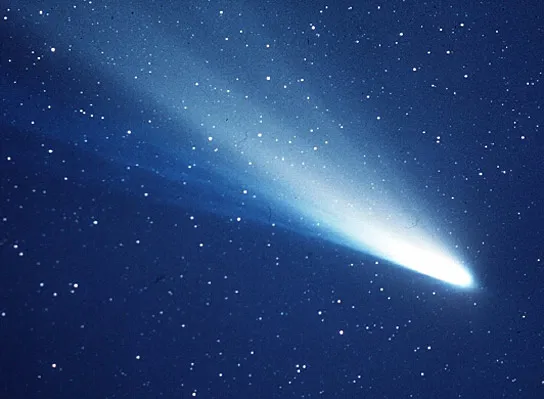
An image of Halley's Comet taken in 1986.
Halley's Comet from Table Mountain Observatory

This photograph of Halley's Comet was taken January 13,1986, by James W. Young, resident astronomer of JPL's Table Mountain Observatory in the San Bernardino Mountains, using the 24-inch reflective telescope.
Streaks caused by the exposure time are stars in the constellation Aquarius. Visible in the photo are the coma of gases and about 725,000 kilometers (450,000 miles) of the charged ion tail.
Halley's Comet in 1910

Halley's Comet as photographed May 13, 1910, by a wide-angle camera at Lowell Observatory, Flagstaff, Ariz., during the comet's last appearance. A streak across the comet near the coma is a meteor trail, and not a scratch on the negative. Streaks at the bottom right are the city lights of Flagstaff Bright spot above the city lights is the planet Venus.

Halley's Comet Seen by Europe's Giotto Probe
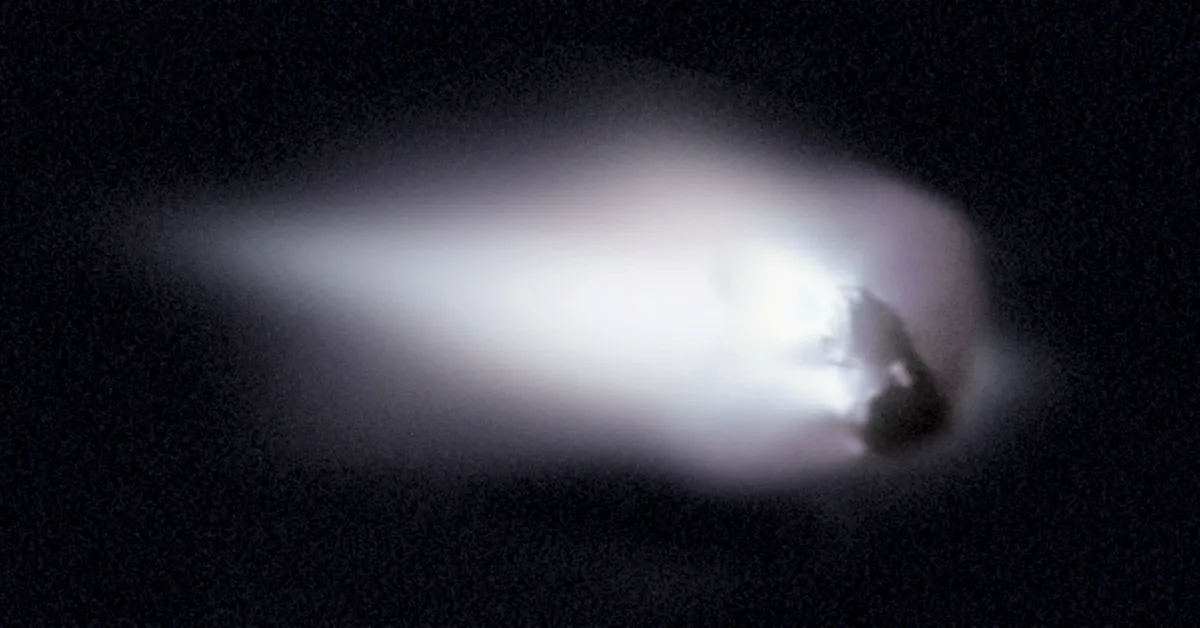
This view of comet Halley's nucleus was obtained by the Halley Multicolour Camera (HMC) on board the Giotto spacecraft, as it passed within 600 km of the comet nucleus on March 13, 1986.
Giotto at Halley

The Giotto space probe, launched in 1985 on an Ariane 1 V14 launcher, brushed past the hidden nucleus of Halley's comet in 1986.
Approaching Halley's Nucleus

Giotto approaching the nucleus of Halley's Comet at 68km/s, protected by its white dust shield.
Two Views of the Galaxy

These two views show the position of Halley's comet and six planets on Jan. 7, 1984. At that time, Halley was about 800 million miles from the sun, traveling at an 18-degree tilt with respect to the plane of the solar system.
Halley's Comet from Diamond Head, Hawaii

These images show Comet Halley as it was photographed on various dates in 1910 from Diamond Head, Hawaii, by Ferdinand Ellerman. The points or short streaks are background stars.
Halley's Comet in 1985

These two photographs of Comet Halley were obtained the night of Nov. 14, 1985, by JPL astronomer Eleanor Helin. Halley was about 105 million kilometers (65 million miles) from Earth and traveling about 33 kilometers per second (74,000 mph) with respect to our planet.
The Adoration of the Magi

'The Adoration of the Magi' is a scene in a fresco cycle decorating the interior of the Scrovegni Chapel in Padua. The fresco was painted by the Florentine master Giotto di Bondone, probably in 1303 and 1304. Halley's Comet had appeared in 1301, and inspired the artist to depict the Star of Bethlehem as a fiery comet.
When the European Space Agency elected to send a spacecraft to encounter the comet, the spacecraft was named after the artist. Reproduction of the painting is by the courtesy of the Comune di Padova.
Halley's Comet and Others May Be Stolen Goods

The detailed tail photograph of Halley's Comet was obtained by Jet Propulsion Laboratory astronomer Eleanor Helin with the 48-inch Schmidt telescope at Caltech's Palomar Observatory on Dec. 13, 1985.