The interstellar invader comet 3I/ATLAS is spraying enough water into space to fill 70 Olympic swimming pools each day. The discovery gives scientists a remarkable opportunity to study the elements present during the formation of planets around other stars, potentially much older than the sun.
The discovery was made by the European Space Agency (ESA) mission Jupiter Icy Moons Explorer (Juice), which is currently heading towards Jupiter and its icy moons. JUICE observed 3I/ATLAS, which is just the third object found passing through the solar system from beyond its boundaries, in November, 2025, using its MAJIS (Moons And Jupiter Imaging Spectrometer) and JANUS (Jovis, Amorum ac Natorum Undique Scrutator) instruments.
Like comets native to the solar system, 3I/ATLAS began expelling material when it passed close to the sun, with solar radiation heating its icy heart, causing solid ice to transform immediately into gas, a process called sublimation. As this gas makes its explosive escape, it forms the coma and tail that are characteristic of comets. This is accompanied by a brightening of the comet, but 3I/ATLAS brightened even more than expected.
During its observations, MAJIS identified infrared emissions from water vapor and carbon dioxide molecules. These are known as "volatiles" because they evaporate easily.
"Repeated detections of water vapor and carbon dioxide by MAJIS indicate that volatile ices buried beneath the surface were actively released into space shortly after perihelion passage," team member Giuseppe Piccioni of the National Institute for Astrophysics (INAF) said in a statement. "From the data collected, we estimated an outflow from the comet's nucleus of about two tons per second, equivalent to approximately 70 Olympic swimming pools of water vapor ejected into space every day.
"The MAJIS data will allow us to better understand the activity of this comet after perihelion and the physical and chemical properties of the materials formed around another star billions of years ago."
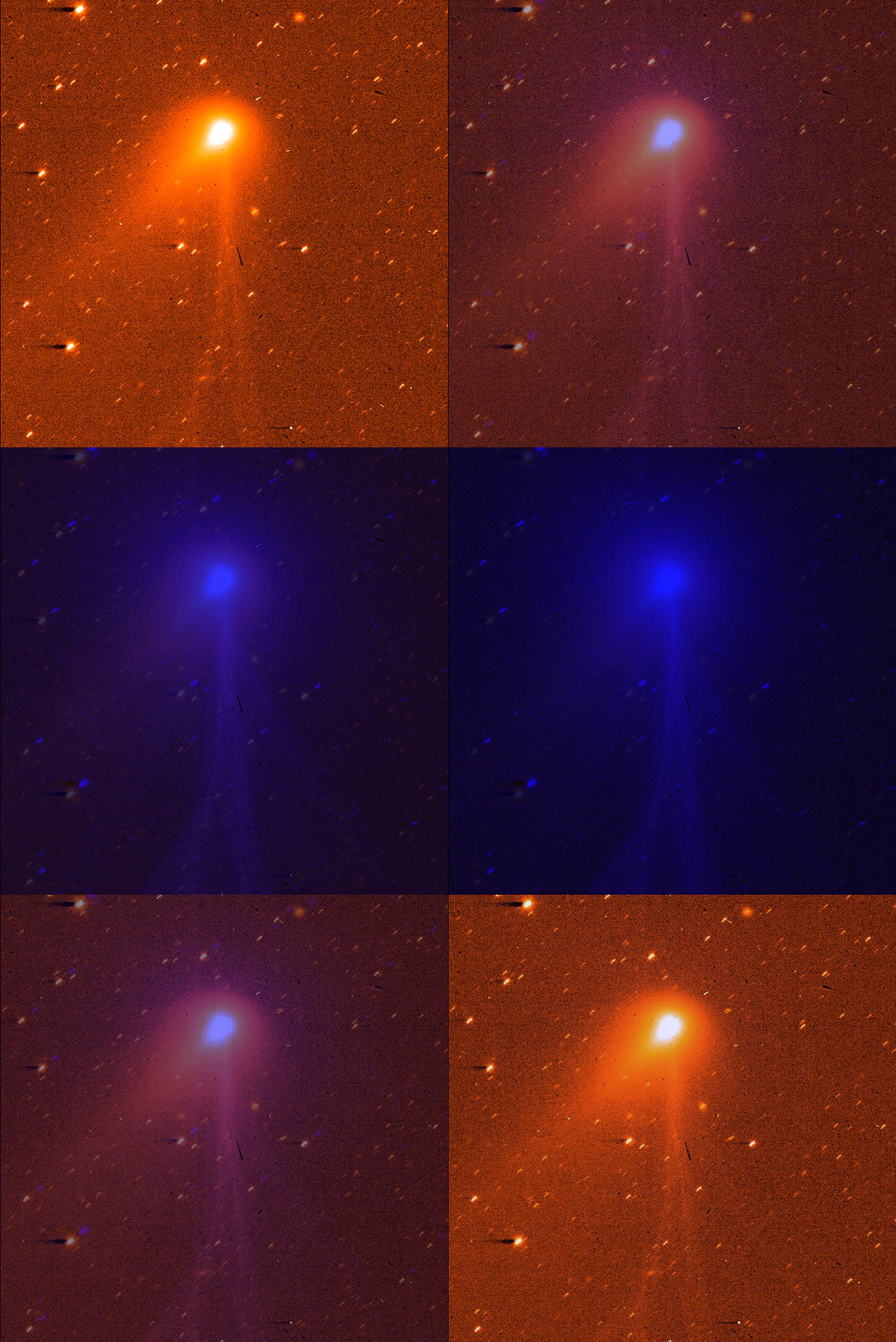
The JUICE observations of 3I/ATLAS were more extraordinary because they were unplanned, only occurring to the team after the discovery of 3I/ATLAS on July 1, 2025. The observations were challenging due to the short periods of time JUICE had to spot 3I/ATLAS and how faint the interstellar comet's emissions were.
These observations were followed by a prolonged wait, with the data only reaching Earth in February 2026.
"We waited a long time, but it was truly worth it," team member Pasquale Palumbo, an INAF researcher and principal investigator of JANUS, said. "The wonderful images collected reveal for the first time the comet's intense activity right around perihelion. 3I/ATLAS showed an extended coma, a tail, and various morphological structures, such as rays, jets, and filaments. The data collected will allow us to study the morphological structures, light intensity, and evolution of the comet's coma and tail on short and medium timescales.
"We are very pleased with the performance JANUS has provided us; it is an excellent preview of what it will be able to do when it operates around Jupiter and its icy moons, the final destination of the JUICE mission."