





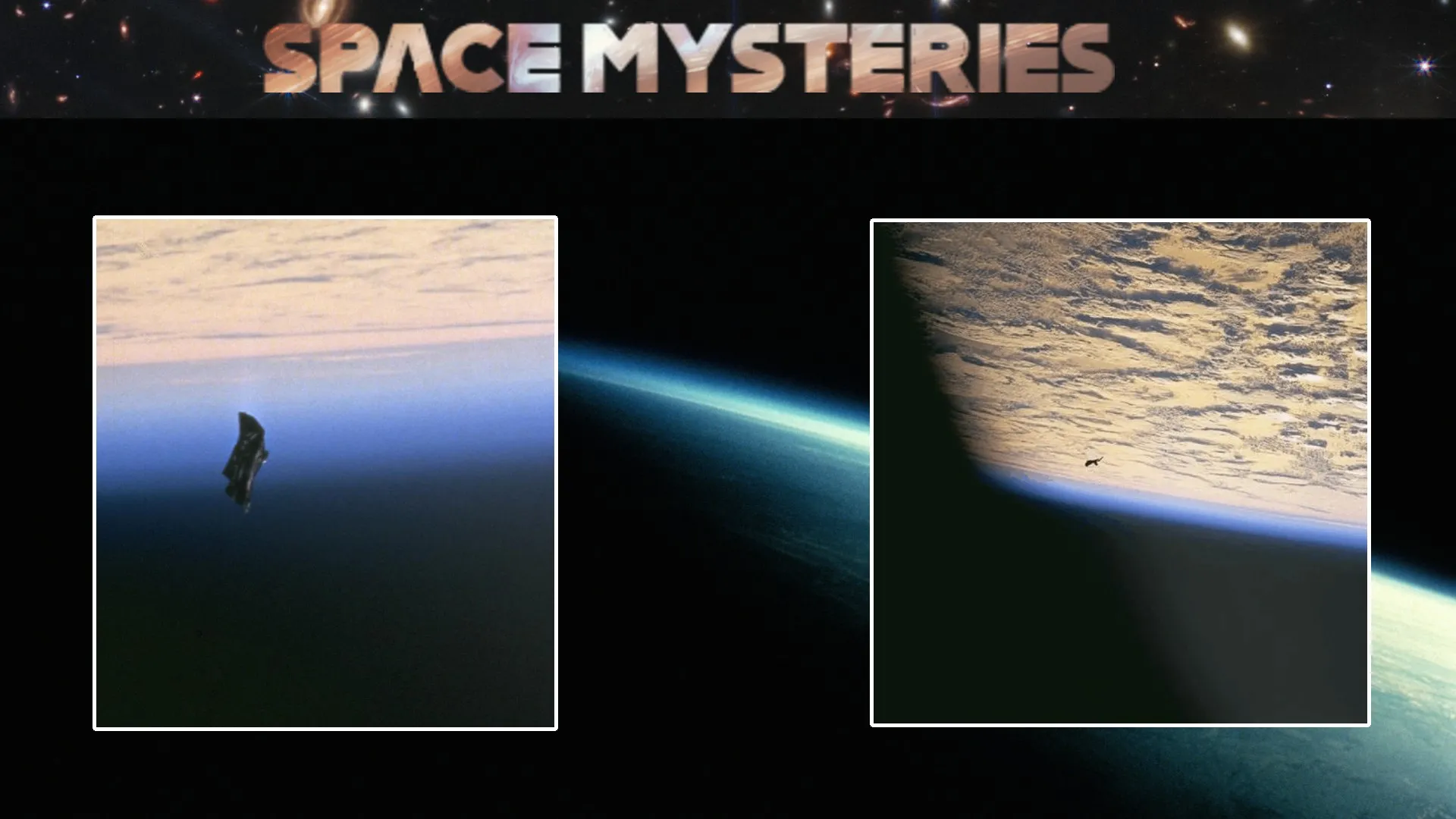
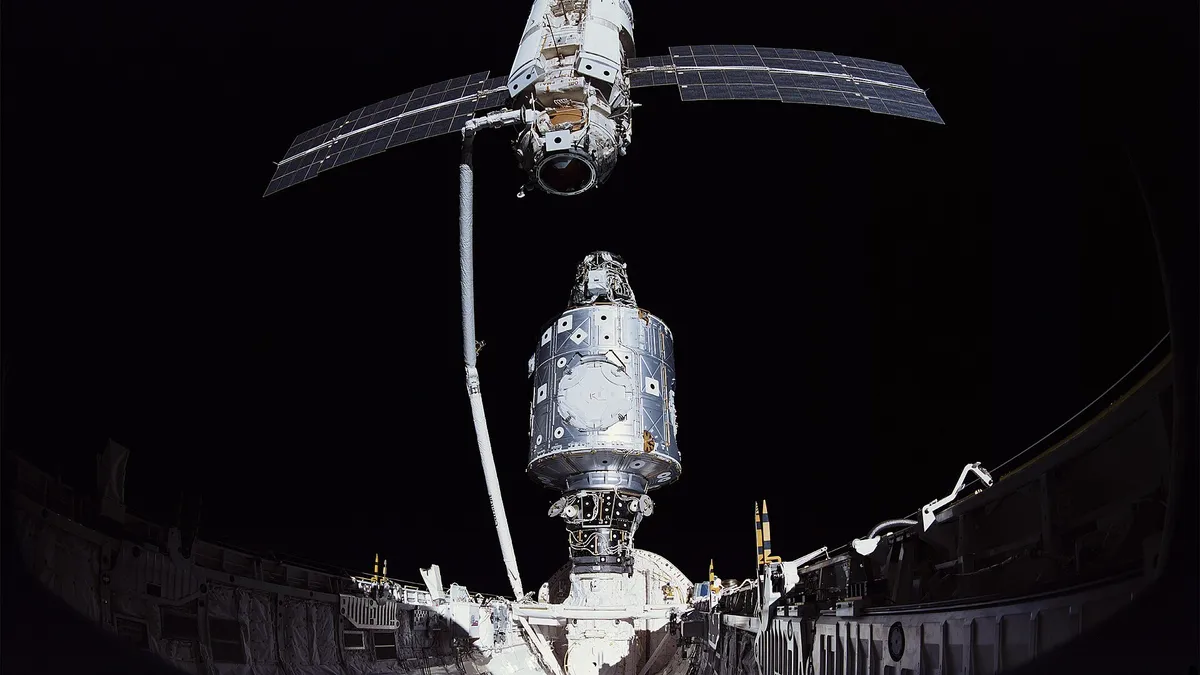
In the final days of 1998, as astronauts aboard NASA's Space Shuttle Endeavor were working during one of the early missions to assemble the International Space Station, crew members from the STS-88 mission captured photographs of a dark colored, unusually shaped object drifting through space.
Despite its unusual appearance in the photographs, the object had a conventional explanation, and one that was known to the astronauts at that time: it was one of several thermal covers that had been wrapped around trunnion pins used in the space station's construction. Upon noticing the "escape" of one of the covers, Mission Commander Bob Cabana remarked over the radio to fellow astronaut Jerry Ross that "one of the thermal covers got away from you."
Seeing the cover drifting away, a frustrated Ross snapped a photograph of it. Yet despite the innocuous story behind the images, they have nonetheless helped fuel belief in an unusual Space Age conspiracy theory: one involving the alleged presence of an ancient satellite, presumably of alien origin, that has long been orbiting our planet — perhaps since the end of the last Ice Age.
According to proponents of this theory, the object photographed by Ross in 1998 is actually what many call the "Black Knight Satellite," and is only one piece of evidence they point to in a long succession of unrelated — and often misinterpreted — events in modern history that supposedly lend further evidence to the alleged alien spacecraft's existence.
So how did such a legend gain traction in the first place, with some versions alleging that NASA and the U.S. government have worked to conceal evidence of the alleged space object's existence from the public?
Odd detections at Colorado Springs
Depending on which version of the story you come across, the strange roots of the Black Knight conspiracy theory might be traced all the way back to the nineteenth century, when the famous inventor Nikola Tesla began detecting unusual electrical signals while conducting radio experiments at his laboratory in Colorado Springs.
At the time, Tesla considered whether the signals might be communications from intelligent aliens on nearby planets, although the likely source had actually been terrestrial radio interference. Notably, Tesla also never claimed that the emissions might be coming from an object in Earth's orbit; nonetheless, some proponents of the Black Knight Satellite theories have incorporated Tesla's experiments into the mythos, suggesting they may represent some of the earliest detections of a mysterious object lurking near Earth.
Unidentified objects in orbit?
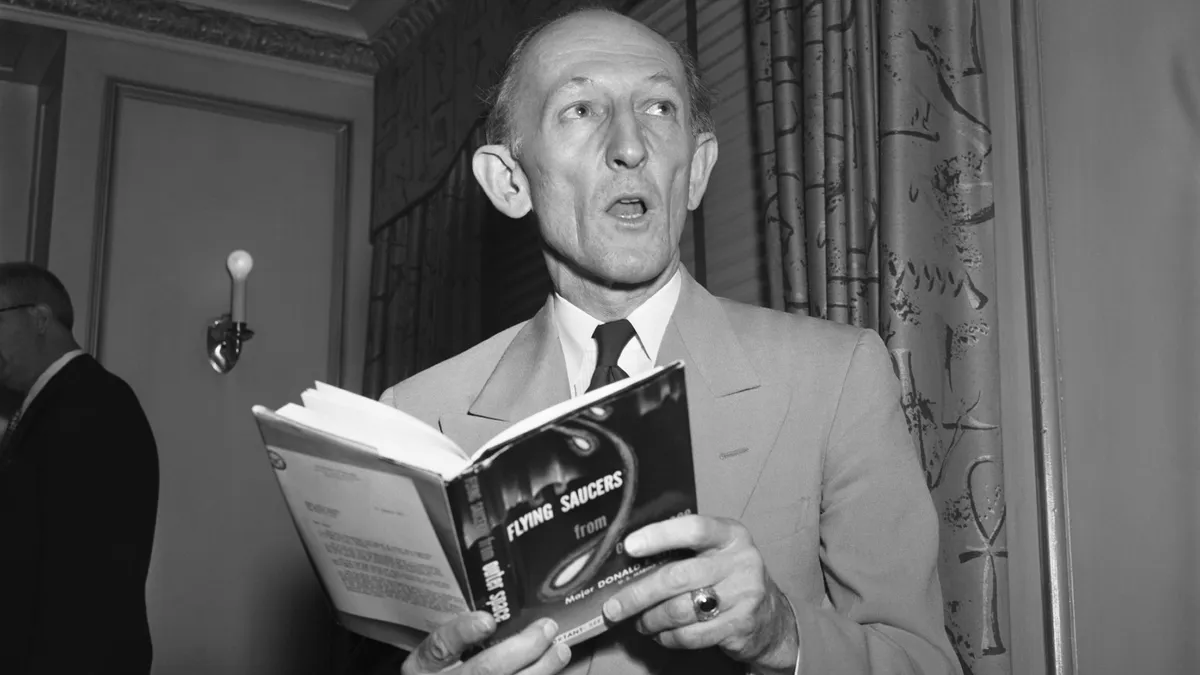
Another component that was later incorporated into the Black Knight Satellite mythos came to light in May 1954, when newspaper reports began publicizing author Donald Keyhoe's assertions that the U.S. Air Force had detected at least two unidentified satellites orbiting Earth.
At the time, Keyhoe claimed that U.S. government scientists at White Sands were reportedly "making an intensive effort to locate and chart the course of the satellites in an attempt to determine what they are and where they came from," as the author was quoted as saying in articles like one that appeared in the St. Louis Post-Dispatch on Friday, May 14, 1954.
However, later in August of that year, U.S. officials apparently concluded these objects were likely to have been meteors that became "satellites of the Earth and were revolving with it 400 to 600 miles out in space," and that Dr. Lincoln LaPaz, one of the preeminent experts on meteors at the time, had "definitely identified the objects as natural rather than man-made," as reported by the New York Times.
Just a few years later in February 1960, a similar story appeared in Time magazine, which this time alleged that the U.S. Navy had spotted an unidentified dark object in orbit that was suspected of being a Soviet reconnaissance satellite. This object was later identified as well, with officials determining it had likely been debris from the American spy satellite Discoverer 8.
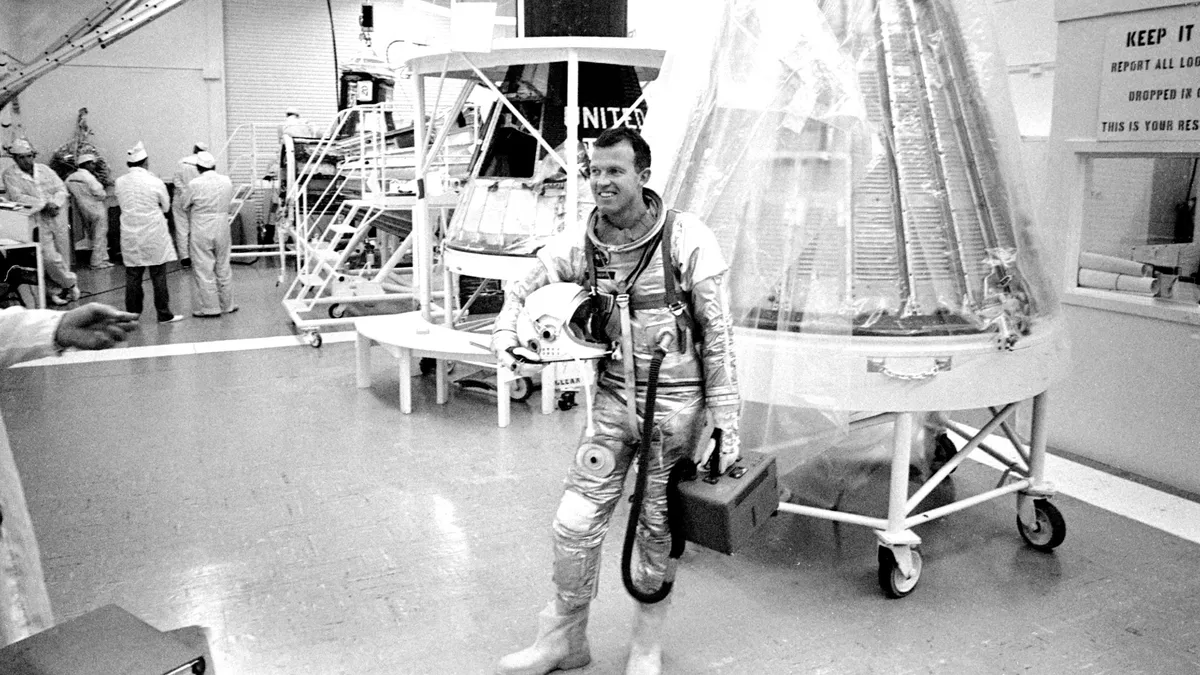
Another similar claim suggests that on May 15, 1963, during the Mercury-Atlas 9 mission, NASA astronaut Gordon Cooper allegedly observed an unusual object in space, which some accounts describe as a "glowing green object" that followed his capsule. While it is true that Cooper reported seeing what he characterized as "John’s fireflies," which were a reference to earlier sightings of unusual luminous objects made by astronaut John Glenn during the Mercury-Atlas 6 mission, it was later concluded that the so-called "fireflies" resulted from small bits of ice separating from the spacecraft itself, which present a greenish hue as sunlight reflects off of them (audio of Cooper describing this during the Mercury-Atlas 9 mission can be found here).
Beyond this, however, there is no evidence of Cooper observing any singular object during this mission, either in Cooper's personal records or mission audio and transcripts from the time.
"Echoes" from a 13,000-year-old satellite
Arguably, one of the most extraordinary components of the Black Knight Satellite theory involves its alleged age, which according to some theories places its initial entry into Earth's orbit as far back as 13,000 years ago. But if so, how would anyone know this, and what evidence could support such an idea?
Understanding this bizarre aspect of the Black Knight mythos requires a look back at the theories of Scottish writer Duncan Lunan, which he first proposed in 1973. At that time, Lunan was receiving international attention for his investigation into mysterious long-delayed echoes, proposing that one theory behind the phenomenon could be that they represented signals from Earth that were being rebroadcast from an extraterrestrial probe — an idea that borrowed from theories first proposed by Australian scientist Ronald Bracewell.
According to Lunan's theory, such a hypothetical "Bracewell probe" might have arrived in Earth's vicinity roughly 13,000 years ago after traveling from within a planetary system associated with the star Epsilon Boötis, some 236 light-years away.
Within just a few years, Lunan had withdrawn his conclusions, but this did little to prevent his initial ideas about a 13,000-year-old alien satellite from being incorporated into the growing mythos surrounding the alleged Black Knight Satellite.
The STS-88 mission photographs
That brings us back to what are arguably the most widely circulated images associated with the Black Knight satellite: the famous images from NASA's STS-88 mission taken by astronaut Jerry Ross in December 1998.
According to spaceflight historian James Oberg, the object in Ross's photos could indeed be positively identified as the thermal blanket lost during the mission, especially since he had specifically asked Ross about the incident — and later misinterpretations of his photos as being evidence of an alien spacecraft — during an October 2014 interview.
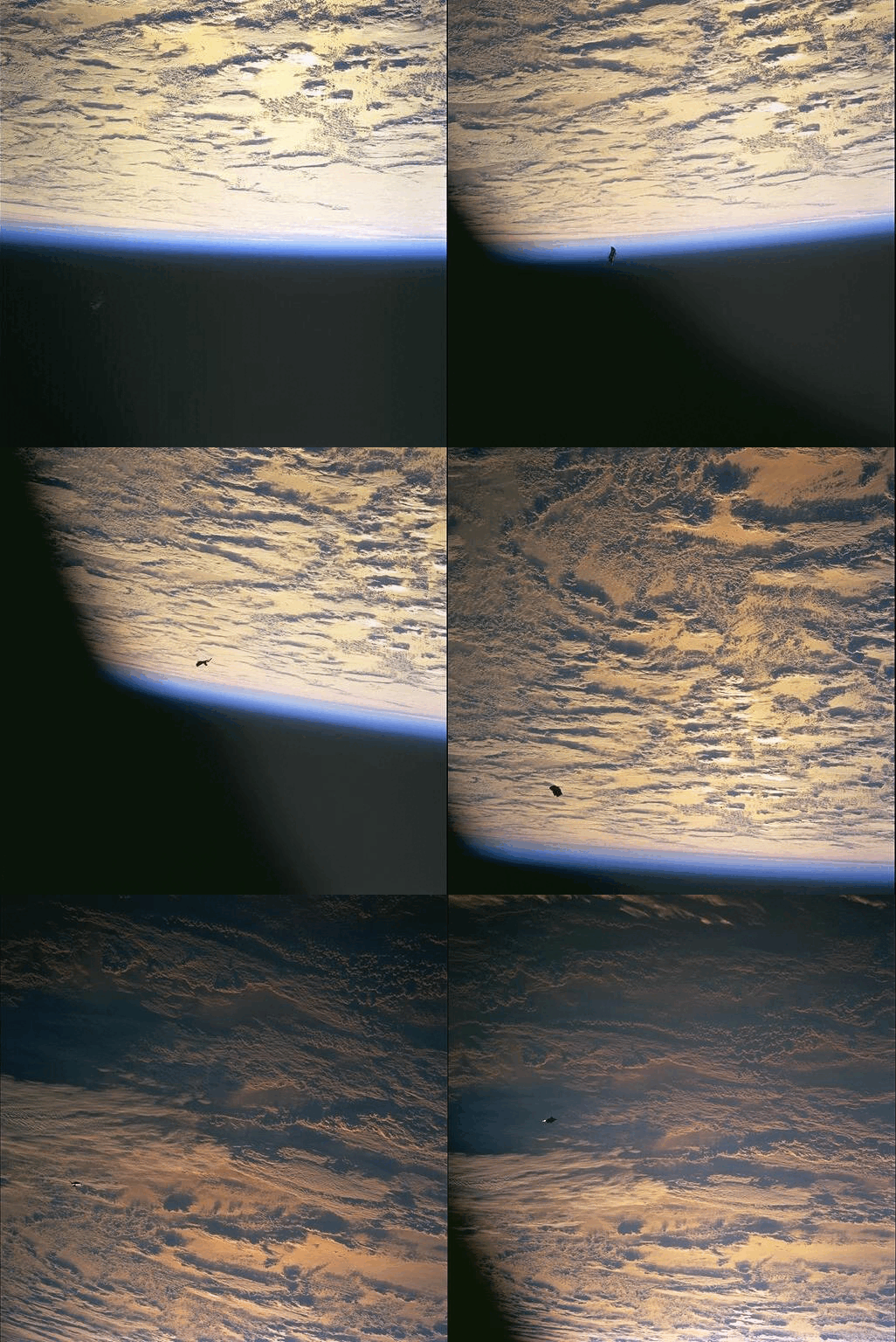
At that time, Oberg asked Ross whether he had time during the 1998 spacewalk "to gaze at [the thermal cover] and think about how it looked," to which Ross said no, admitting he had been "too pissed at myself to wonder what it looked like!"
When asked what advice he would offer to those who have misinterpreted the object in his photographs for being something more exotic and otherworldly, Ross told Oberg, "If we see something up there we will be the first ones to ask questions and to tell people we saw something we didn't understand."
"Conspiracy theories are fun for those working on them, but a waste of valuable brain power," Ross added.
The legend continues
But what, specifically, about the idea of an ancient extraterrestrial probe lurking in orbit around our planet makes this far-fetched theory so captivating?
"I think it's because this idea of an alien satellite kicking around in orbit checks so many conspiracy theory boxes," says Amy Shira Teitel, a spaceflight historian who has also tackled the Black Knight satellite theories in the past, and points to other misperceptions about space that have given rise to conspiracy theories over the years.
"People, for some reason, believe space is fake or that every mission is fake because the Van Allen Belts will kill you," Shira Teitel recently told Space in an email, while noting that most missions take place well within safe distances from the inner radiation belt, with notable exceptions that include the Gemini 11 mission, as well as lunar flights.
"People also love UFOs," she adds. "Even skeptics have a little bit of a soft spot for the idea of an alien craft flying by to say hi. I think when you take all these conspiracy threads together, the Black Knight sort of fits perfectly in that intersection!"
Overall, the bizarre story of the Black Knight satellite offers a textbook example of how a collection of unconnected events and speculative interpretations can gradually accumulate into a single narrative over time.
Despite this reality, belief in the existence of a mysterious ancient satellite lurking in orbit will likely persist for years to come, helping ensure its place as one of the most peculiar — and enduring — legends of the Space Age.
