





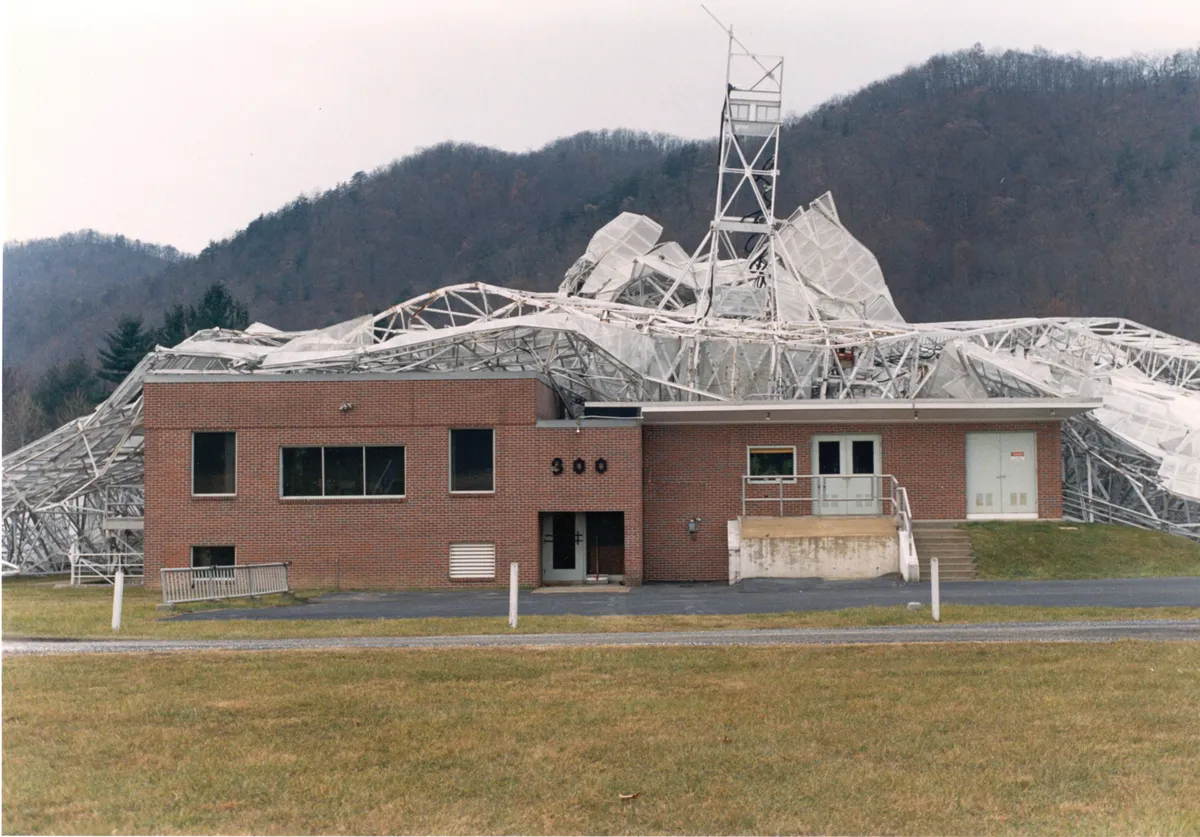
On Nov. 15, 1988, a 300-foot radio telescope in Green Bank, West Virginia suddenly collapsed. It happened at 9:46 p.m. on a clear night with no strong winds.
When the observatory staff showed up to work the next morning, they were greeted by a huge pile of wreckage. The telescope collapsed under its own weight after a key structural element called a "gusset plate" failed. This was one of four connecting plates that held the telescope's large, metal beams together. Investigators found that these gusset plates were not built to last the 26 years that this telescope had been in use.
Three years later, construction began on a new telescope. The Green Bank Telescope was even bigger and more sensitive, and it began science operations in 2001.
Why it mattered
When the 300-foot telescope first debuted, it was not just the United States' largest radio observatory, but the largest such facility in the world. But its quick construction — just two years — led to it having to be significantly upgraded later.
"In 1970, the 300-foot’s surface had become so warped from maintenance crews, snow, and its own weight that a new finer-meshed aluminum surface was installed," the website for the National Radio Astronomy Observatory reads. "A larger traveling feed was also installed at the prime focus."
The collapse, however, was no one's fault. "Unforeseeable stress factors cracked a steel connector plate," wrote the NRAO.

During its years of observations, the 300-foot telescope contirbuted to the discovery of dark matter and the realization that pulsars come from supernova explosions.
"One of the most important products to come out of the 300-foot telescope was an all-sky survey of radio objects called the Green Bank 6cm Survey. Nearly every northern hemisphere radio object studied by any other telescope is from a catalog compiled using this telescope," reads the NRAO website.
Want more space history? Check out our full On This Day In Space Story archive and watch our On This Day In Space videos on YouTube.