


On Sept. 5, 1977, Voyager 1 began its epic journey through deep space with a glorious morning launch from Cape Canaveral, Florida.
Voyager 1 initially launched on a mission to explore the outer planets. After flying by Jupiter and Saturn in 1979 and 1980, the spacecraft took a sharp turn and started heading straight out of the solar system.
Voyager 1 became the first spacecraft to reach interstellar space in 2012, although scientists are still debating about exactly where that boundary lies.
The spacecraft's next big encounter will take place in about 40,000 years, when it will fly by another star system. And just in case it comes across any intelligent life out in the universe, it's carrying a golden record with sights, sounds and greetings from planet Earth.
Why it mattered

Voyager 1 is a space exploration icon and NASA's ultimate long-lasting mission.
The spacecraft was part of a two spacecraft mission (Voyager 2 launched a few weeks earlier) to explore the outer solar system like never before. While Voyager 2 launched on a four-planet "Grand Tour" of the solar system, a trajectory that included flybys of Jupiter, Saturn, Uranus and Neptune, it wasn't the fastest of missions.
Voyager 1 launched on a fast-track to Jupiter. In fact, the probe actually overtook Voyager 2 on the way to Jupiter and arrived their first for a flyby in March 1979. A year later, in November 1980, Voyager 1 passed by Saturn in a flyby that shot it out of the solar system.
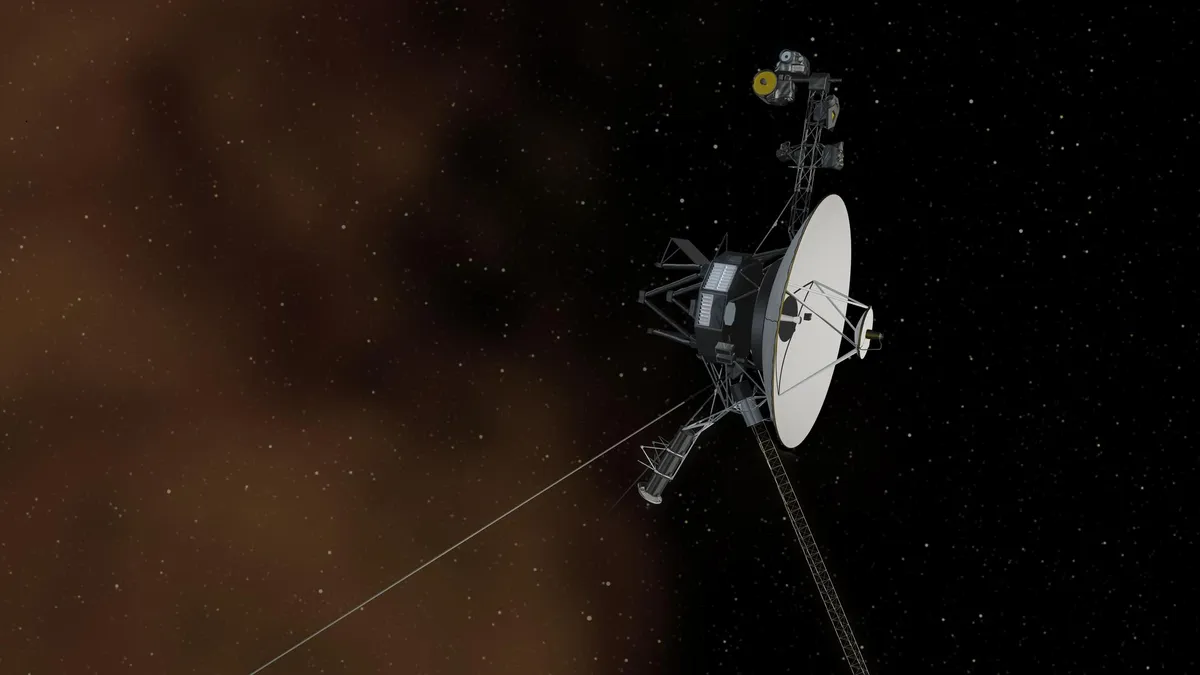
By Feb. 17, 1998, Voyager 1 grabbed the record as the farthest human-built object after it flew farther than Pioneer 10 and in 2012, the spacecraft became the first probe ever to enter interstellar space. It remains NASA's farthest flung mission still active today.
Today, Voyager 1 is 15.9 billion miles (171.6 astronomical units) from Earth and still flying. Even 49 years after launch, the spacecraft is still collecting some data, but its nuclear radioisotope thermoelectric generator does not produce as much power as it did at launch, so NASA teams have steadily shut down heaters and unneeded instruments over the decades.
Earlier this year, on April 17, NASA commanded Voyager 1 to shut down its low-energy charged particles experiment to save power. For nearly 50 years, the instrument has provided constant measurements on the ion, electron and cosmic ray environment in deep space.
Want more space history? Check out our full On This Day In Space Story archive and watch our On This Day In Space videos on YouTube.

