Update for May 22, 7:48 pm ET: SpaceX successfully launched its first next-generation Starship V3 megarocket on a test flight from Starbase, Texas on May 22. Our wrap story will be posted shortly.
The Ship upper stage lost one engine but performed most of its planned objectives and landed in the Indian Ocean as planned. The Super Heavy booster failed to perform its boost back burn correctly and crashed into the Gulf of Mexico, but it also was not planned to be recovered. See our latest Starship V3 launch updates
There's a lot riding on the debut flight of SpaceX's Starship V3 megarocket — not the least of which are NASA's Artemis moon landing ambitions.
The Starship launch is scheduled to take place Friday (May 22) from SpaceX's Starbase test site in South Texas, during a 90-minute window that opens at 6:30 p.m. EDT (2230 GMT; 5:30 p.m. local Texas time). An attempt the launch Starsip Flight 12 on Thursday was delayed by a stuck pad hydraulic pin. You can watch the launch here at Space.com when the time comes and see our latest Starship V3 launch updates for more.
The flight will be the 12th overall for Starship, and it will be broadly similar to previous efforts — a suborbital jaunt that ends with controlled ocean splashdowns of Starship's Super Heavy booster and its Ship upper stage. But the vehicle involved is quite new, and SpaceX expects a lot out of it.
A bigger (and better?) Starship megarocket
The 408-foot-tall (124 meters) V3 ("Version 3") is bigger and more powerful than previous Starship iterations, which were already the biggest and most powerful rockets ever built, and it sports a number of other important upgrades as well.
For starters, it's outfitted with the new V3 Raptor engine — 33 of them on Super Heavy and six on Ship — which provides more heft, and a far more streamlined design, than its predecessors.
The V3 Super Heavy also now has just three grid fins (which help it steer its way back to Earth for recovery and reuse) instead of four. And the "hot stage ring" — the structure that marks the meeting point of Super Heavy and Ship — is now attached to the booster, meaning it can be reused, whereas previously it had fallen away during flight. (Starship engages in "hot stage" separation, meaning Ship fires its engines before it has detached from Super Heavy.)
Super Heavy's fuel transfer tube, which funnels propellant from its main tank to all 33 Raptors, "has been completely redesigned and is now roughly the size of a Falcon 9 first stage," SpaceX wrote in an update last week. This change allows all 33 engines to start up simultaneously and will improve the speed and reliability of in-flight maneuvers, according to the company.
V3 of Ship, meanwhile, "incorporates a clean-sheet redesign of its propulsion systems," SpaceX wrote. "These changes enable a new Raptor startup method, increase propellant tank volume and improve the reaction control system used for steering while in flight. The propulsion updates also reduce contained volumes in the aft end of the vehicle that could trap propellant leakage."
Ship's PEZ-dispenser-like deployment mechanism has been upgraded as well, enabling speedier ejection of payloads. We'll see this mechanism in action on today's flight: Ship will deploy 20 dummy Starlink satellites, as well as two actual Starlinks equipped with special cameras that will scan Ship's heat shield. (On previous flights, Ship has deployed just eight to 10 dummy Starlinks.)
There are other significant Ship changes as well, the update relates. The V3 vehicle "is now designed to be capable of long-duration flights with more efficient reaction control systems, isolation valves for high-pressure gases, 100% vacuum jacketing coverage of the header feed system, a high-voltage electrically actuated cryogenic recirculation system, and a dedicated system for managing cryogenic propellant interactions with the engines during extended coasts in space."
V3 Ship also features four "docking drogues" — small receptacles that allow it to link up with specially modified (and not yet built) "tanker" Ships — as well as propellant line connections enabling those tankers to transfer their fuel. This upgrade is a very big deal, for every Ship headed to the moon, Mars and other deep-space locales will need to be fueled up in space a dozen times or more.
Today's flight will also mark the debut of the second launch pad at Starbase, which features advances of its own. For instance, its propellant farm can load fuel into the megarocket faster, according to SpaceX. And the "chopstick arms" of Pad 2's launch tower, which are designed to catch returning Super Heavy boosters and Ships, are shorter and nimbler.
"Together, these new elements are designed to enable a step-change in Starship capabilities and aim to unlock the vehicle's core functions, including full and rapid reuse, in-space propellant transfer, deployment of Starlink satellites and orbital data centers, and the ability to send people and cargo to the moon and Mars," SpaceX wrote in the update.
Will it really land on the moon?
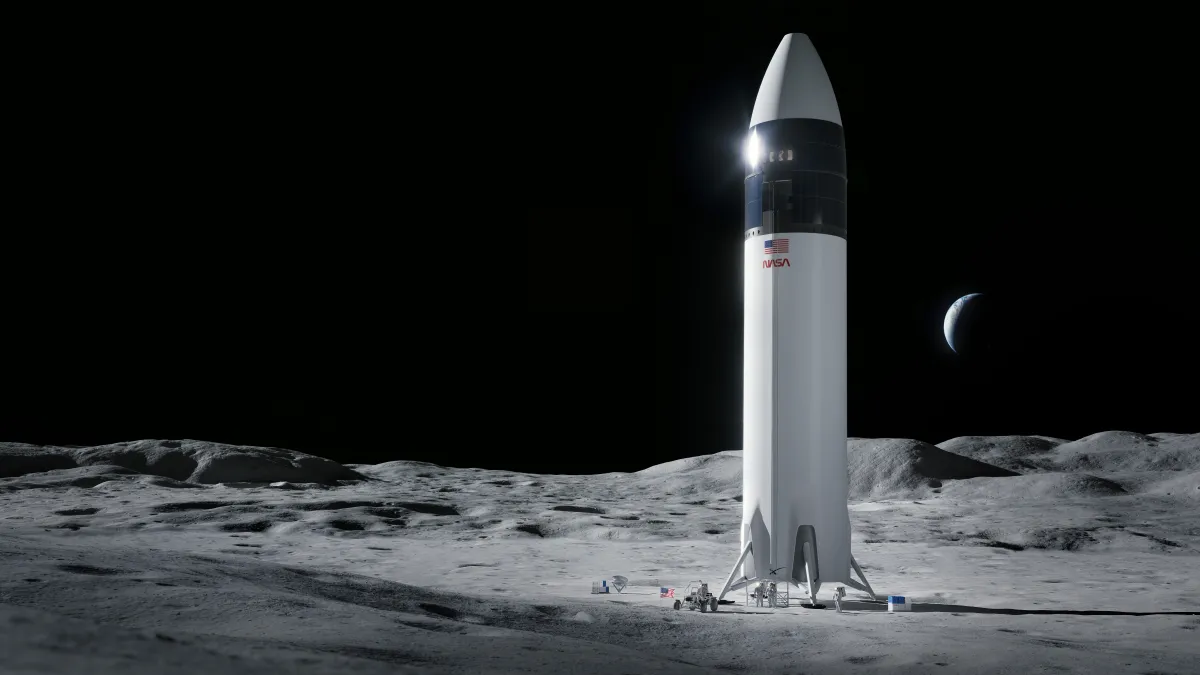
And the moon is a destination for Starship V3 in the not-too-distant future. If all goes to plan, the vehicle will land astronauts on the lunar surface during NASA's Artemis 4 mission, which the agency aims to launch in late 2028.
Starship will have to check a lot of boxes before it flies that mission, however. For example, the vehicle has yet to reach Earth orbit; all 11 of its test flights to date (Flight 1 launched in April 2023) have been suborbital, as today's will be. It also needs to demonstrate off-Earth refueling and be outfitted with a life-support system and other astronaut accoutrements.
Such milestones must be met soon if SpaceX wants to stay on NASA's Artemis program timeline.
The agency plans to launch its crewed Artemis 3 mission to Earth orbit in mid- to late 2027. This will be a docking test between Artemis' Orion crew capsule and one or both of the program's privately developed lunar landers — Ship (by itself, without Super Heavy) and Blue Origin's Blue Moon vehicle. If Ship isn't ready and Blue Moon is, NASA will presumably go with the latter on Artemis 3, putting the Blue Origin vehicle in pole position for the moon a year later.
Blue Moon has a lot of work to do as well, of course; it has yet to get off the ground. But that could change soon: Blue Origin plans to launch an uncrewed test flight to the lunar south pole with a prototype lander called Blue Moon Mark 1 later this year. It will launch on a Blue Origin New Glenn rocket, which is also facing its own hurdles. New Glenn's recent NG-3 launch suffered an upper-stage failure, leading to the loss of its satellite payload. Blue Origin will need to fix that issue before Blue Moon Mark 1 can fly.
What if Starship V3 doesn't work?
Failure on V3's debut launch could therefore be a big deal — especially if the fix requires significant modification of a key Starship system or subsystem. SpaceX needs to move quickly at this point in Starship's development and cannot afford many more long delays. (Getting V3 to the pad took a while; Starship hasn't flown since October 2025.)
A subpar flight could also have short-term financial consequences.
SpaceX is gearing up for its initial public offering next month, which is expected to value the company at a record $1.75 trillion or so. A catastrophic Starship failure in the leadup to the market debut could affect that valuation, given how central the vehicle is to SpaceX's future: The company has said that Starship will be its workhorse over the long haul, doing everything from satellite launches to crewed Mars missions to "point-to-point" transportation around Earth.
If SpaceX CEO and founder Elon Musk is nervous about V3's debut, however, he isn't showing it.
"The Starship production pipeline is full and will complete roughly 10 more ships and about half that number of boosters this year, so, if something goes wrong, it will not be a major setback, unless the launch stand is destroyed," Musk said on Monday (May 18) via X, the social media platform that he owns.