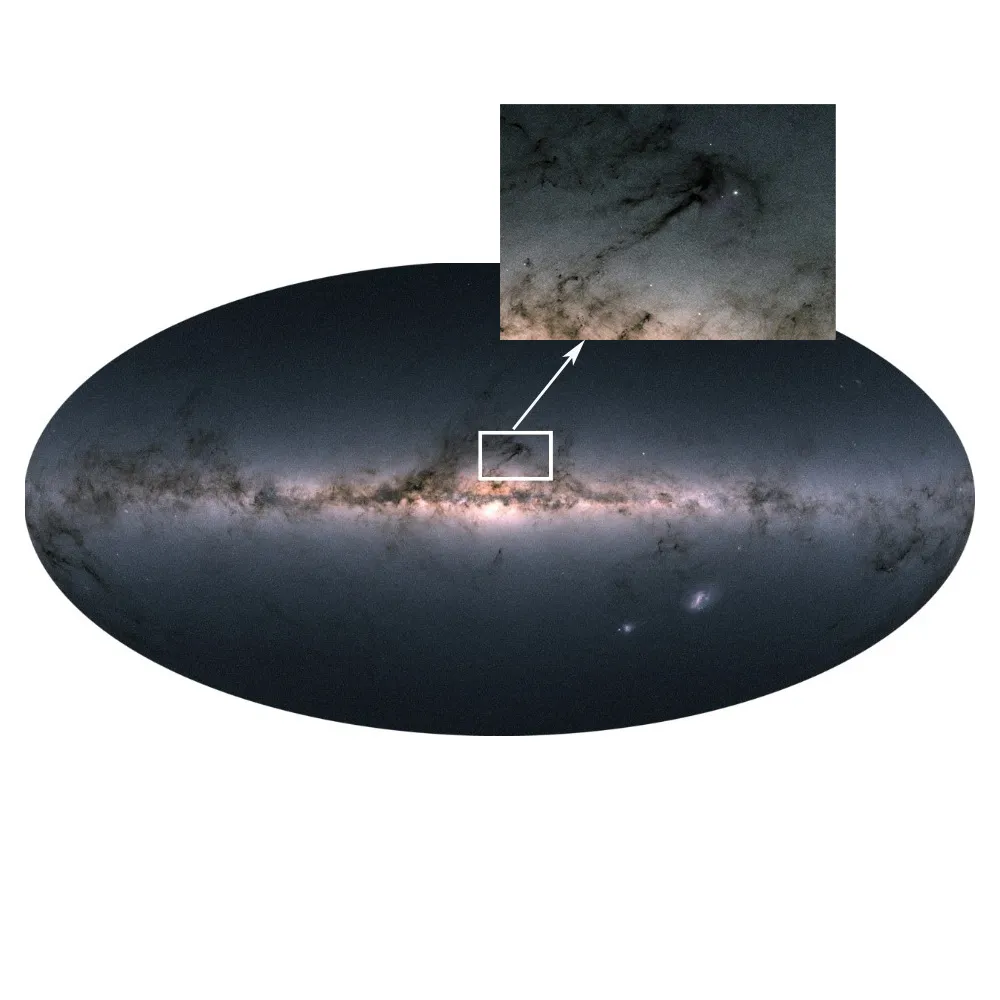
A galactic merger in our Milky Way galaxy likely produced a star "baby boom" billions of years ago, according to new research.
Knowledge about this burst of star formation comes courtesy of the European Space Agency's Gaia satellite, which monitors the positions and velocities of stars throughout our galaxy.
The young Milky Way would have had a lot of gas available to it, but the supply diminished over time as stars formed and used up the available material. What the new research shows, however, is that the Milky Way had a steady decline in star formation during its first 4 billion years, before a burst in star formation took place.
This means that a new supply of gas must have come in, and the study's researchers suggested that supply came from the Milky Way's merger with a satellite galaxy. A merger would also explain some of the variation in star ages, masses and distances that Gaia observed, the researchers said in a statement released May 8. Additionally, it's well-known that the Milky Way is a product of past galactic mergers, and that it's on its way to colliding with the Andromeda galaxy in a few billion years, so the results match up with other scientific work on our home galaxy.

The length of the star formation observed, along with the vast amounts of mass involved in the process, therefore shows the Milky Way "may have suffered an external perturbation that began about five billion years ago," lead author Roger Mor, a doctoral student in astronomy at the University of Barcelona, said in the statement. (The external perturbation was most likely the galactic merger.)
The researchers discovered this information by using Gaia to look at star distances, which allowed the researchers to pinpoint the stars' positions for the first time.
Santi Roca-Fàbrega, a cosmologist at the Complutense University of Madrid and co-author of the article, added in the statement that the observations do match up with current cosmological models. "Our galaxy seen from Gaia's eyes is an excellent cosmological laboratory where we can test and confront models at a bigger scale in the universe," he said.
The new work was detailed in April in the journal Astronomy & Astrophysics.
- This 3D Color Map of 1.7 Billion Stars in the Milky Way Is the Best Ever
- Evolution of Milky Way Galaxy Revealed by Hubble Space Telescope
- Milky Way Galaxy's Cosmic Halo Is 11.4 Billion Years Old
Follow Elizabeth Howell on Twitter @howellspace. Follow us on Twitter @Spacedotcom and on Facebook.