The celestial dragon is in its ascendancy this week forearly-evening observers.
Have you ever wondered why a particular group of stars wasmade into a certain constellation? Sometimes a star pattern suggests an object,creature or person. Other constellations portray mythological creatures such asunreal monsters.
Draco, the Dragon, is one of these.
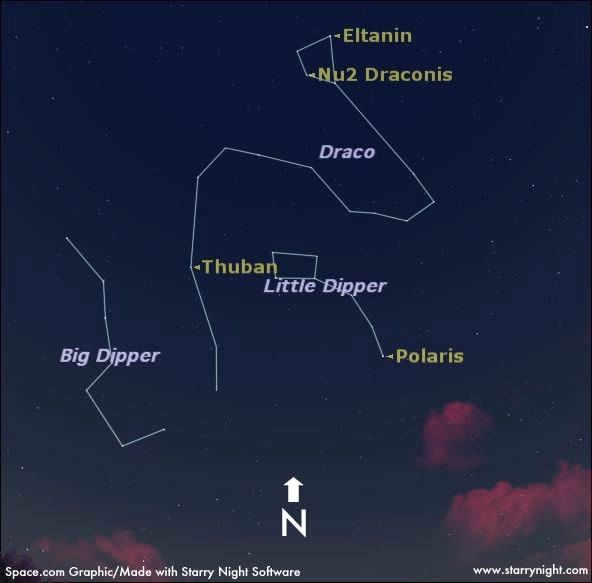
Draco is almost entirely circumpolar – that is, it alwaysremains above the horizon, never rising or setting for skywatchers at mostmid-northern latitudes. But right now is the best evening season for tracingout the windings of this unusual beast's snakelike body. This week, between 8:30and 9:00 p.m. local daylight time, he appears to pass between both the Littleand Big Dippers, with his head raised high above Polaris, almost to theoverhead point (called the zenith).
The Dragon's head is the most conspicuous part of Draco: an irregular,albeit conspicuous quadrangle, not quite half the size of the Big Dipper'sbowl. You can find it situated about a dozen degrees to the north and west ofthe brilliant blue-white star, Vega, the brightest of the three stars that makeup the SummerTriangle (ten degrees is roughly equal to your clenched fist held at arm'slength).
Draco is a very ancient grouping. The earliest Sumeriansconsidered these stars to represent the dragon Tiamat. Later it became one ofthe creatures that Hercules killed. One of Draco's tasks was to guard the garden of Hesperides and its golden apples that Hercules was supposed to retrieve. In thestars, as Draco coils around Polaris we now see Hercules standing (albeitupside down) on Draco's head.
The brightest star is Eltanin, a second magnitude star,shining with an orange tinge. This star is famous for being the one with whichthe English astronomer, James Bradley,discovered the aberration of starlight – an astronomicalphenomenon which produces an apparent motion of celestial objects ? in the year1728. Interestingly, a number of temples in Ancient Egypt were apparentlyoriented toward this star.
The faintest of the four stars in the quadrangle is NuDraconis, a wonderful double star for very small telescopes. The two stars arepractically the same brightness, both appearing just a trifle brighter thanfifth magnitude and separated by just over one arc minute (or about 1/30 the apparentdiameter of a full Moon). I first stumbled across Nu as a teenager in the Bronx, using low power on a four-and-a-quarter-inch Newtonian reflecting telescope. Ilikened it to a pair of tiny headlights. Check it out for yourself.
The pole of the heavens is moving slowly among theconstellations of the northern sky, once around a large circle. It is owing toa movement of the Earth for which the pull of both the Sun and Moon on ourbulging equator is chiefly responsible, a movement known as "precession."This double attraction causes the Earth to wobble slightly like a slowing-downtop does.
While the tilt of the axis to the Earth's orbit remains thesame (tilted 23.5 degrees from the equator), the axis itself describes afunnel-shaped motion, completing one rotation in about 25,800 years. This timespan – one complete wobble – is called a "Great" or "Platonic"Year.
Located in Draco's tail is the faint star Thuban. Duringthe third millennium, BC, the Earth's axis was pointed almost directly at thisstar. As such, Thuban was the North Star when the Pyramids were being built,some 5,000 years ago. Thuban was nearest to the North Pole of the sky about2830 B.C. It then shone in the sky almost motionless in the north near to wherethe current North Star, Polaris, now appears. Look roughly midway between thebowl of the Little Dipper and the star Mizar (where the Big Dipper's handlebends) and there you will find the former North Star.
And thanks to the oscillating motion of precession, Thubanwill again be the North Star some 20,000 years from now.
Joe Rao serves as an instructor and guest lecturer at New York's Hayden Planetarium. He writes about astronomy for The New York Times and otherpublications, and he is also an on-camera meteorologist for News 12 Westchester, New York.