


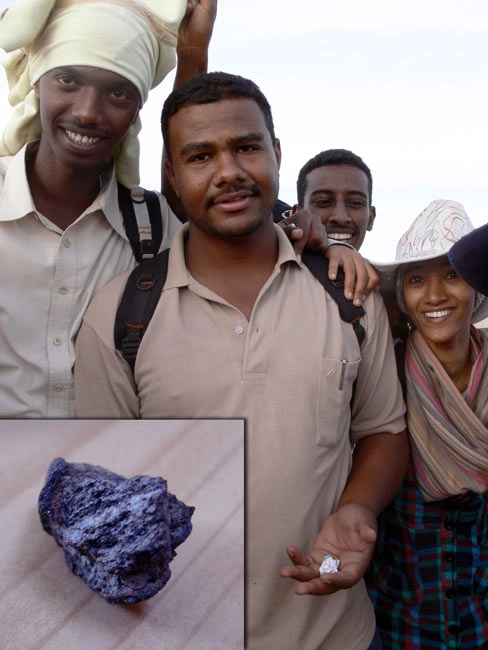
Fortunately,it wasn't large enough to require intervention by Bruce Willis, but asteroid2008 TC3 is the first space rock to have been spotted before it crashed toEarth. It streaked into the skies over northern Sudan in the early morning ofOctober 7, 2008, and then exploded at a high 37 km above the Nubian Desert,before the atmosphere could slow it appreciably. It was believed that theasteroid had fully disintegrated into dust.
Ameteor astronomer with the SETI Institute's Carl Sagan Center, PeterJenniskens, thought otherwise. After establishing a collaboration with MauwiaShaddad of the Physics Department and Faculty of Sciences of the University ofKhartoum, he traveled to the Sudan.? The two researchers, together withstudents and staff from the university, collectednearly 280 pieces of the asteroid, strewn over 29 km of the Nubian Desert.?Never before had meteorites been collected from such a high altitude explosion.As it turns out, the assembled remnants are unlike anything in our meteoritecollections, and may be an important clue in unraveling the early history ofthe solar system.
"Thiswas an extraordinary opportunity, for the first time, to bring into the lab actualpieces of an asteroid we had seen in space," comments Jenniskens, thelead author on a cover story article in the journal Nature thatdescribes the recovery and analysis of 2008 TC3.?
Pickedup by Arizona's Catalina Sky Survey telescope on 6 October, 2008, thetruck-sized asteroid abruptly ended its 4.5 billion year solar-system odysseyonly 20 hours after discovery, when it broke apart in the African skies. Theincoming asteroid was tracked by several groups of astronomers, including ateam at the La Palma Observatory in the Canary Islands that was able to measuresunlight reflected by the object.
Studyingthe reflected sunlight gives clues to the minerals at the surface of theseobjects. Astronomers group the asteroids into classes, and attempt to assignmeteorite types to each class. But their ability to do this is often frustratedby layers of dust on the asteroid surfaces that scatter light in unpredictableways.
Jenniskensteamed with planetary spectroscopist Janice Bishop of the SETI Institute tomeasure the reflection properties of the meteorite, and discovered that boththe asteroid and its meteoritic remains reflected light in much the same way —similar to the known behavior of so-called F-class asteroids.
"F-classasteroids were long a mystery," Bishop notes.? "Astronomers havemeasured their unique spectral properties with telescopes, but prior to 2008TC3 there was no corresponding meteorite class, no rocks we could look at inthe lab."
Thegood correspondence between telescopic and laboratory measurements for 2008 TC3suggests that small asteroids don't have the troublesome dust layers, and maytherefore be more suitable objects for establishing the link between asteroidtype and meteorite properties. That would allow us to characterize asteroidsfrom afar.
RoccoMancinelli, a microbial ecologist at the SETI Institute's Carl Sagan Center,and a member of the research team, says that "2008 TC3 could serve as aRosetta Stone, providing us with essential clues to the processes that builtEarth and its planetary siblings."
Inthe dim past, as the solar system was taking shape, small dust particles stucktogether to form larger bodies, a process of accumulation that eventuallyproduced the asteroids. Some of these bodies collided so violently that theymelted throughout.
2008TC3 turns out to be an intermediate case, having been only partially melted.?The resulting material produced what's called a polymict ureilite meteorite.The meteorites from 2008 TC3, now called "Almahata Sitta," areanomalous ureilites: very dark, porous, and rich in highly cooked carbon. Thisnew material may serve to rule out many theories about the origin of ureilites.
Inaddition, knowing the nature of F-class asteroids could conceivably pay off inprotecting Earth from dangerous impactors. Theexplosion of 2008 TC3 at high altitude indicates that it was of highlyfragile construction. Its estimated mass was about 80 tons, of which only some5 kg has been recovered on the ground.? If at some future time we discover anF-class asteroid that's, say, several kilometers in size — one that could wipeout entire species — then we'll know its composition and can devise appropriatestrategies to ward it off.? Hitting such a fragile asteroid with an atomicbomb, as Bruce Willis might do, would merely turn it into a deadly swarm ofshotgun pellets.
Asefforts such as the Pan-STARRSproject uncover smaller near-Earth asteroids, Jenniskens expects more incidentssimilar to 2008 TC3.? "I look forward to getting a call from the nextperson to spot one of these," he says.? "I would love to travel tothe impact area in time to see the fireball in the sky, study its breakup andrecover the pieces. If it's big enough, we may well find other fragile materialsnot yet in our meteorite collections."
- Video: Asteroid Hunting
- Asteroid Exploded in Earth's Atmosphere
- Images: Asteroids
