

SEARCH:
   Hubble Space Telescope

advertisement


Dark Matter Exposed: Animation Offers Clues to Cosmic Mystery

By Robert Roy Britt
Senior Science Writer
posted: 07:00 am ET
15 April 2003

EMBARGOED FOR


PHILADELPHIA - As if it weren't strange enough that the cosmos is loaded with invisible and elusive matter, a new theory has the stuff wandering through the early universe like a drunken sailor.

The idea is a serious attempt to examine dark matter -- which is far more prevalent than normal matter -- by modeling its behavior, despite the troubling fact that no one knows what it actually is. The result is an animation showing how thousands of relatively small and invisible dark matter galaxies might have developed and still reside in the vicinity of our own Milky Way.

Chung-Pei Ma, an astronomer at the University of California, Berkeley, unveiled the new theory here last week at a meeting of the American Physical Society. Ma envisions dark matter particles behaving like bits of dust bounced around by water molecules in a microscopic process called Brownian motion.

Brownian motion was discovered in 1827 by botanist Robert Brown, who noticed a pollen grain moving erratically for unseen reasons under his microscope. Einstein later figured out that molecules were bouncing randomly off the pollen. The concept was applied decades ago to better understand the behavior of stars in dense clusters.
SCIENCE TUESDAY
Visit SPACE.com to explore a new science feature each Tuesday.
>>Go to Science Tuesday archive page

   Images

Stills from the animation: Simulated particles of dark matter wander like drunken sailors but finally come together in these five panels. However, in addition to a primary galaxy, several significant satellite knots of dark matter result.

   Related SPACE.com STORIES

'Groundbreaking' Discovery: First Direct Observation of Dark Matter


Missing Matter Found, Partially Squaring Cosmic Accounting Sheets


Scientists Doubt Claims of Invisible 'Mirror' Comets and Asteroids

   TODAY'S DISCUSSION
What do you think of this story?
>>Uplink your views

Ma describes Brownian motion as being something like the unpredictable path of a drunken sailor. She and her colleague, Ed Bertschinger of MIT, were surprised that the basic principle of Brownian motion could be applied on a galactic scale, but the results fit a line of theoretical thinking that predicts dark satellite galaxies should exist.

Modeling the invisible

Scientist suspect the bulk of dark matter involves tiny particles they've yet to detect. The two leading candidates are called axions and neutralinos. Whatever they are, they are known to interact gravitationally with regular matter, because observable matter can't account for the speed with which stars move around galactic centers.

Dark matter particles appear not to interact with electromagnetic forces, however. They don't make or reflect light, which explains why they can't be seen.

"It has to be some kind of exotic particle, something we can't touch," Ma said.

Until recently, scientists assumed dark matter was distributed evenly in a massive halo around each galaxy. Not quite true, Ma and others have come to believe. The halos are there, but so possibly are thousands of clumps that can be thought of as dark, satellite galaxies, several researchers have suggested in recent years. One idea for along these lines was put forth in 2001 by a team led by Neil Trentham at the University of Cambridge. Trentham said that for every normal, star-filled galaxy, there might be 100 that contain primarily stuff we can't see.

Dark matter satellite galaxies -- if they exist -- cannot be detected by conventional telescopes because they don't contain enough normal matter to fuel star birth.

Ma and Bertschinger let millions of hypothetical dark matter particles interact over billions of years in a computer model governed by gravity. Many of the particles coalesce into central clumps as massive as billions of suns, a neat fit with expectations for the process that would build a normal galaxy.

But thousands of dark galaxies develop in the simulation, too, each containing masses equal to several million suns.

"We then realized that the motion of dark matter can also be described statistically by a similar equation used for the Brownian motion," Ma told SPACE.com. "This equation is very different from Newton's law [of gravity] used in the computer model. This doesn't mean Newton's law is not applicable -- it means the new equation that we found provides a new language for describing how dark matter clumps."

The Simulation

CLICK TO SEE FULL ANIMATION

Gravity pulls dark matter into clumps, but Brownian motion aptly describes the "drunken sailor" behavior of the particles.
IMAGE: Chung-Pei Ma, University of California, Berkeley

A paper describing the new work will soon be submitted to the Astrophysical Journal for possible publication.

Finding dark matter

Dark matter makes up about 23 percent of the universe's mass-energy budget. Normal matter, the stuff of stars, planets and people, contributes just 4 percent. (The rest of the universe is driven by an even more mysterious thing called dark energy.)

A small portion of dark matter has already been identified and is no longer mysterious. Tiny particles called neutrinos, once thought to be massless, are now known to make up a sprinkling of the total dark matter column of the budget. Cold dead stars, recently found to be plentiful, also contribute modestly to this accounting.

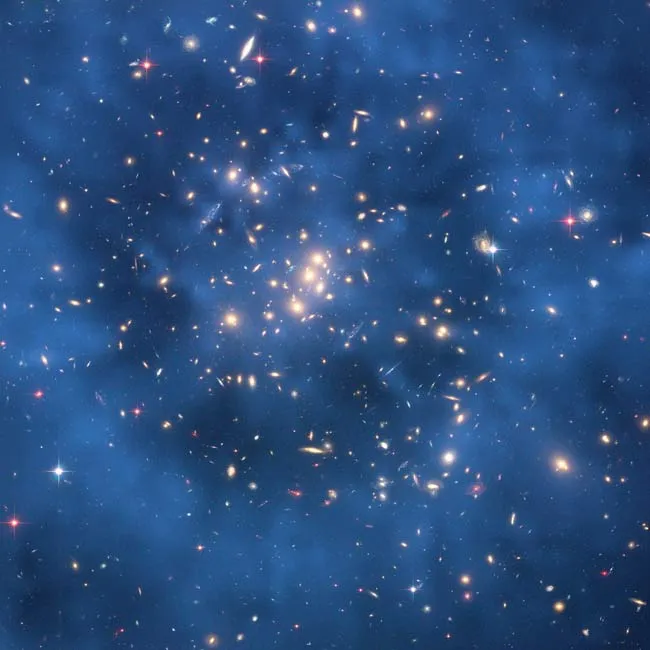
If dark satellite galaxies exist, astronomers should be able to detect some of them. Their gravity would bend light traveling toward Earth from more distant objects, distorting and possibly magnifying them. This so-called gravitational lensing effect is used already to study distant objects by peering through and around visible, intervening galaxies or galaxy clusters.

Finding and cataloguing these dark matter galaxies would help researchers understand what they're made of.

"Different dark matter models [for material that is cold or warm] predict different number of these dark galaxies," Ma said. "So if we can estimate the number and masses of these galaxies, it can constrain the nature of dark matter."


Deep Space Explorer takes you on a 3-D multimedia journey through time. Narrated by your personal tour guide, Star Trek: Deep Space 9 actress Chase Masterson.

Saul Perlmutter of the Lawrence Berkeley National Laboratory, speaking at the same meeting of physicists, said knowledge of dark matter has come a long way since the first strong hints of it emerged in the 1970s. Researchers no longer wrestle with whether it exists or how much there is but instead can focus on its properties, Perlmutter said.

He added, though, that physicists should remain humble about the time it might take to figure out the remaining mysteries.


     about us | FREE Email Newsletter | message boards | register at SPACE.com | contact us | advertise with us | terms & conditions | privacy policy      DMCA/Copyright

     © Imaginova Corp. All rights reserved.