Brown dwarfs are curious celestial bodies that appear to straddle the mass divide between stars and planets. Often referred to as "failed stars," brown dwarfs form in isolation from a collapsing cloud of gas and dust like a star.
However, while fully-fledged stars continue to gather material from the gas and dust cloud that births them, brown dwarfs are less successful at this mass harvesting. As a result, they don't reach the masses of the smallest stars and can't trigger the process that defines main sequence stars, like our sun.
Don't be fooled by the unfortunate and slightly unfair nickname; brown dwarfs are anything but failures. And it is over the past few decades that these curious celestial bodies have risen to prominence.
Brown dwarfs, stars, planets: What's the difference?
Both stars and brown dwarfs form when overdense patches in massive clouds of gas and dust collapse under their own gravity. This leaves a body called a protostar wrapped in a prenatal cocoon of gas and dust. Many protostars continue to gather matter from these prenatal envelopes of material until they have enough mass to generate the pressure and temperature needed in their core to kick-start the nuclear fusion of hydrogen to helium. This fusion-starting mass is thought to be somewhere between 12 to 14 times the mass of Jupiter or around 0.012 and 0.014 times the sun's mass.

Brown dwarfs' "failure" lies in their inability to accumulate this mass. Astronomers currently believe that the lightest brown dwarfs have around 0.013 times the mass of the sun, while the heaviest "failed stars" have a mass of around 0.08 times the mass of the sun. For context, that is between 13 and 80 times the mass of Jupiter.
This seems to correlate with the fact that among the tens of millions of stars, we have discovered 2MASS J0523-1403, with a mass of between 54 to 80 times that of Jupiter.
Of course, planets form differently, emerging from so-called "protoplanetary disks" around young stars. That means brown dwarfs can be defined as planetary-mass objects that form like stars. However, this is a difficult delineation to make because it is hard to determine the origins of a celestial body.
Brown dwarfs are not complete failures
Brown dwarfs can be defined and distinguished from planets in another way. This is because, though these stellar bodies "fail" to fuse normal hydrogen to helium in their cores, they can fuse some atomic nuclei to forge heavier elements, for example, a "heavy" isotope of hydrogen called deuterium.
The major difference between brown dwarfs and planets is their mass and the occurrence of deuterium, or 'heavy hydrogen' burning. At larger masses, an object will have a high enough internal pressure and temperature to burn a majority of the deuterium that was initially present in the object. The dividing line was defined in the 1990s so that brown dwarfs were objects that burned 50% or more of their initial deuterium, while planets do not burn a majority of their deuterium.
There are several factors that can influence the burning of deuterium, and when these are considered, the dividing line between brown dwarfs and planets becomes slightly more blurry than the line between stars and brown dwarfs. The mass of an object that will burn a majority of its deuterium has a lower limit of approximately 12 to 14 times the mass of Jupiter.
Again, this sets the lower mass of brown dwarfs at around 13 Jupiter masses, often cited in the literature to separate planets from brown dwarfs literature to separate planets and brown dwarfs. Interestingly, this all means there can be an overlap between the masses of the most massive planets and the least massive brown dwarfs. Additionally, gas giants can be larger in size than more massive brown dwarfs because they can vary in density. This is because, at lower masses, planets can experience lower pressures, leading to a lower l density, 'puffier' planets that are larger in size compared to some brown dwarfs.
When was the first brown dwarf discovered?
In 1995, Gliese 229Ba became the first brown dwarf discovered by astronomers, marking the recognition of this new class of stellar bodies. However, a curious mystery soon developed around this brown dwarf, 19 light-years from Earth. Gliese 229Ba was thought to have a mass of around 70 times that of Jupiter, or around 0.07 times the mass of the sun. However, astronomers expected that such a massive brown dwarf would be hotter and brighter than Gliese 229Ba actually is.
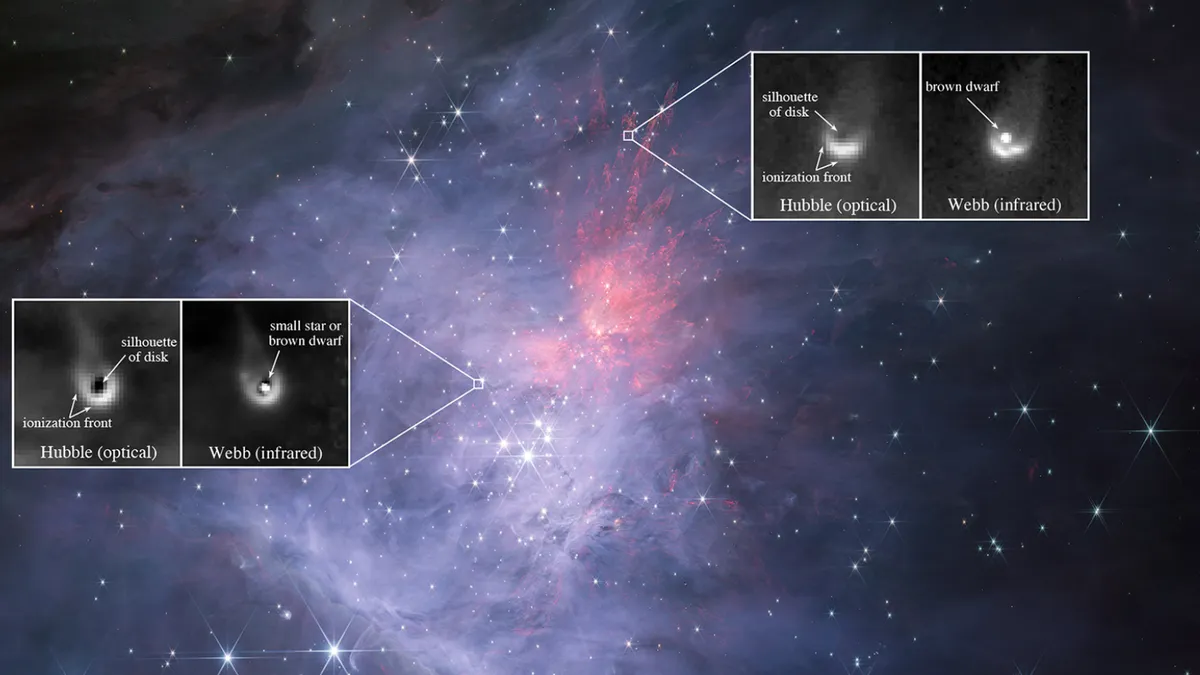
In 2024, astronomers discovered the answer to this mystery. Gliese 229Ba is not, in fact, a single brown dwarf but two brown dwarfs locked in a tight binary system. Now designated Gliese 229Ba and Gliese 229Bb, the two brown dwarfs orbit each other at a distance equivalent to just 16 times the distance between Earth and the moon. Gliese 229Ba and Gliese 229Bb are so close together they orbit each other in just 12 Earth days.
Do brown dwarfs prefer life in binaries?
Cleary binary brown dwarfs do exist, but everything that scientists know about binaries suggests that the likelihood of finding a stellar body with a binary partner diminishes as the mass of these bodies gets smaller.
According to the book "Transiting Exoplanets" (Cambridge University Press, 2010), around 75% of high-mass stars are found in multiple-star systems, roughly half of all known stars with sunlike masses are found with a companion, and just 25% of small red dwarf stars are found in multi-star systems. That means that brown dwarf binaries should be rare indeed.

Brown dwarf binaries are thought to form like binary stars from the collapse of a massive cloud of gas to form two stellar bodies. In March 2024, using the Hubble Space Telescope, astronomers discovered that older brown dwarfs are less likely to exist in binary pairings.
This implies that the gravity binding brown dwarfs together is so weak that over just a few hundred million years, the gravitational pull of passing stars can destroy these binary arrangements, meaning these failed stars fail at relationships, too.
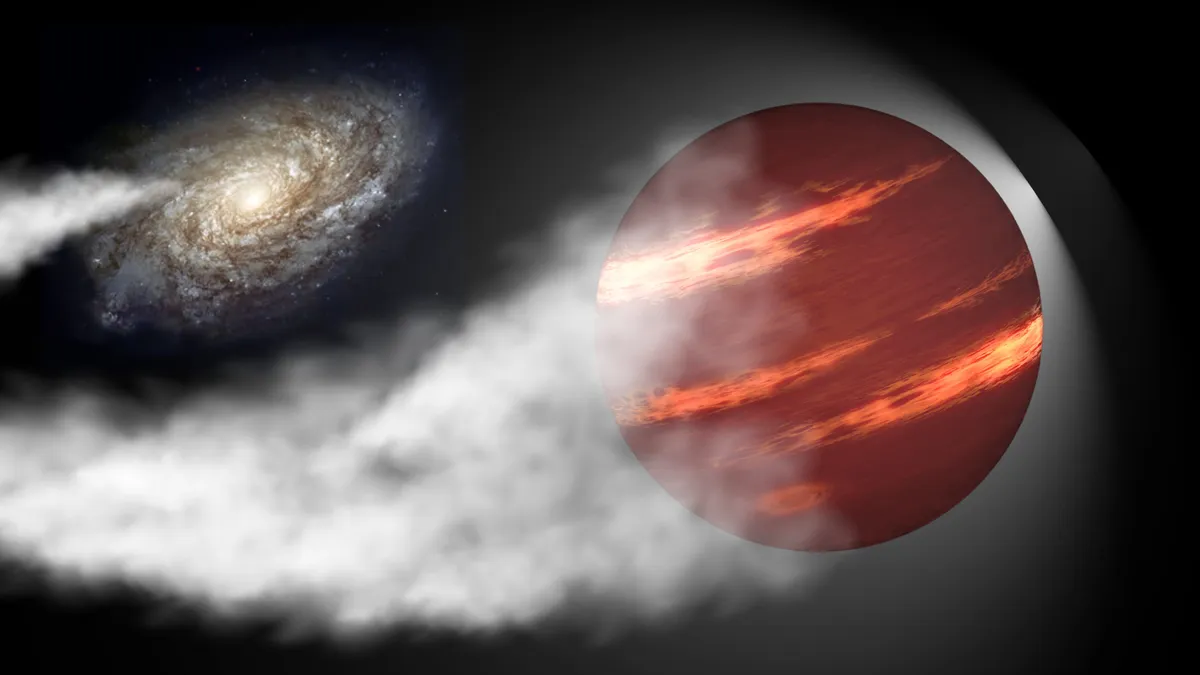
In July 2024, citizen scientists found evidence of what happens to ejected brown dwarfs using data from NASA's Wide-field Infrared Survey Explorer (WISE), they discovered a suspected brown dwarf racing through the cosmos at a staggering 1.2 million mph (1.9 million kph) alone.
The rogue brown dwarf designated CWISE J1249+3621 has a mass around 80 times that of Jupiter, or around 0.08 solar masses, and it is racing toward the heart of the Milky Way. It is the lowest mass high-velocity "runaway" stellar body observed to date.
Brown dwarf expert Q&A
Nolan Grieves is a researcher in the University of Geneva's Department of Astronomy specializing in the characterization of the fundamental properties of stars and the investigation of brown dwarfs.
What is so fascinating about brown dwarfs?
I first started researching brown dwarfs while searching for exoplanets. One of the spectrographs I was working with during my PhD did not have the precision to definitively detect the smaller mass of planets, but the instrument was suitable for detecting the slightly more massive (larger Doppler shift) brown dwarfs. It was here that I surprisingly learned that when looking at other star systems, brown dwarfs are uncommon compared to planets, as well as other stars, which are quite common as many of the stars you see in the night sky are binaries. This is evidence that the physical conditions of star system formation make objects with the specific masses in between planets and stars harder to form around protostars. Thus, brown dwarfs around our neighboring stars are a rarity compared to planets and not fully understood, making them fascinating objects to study.
What do these bodies tell us about the difference between planets and stars?
Planets are created in protoplanetary disks surrounding newly formed stars. After the initial collapse of a molecular cloud (stellar nursery), conservation of angular momentum causes rotation to increase as the cloud gets smaller, causing the cloud to flatten and form a disk. In addition to planets, if there is enough mass, other stars can form in the disk (binaries also form in general from fragmentation of molecular clouds). Planets, from their definition, must be orbiting a star, and other stars can orbit stars. However, some objects, just larger than planets, can form deuterium burning in their cores, making them brown dwarfs. While objects just more massive than brown dwarfs can have stable hydrogen fusion in their cores, making them stars. So the border between planets and stars is clear with brown dwarfs serving as the buffer.
Are we sure where the dividing lines between a star and a brown dwarf and a brown dwarf and a planet are?
The dividing lines remain a bit ambiguous. The conditions for a stable proton-proton chain reaction (the thermonuclear fusion process that occurs in low-mass stars) depends on many factors that allow an object to reach thermal equilibrium with thermonuclear burning at its core. The lower limit of stable fusion depends on temperature, mass, pressure, chemical composition, and opacity (how effectively material can absorb or scatter radiation). Thus, when we only have certain measurements like luminosity, temperature, or mass, it can be hard to tell if this process is actually occurring (note that some high mass brown dwarfs may have proton-proton chain fusion for a time but will not be stable). On the other side, a planet is no longer considered a planet when it is able to fuse deuterium in its core. Similar to the proton-proton chain reaction, deuterium burning depends on specific conditions for the lowest mass brown dwarfs near the boundary of where deuterium burning is possible.
Is the nickname "failed stars" fair for brown dwarfs?
If we are talking about the most massive brown dwarfs, then it is fair. As conditions were just not right for them to obtain stable thermonuclear fusion. However, if they are on the smaller side, they're more similar to a massive Jupiter.
How does you research touch upon brown dwarfs?
While working at the University of Florida and the University of Geneva, I specialized in the analysis of radial velocity data from echelle spectrographs. The first exoplanet, 51 Pegasi b, was discovered with the ELODIE echelle spectrograph by researchers at Geneva. These instruments, which detect doppler shifts of stars moving from the gravitational pull of orbiting objects, are ideal for measuring the masses of stellar companions. In the search for planets, every so often we would come across brown dwarfs orbiting the star we were examining. Brown dwarfs are easier to detect than planets, but with high precision instruments we observed that they are uncommon compared to planets. This created an entire niche of research to unearth the physical properties that cause a difference in frequency between these objects. While discovering these brown dwarfs, I was able to add to the limited sample of brown dwarfs orbiting other stars and further understand why they do not form as often.
Additional resources
Want to know more about the main sequence star-defining nuclear fusion process that brown dwarfs fail to attain? Lawrence Berkeley National Laboratory has a really accessible guide.
In this helpful video, Space.com contributor, Paul M. Sutter, explains why brown dwarfs are considered so strange.
If you think brown dwarfs are weird and blur the lines between stars and planets, you should check out JuMBOs (Jupiter-Mass Binary Objects). In 2023, astronomers discovered 40 pairs of these planetary mass objects located in the Orion stellar nursery located around 1,350 light-years from Earth. After two years, scientists are still scratching their heads about how these rogue bodies could have formed!
Bibliography
Star Gliese 229 Ba
https://www.stellarcatalog.com/stars/gliese-229-b
Discovery of a starless binary system of brown dwarfs
https://www.ph.ed.ac.uk/news/2020/discovery-of-a-starless-binary-system-of-brown-dwarfs-20-12-16
C. A. Haswell., Transiting Exoplanets: Measuring the properties of planetary systems, Cambridge University Press, [2010], ISBN 978 0 521 13938 0
An HST survey of 33 T8 to Y1 brown dwarfs: NIR photometry and
multiplicity of the coldest isolated objects
https://stsci-opo.org/STScI-01HRABPNJMAE3XS5P2RAV1A3RP.pdf
How Many Brown Dwarfs in the Milky Way?
https://www.centauri-dreams.org/2017/07/07/how-many-brown-dwarfs-in-the-milky-way/
The low-mass content of the massive young star cluster RCW 38, https://arxiv.org/abs/1707.00277
Discovery of a Hypervelocity L Subdwarf at the Star/Brown Dwarf Mass Limithttps://arxiv.org/abs/2407.08578
THE DEUTERIUM-BURNING MASS LIMIT FOR BROWN DWARFS AND GIANT PLANETS
https://iopscience.iop.org/article/10.1088/0004-637X/727/1/57