
Water and
ice have left their marks on the Martian surface, from pits and ridges to
winding channels and gullies.
Evidence
for past
water or water ice on Mars has accumulated rapidly in the past decade. A
new study, which will be published in the journal Icarus, paints a
scientific picture of flowing rivers and glaciers
that likely shaped the topography of the planet's large craters.
"If
you look at all of these [features] individually, it's not necessarily strong
evidence that there was ice and/or water flowing on the surface," said lead
researcher Daniel Berman of the Planetary Science Institute in Arizona. "But if you look at this suite of features you see throughout these regions,
what you have is a story of the deposition of a fair quantity of ice most
likely during this period of high obliquity, several million years ago, which
has subsequently begun to melt and flow down the crater walls and across their
floors."
Martian
landscape
Berman and
his colleagues analyzed images of about 100 craters in Mars' Arabia Terra
region of the northern hemisphere and about 100 more in an area east of Hellas
Basin in the southern hemisphere.
The craters
are all greater than about 12.5 miles (20 km) in diameter and had been photographed
by cameras on various spacecraft, including the Mars Odyssey THEMIS VIS camera,
the Mars Global Surveyor Mars Orbiter Camera and the Viking Orbiter cameras.
Here are
some of the surface features found by these instruments and that scientists
think formed as a result of flowing water and ice:
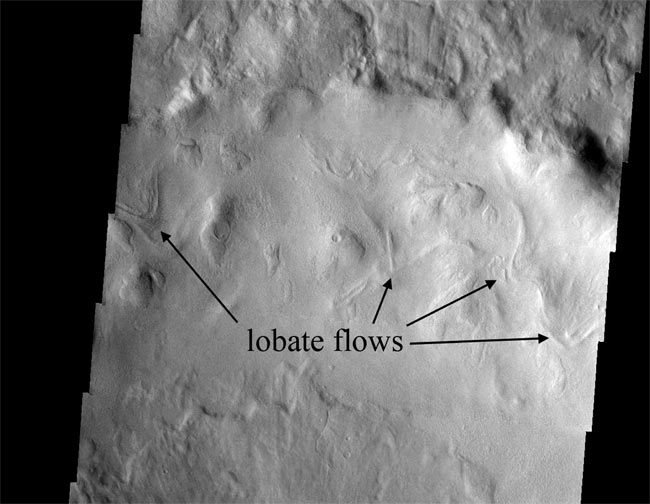
- Lobate
flows — Tongue-shaped deposits that resemble rock glaciers on Earth showed
up in images of 30 craters in the Hellas Basin. And the ice that caused
the lobes could be still flowing. "We can see on the surface [of the
lobes] these lineated grooves, lines going in the direction of the flow,
and also these pits, which indicate ice is currently flowing and
evaporating from the surface," Berman told SPACE.com,
explaining how the ice would sublimate directly from a solid to a vapor.
- Narrow
channels — In craters in both regions, Berman found narrow channels about
3 to 7 feet (1 to 2 meters) across that meandered down crater walls and
sometimes beyond the craters. "They are really narrow, branching
channels, which is usually indicative of the flow of water," Berman
said.
- Crater-wall
valleys — Troughs up to about a half mile (1 km) wide were etched into the
crater walls in both Martian regions. Some of the valleys were filled with
rough-textured deposits of material, suggesting ice-rich debris is flowing
(or was flowing) down the crater walls, Berman said.
Sun
factor
The
scientists also found the landscape features were more common on either the pole-facing wall or equator-facing
wall depending on where the crater was located. So, for instance, in the
southern hemisphere (Hellas Basin region) there was a sort of line of
demarcation. North of this imaginary line, more of the features showed up on
the crater walls facing the south, while south of the line most features were
found on crater walls facing the equator.
This
pattern would suggest uneven heating of crater walls. So ice on the walls that
got more sunlight would melt faster, causing more water and/or ice to flow and
form the gullies and other features.
Unlike
Earth, with an axis that only oscillates through an arc of about 4 degrees over
millions of years, Mars seems to have an axis that tilts between vertical and
as much as 60 degrees, according to recent studies.
"This
is proving [these features] happened when the planet was tilted much more than
it is now," Berman said. "And that means these deposits were
initially formed during this period of higher tilt, which happened several million
years ago."
Berman and his colleagues have estimated the ages of some of these crater features using a technique known as crater counting, finding they range from 1 million to 10 million years old --relatively young, geologically speaking.