


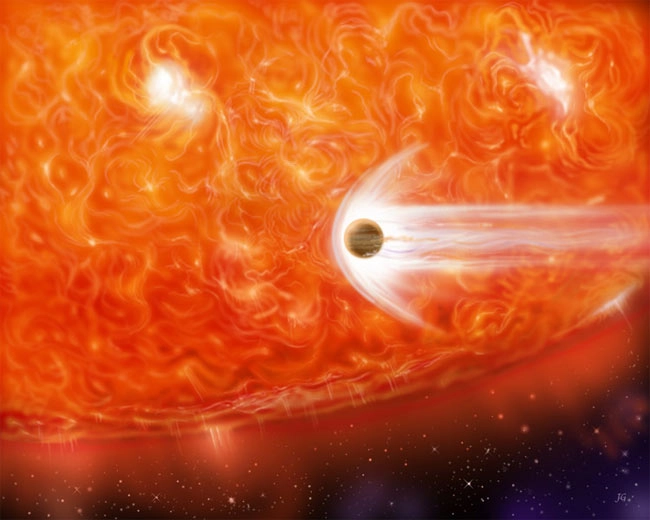
A planetoutside of the solar system has been discovered orbiting a dying, puffed-upstar called a red giant.?
The findingcould help astronomers learn more about the fate of our solar system.
The newlydiscovered exoplanet is nearly six times the mass of Jupiter and orbits the redgiant star HD 102272, which is located 1,200 light-years away in theconstellation Leo. To date, about 20 redgiants are known to support planets.
Theresearchers suspect another world is orbiting farther out in the system. Ifconfirmed, the system would be the first red giant star known to support morethan one planet.
Small andmedium-sized stars like our sun become red giants when they exhaust all oftheir hydrogen fuel near the end of their lives. The stars? cores contract andbegin to burn helium, while their outer shells balloon upto 100 times their original size. When our sun does that, Earth and otherplanets will be vaporized.
Thefinding, which will be published in a forthcoming issue of the AstrophysicalJournal, will shed light on howbloated stars interact with their resident planets.
The newplanet orbits closer than any other world to its red giant parent, orbitingjust 0.6 astronomical units (AU) from the star. The researchers suggest thisdistance could be the limit, with no planets venturing in closer to a redgiant.
"Whenred-giant stars expand, they tend to eat up the nearby planets," saidresearcher Alexander Wolszczan, an astrophysicist at Penn State. "Thereappears to be a zone of avoidance around such stars of about 0.6 astronomicalunits.?
Oneastronomical unit is equal to the average distance between Earth and the sun.
Theresearchers detected the planet with the Hobby-Eberly Telescope of McDonaldObservatory in Texas. They used the radial velocity method, which involvesmeasuring the slight wobbles of a star caused by the tug of an orbiting planet.
The hoststar is currently about 10 times the size of the sun, but it will eventuallyexpand to up to 100 times the size of the sun. Since the star is a relativelyyoung red giant, this mushrooming will probably not take place for another 100million years, Wolszczan said. At that time, the star's outer shell will engulfthis exoplanet.
"Theplanet finds itself orbiting, not in a vacuum anymore, but in gas that imposes adrag on the planet," Wolszczan told SPACE.com. "So its orbitalenergy gets lost to the surrounding atmosphere of the star through friction.And so [the planet] starts spiraling in."
While redgiants vaporize those planets closest to them, they could thaw more distantworlds in their systems, creating new havens for life.
This couldhappen in our own solar system when our sun begins its transitioninto a red giant in about 5 billion years, Wolszczan said.
Earth willlikely be destroyed, but more distant ? and currently frozen ? worlds such asJupiter?s frozen moon Europa will survive and perhaps be bathed in sunlight asour star rapidly expands.
Europa ?maybecome a very pleasant, nice ocean world," Wolszczan said. "Therewould still be more than a billion years of time for life to develop againsomewhere else in the solar system, even though at this point it is not quitepossible."
- Video: Planet Hunter
- Top 10 Strangest Things in Space
- Top 10 Star Mysteries
