





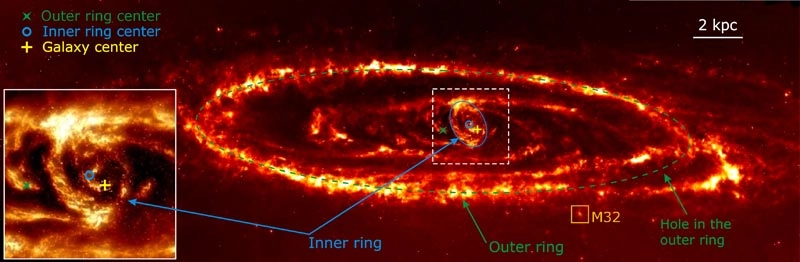
Our giantneighboring galaxy,Andromeda,was involved in a head on collision with the dwarf galaxy, M32,some 210 million years ago, scientists announced today.
Infraredimages from NASA'sSpitzer Space Telescope recently revealed a never seen before ring of dustwithin Andromeda.
The new ring[image]and the presence of a previously observed outer ring suggest a disturbance thatcould have only been caused by a collision. Astronomers suspect that the impactwas brought about by the dwarf galaxy Messier 32 (M32).
"Thesedust rings are like ripples in a pond," said lead study author David Blockfrom University of the Witwatersrand, Johannesburg. "Plop a stone intowater and you get an expanding series of rings or waves. Let a small galaxycollide nearly head-on with a larger one, and you will see waves or rings ofgas and dust that propagate outward as a result of the violent gravitationalinteraction."
To recreatethe impacts of the crash, the researchers used computer models. Thesimulations showed that M32 plunged through the disk of Andromeda alongAndromeda's polar axis back when dinosaursroamed the Earth.
In thecrash, M32 lost more than half of its original mass and the much more massiveAndromeda was disrupted.
Astronomersbelieve that Andromeda--currently 2 million light years away from the Milky Way--will collide with ourgalaxy in 5 billion to 10 billion years. The two will eventually join to formone large elliptical galaxy.
The studyis detailed in the Oct. 18 issue of the journal Nature.
- The Strangest Things in Space
- Crash Course: Simulating the Fate of Our Milky Way
- Andromeda Galaxy: The Best of Your Amazing Images
- Strange Setup: Andromeda's Satellite Galaxies All Lined Up
