newsarama.com
advertisement


Mojave Airport is headed for spaceport status. Image Courtesy: Mojave Airport


X marks the spot. Seemingly by request, White Knight/SpaceShipOne and their chase Alpha jet form the X Prize logo high above Mojave, California desert during a record breaking flight on 13 May 2004. Photo credit: Ollie Laughton


View from back seat at top of SpaceShipOne's climb, flight 14P. Pilot Mike Melvill is at controls of the private spaceship. Note bright sun cast on interior while black sky is seen out top, right and forward windows. Image Credit: Scaled Composites


SpaceShipOne with tail section feathered into position above 200,000 feet on May 13 flight. San Diego is at left, Santa Barbara is under the left wing and Edwards Air Force Base is at right/center. Image Credit: Scaled Composites
Private Spacecraft's Inaugural Launch Set for June 21
Spaceport to Rise in California's Mojave Desert
Data From Recent Test Flight of Private Spacecraft Released
Canadian Arrow Team Prepares Rocket for Safety Shakedown
Mojave Prepares to Make Space History
By Leonard David
Senior Space Writer
posted: 07:00 am ET
10 June 2004

By Leonard David

The small desert town of Mojave, California is bracing for a close encounter with space history later this month as the first privately funded rocket plane attempts to soar to the edge of space.

Oddly, this tourist stopover for people en route to the largest open pit borax mine, as well as nearby gold and silver mining ghost towns from the 1890s, is also a nexus for technology and innovation. A dry and sandy expanse of remote landscape, Mojave has historic roots that run deep through decades of American aerospace progress.

To the east of Mojave is Edwards Air Force Base, home for legendary pilots and milestone making aircraft. The NASA X-15 rocket plane, for instance, roared to life high above the Mojave landscape for nearly a decade, piercing the sky to attain speed and altitude records starting in the late 1950s.

Fast forward to the 21st century and Mojave Airport, also known as the Civilian Flight Test Center -- and soon to be the first inland spaceport. It has taken center stage in making public space travel both real and reasonable.

Ground-bound majority

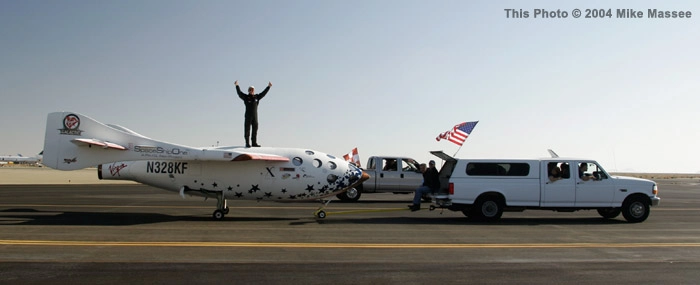
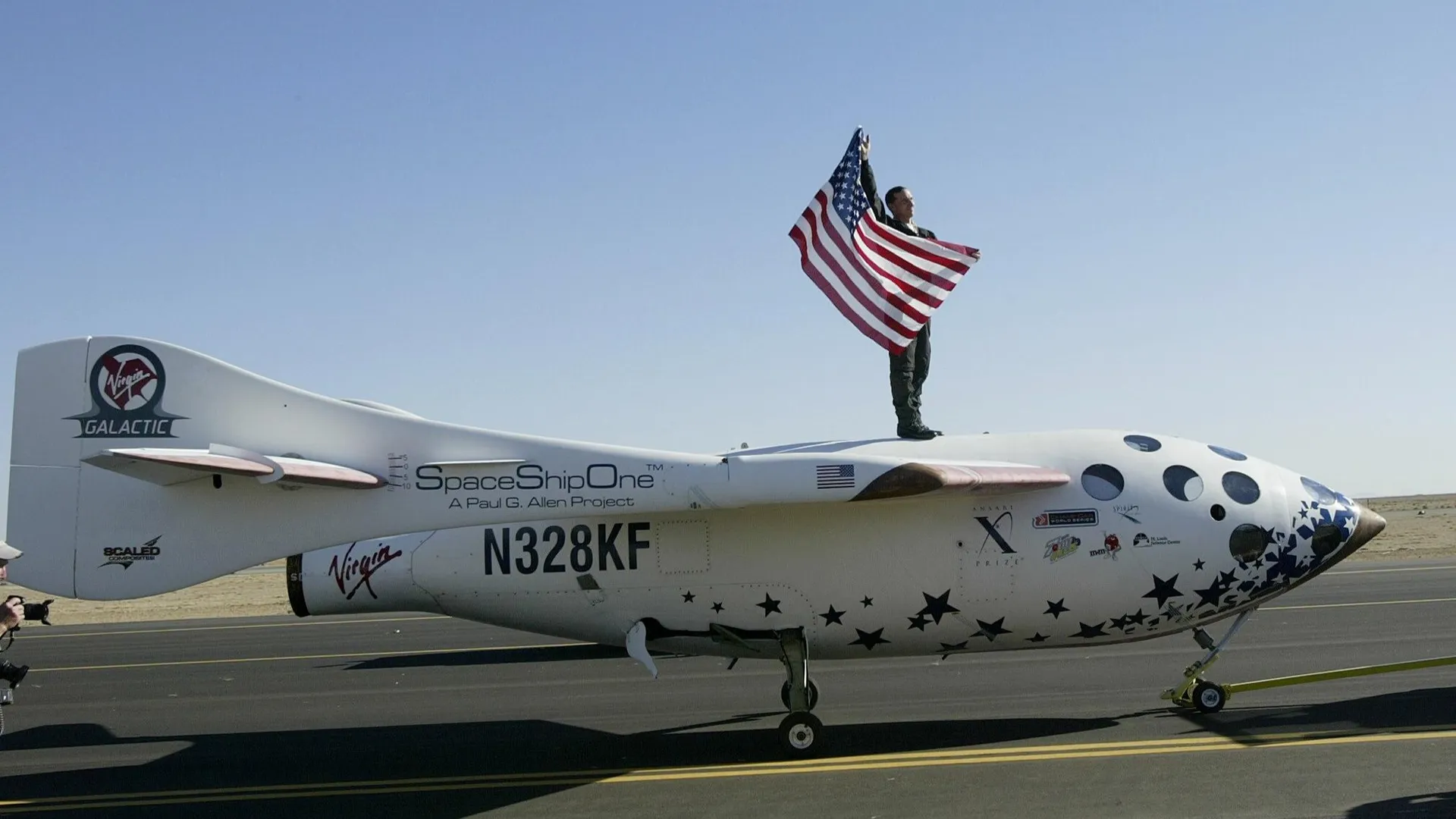
Mojave Airport is homeport for Scaled Composites SpaceShipOne, presently being readied for a June 21 mission to become the worlds first commercial piloted space vehicle. If all goes by the book, the craft will rocket to some 62 miles (100 kilometers) altitude above Earth, flying a sub-orbital trajectory above the commercial airport, followed by a glide back to a runway stop.

Call it a space travel version of early aeronautics: A mix of white scarf, goggles, and a rudder stick gripped by sweaty palms.

The point is to demonstrate that the space frontier is open to private enterprise. More to the point is that SpaceShipOne could signal a breakthrough in access to space for the "ground-bound" majority.

Meanwhile, the Mojave Chamber of Commerce is doing city business by tagging the June 21st public invited event as "Space Day". A Space Day fundraiser form has been made available for non-profit organizations in Mojave and California City to file in order to be considered for participating in the sale of souvenirs and food during the upcoming flight of SpaceShipOne. A "mandatory meeting" at the local Camelot Golf Course was recently held for all organizations interested in participating.

Woodstock of space?

At the epicenter of action, Mojave is already booked. So too are neighboring towns. Motels, hotels, recreational vehicle parking operators, restaurants, convenience stores and the like are preparing for the onslaught of ogling out-of-towners.

"Landing SpaceShipOne safely is the number one issue on our mind," said Bob Rice, Director of Airfield Operations at the Mojave Airport.

"Were dealing with parking locations right now. We can fit only so many cars. As soon as we got wind of the date when SpaceShipOne was going to fly and this was going to be a public eventI immediately opened up what I call the War Room and started assigning duties to everybody," Rice told SPACE.com.

The key is fast turn-around. That is, transforming a commercial airport to a spaceport, launch and land a spaceship, then revert quickly back to a general aviation airport, Rice added.

With the National Space Society hosting an all-night rave in celebration of the launch, the event is taking on Woodstock-like feel, where rocketry out-screams screaming guitars at the circa 1969 pop festival and concert. "Weve got plans for everything," Rice said. "And yes, there will be T-shirts."

Critical bridge

Rice is no stranger to spaceships slashing through local sky. He was the senior Air Force person accountable for handling NASA space shuttle landings at Edwards Air Force Base in the 1990s.

Rice helped write and revalidate shuttle procedures at Edwards -- including how to deal with accidents. "Landing spaceships is not new to me," Rice said, "but they each present their own unique circumstances."

How best to manage the crowd of public spectators, invited VIPs, and media is being mapped out, as is being prepared for any "incident" involving the piloted rocket plane, Rice said.

This months flight is a critical bridge to future back-to-back flights that SpaceShipOne must carry out to claim the $10 million Ansari X Prize. That cash purse will go to the first team that privately finances, builds and launches a craft able to haul three individuals up to 62.5 miles (100 kilometers) altitude, returns safely to Earth, then duplicates the flight with the same vehicle in the span of two weeks.

SpaceShipOnes upcoming excursion to the heights "is not a dry runits a wet run," Rice observed. "It will be a precursor to what the X Prize flights will be like. Much of our planning and preparation will be the same," he said.

"I never thought Id be in this position now," Rice said. "It just hasnt sunk in yetthis is awesome."

Flight day

Stuart Witt, General Manager of the Mojave Airport, is geared up for action. He has already posted an advisory notice to all concerned: "Mojave Airport will be engaged in spaceport operations June 21st with potential extensions through June 22nd. Aircraft will be PPR (prior permission required) for landing beginning June 18th"

On flight day, the White Knight carrier plane will lift SpaceShipOne from the runway. An hour later, after climbing to approximately 50,000 feet altitude just east of Mojave, the mother ship releases the rocket ship into a glide.

The spaceships pilot still to be announced is to fire the crafts rocket motor for about 80 seconds, reaching three times the speed of sound (Mach 3) in vertical ascent. During the pull-up and climb, the pilot will feel forces three to four times the gravity tug here on Earth.

SpaceShipOne then coasts up to its goal height of 62 miles (100 kilometers) before falling back to Earth. The vehicles wing and tail are then canted into a high-drag configuration. That slows the craft in the upper atmosphere and automatically aligns it along a flight path. Upon re-entry, the pilot reconfigures the ship back to a normal glider, touching down like an airplane on the same Mojave Airport runway from which it departed.

All in all, from taxi to rocket ship touchdown, the mission is slated to last roughly one hour and twenty-five minutes.

Suborbital one-upmanship

SpaceShipOnes private trek to the edge of space will earn its pilot "astronaut wings" -- a feat that mimics several of the half-plane, half-rocket flights of the X-15 decades ago.

The X-15 program was a joint effort of NASA, the USAF, and the U.S. Navy. During almost 10 years of solo X-15 flights, several of the pilots met a U.S. criterion for a spaceflight by passing an altitude of 50 miles (80 kilometers). Those individuals were accordingly awarded astronaut status by the U.S. Air Force.

Two of the X-15 pilots also qualified for recognition by the Fdration Aronautique Internationale (FAI).

As a world air sports federation, the Lausanne, Switzerland-based FAI defines the boundary of space as just over 62 miles (100 kilometers) -- a definition used by the X Prize Foundation in setting up its private rocketry contest rules.

In another early suborbital mission, back in May 1961, NASA astronaut Alan Shepard was shoe-horned into his Freedom 7 Mercury space capsule and hurled to an altitude of 116 statute miles courtesy of a Redstone rocket. That flight lasted all of 15 minutes before Shepard and spacecraft plopped down in the Atlantic, helping to pave the way for Americas entry in orbital space travel the following year.

Low-cost era in space travel

Leaving history behind, SpaceShipOnes suborbital pilot will become the first person to earn astronaut wings in a non-government sponsored vehicle, and the first private civilian to fly a spaceship out of the atmosphere.

In the past, piloted travel into space has been carried out through expensive government-led efforts, explains Burt Rutan, chief of Scaled Composites, the firm that has designed and built SpaceShipOne.

"By contrast, our program involves a few, dedicated individuals who are focused entirely on making spaceflight affordable," Rutan noted in a recent press statement. He contends that the SpaceShipOne effort will trigger the industry of private space tourism. The project is financially backed by Microsoft co-founder, Paul Allen.

"Without the entrepreneur approach, space access would continue to be out of reach for ordinary citizens. The SpaceShipOne flights will change all that and encourage others to usher in a new, low-cost era in space travel," Rutan said.


SpaceProbe 130ST EQ
$279.95
Explore More


Site Map | News | SpaceFlight | Science | Technology | Entertainment | SpaceViews | NightSky | Ad Astra | SETI | Hot Topics
Image Galleries | Videos | Reader Favorites | Image of the Day | Amazing Images | Wallpapers | Games | Community
about us | FREE Email Newsletter | message boards | register at SPACE.com | contact us | advertise with us | terms & conditions | privacy statement
DMCA/Copyright
  What is This?