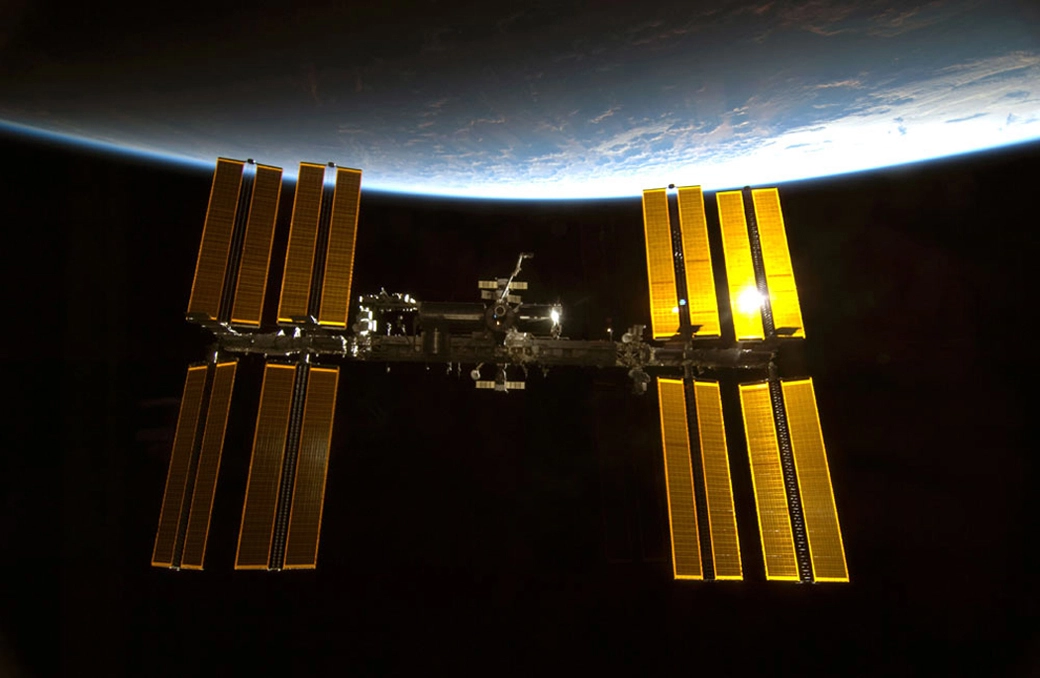
Asking the International Space Station to justify its existence is a tall order. NASA estimates the station has cost U.S. taxpayers $50 billion since 1994 — and overall, its price tag has been pegged at $100 billion by all member nations.
To put that in perspective, the Large Hadron Collider — the world's largest particle accelerator, near Geneva — was a relative bargain at a total of $9 billion, and even its contributions are likely to be too abstract to hold most people's attention.
Yet at least its research goals — it is aiming to discover new fundamental particles that will revolutionize our understanding of the nature of matter and the universe — are ones most scientists can get behind.
Now, as NASA celebrates the 10th anniversary of astronauts living on the space station — and with construction essentially complete, the question remains — will the International Space Station ever really pay off scientifically? [Graphic: The International Space Station Inside and Out]
"I think it's time to start showing what station can really do," David Leckrone, a former senior project scientist for the Hubble Space Telescope, told SPACE.com.
While the space station has taught NASA and its partners much about the science and engineering of keeping people alive in space, critics charge that the outpost hasn't led to enough advancements in basic science — including biology, chemistry and physics — that could affect life back on the ground.
Return on investment
NASA has proven that space can be fertile ground for research. Hubble revolutionized astronomy by peering farther into space than any instrument before it.
But the payoff that would come from building the telescope was clear from the beginning — free a telescope from the distorting effects of Earth's atmosphere, and sharper images will necessarily result.
The space agency contends that the weightless environment provided by the station offers a unique way of unmasking processes of cell growth and chemistry that are hidden on Earth. But some critics don't see a zero gravity laboratory as filling a crucial scientific need.
Gregory Petsko, a biochemist at Brandeis University, said the only basic science justification he has ever heard for the station is that protein molecules form superior crystals in the microgravity of space than they do on Earth. Researchers crystallize proteins in order to determine their precise three-dimensional structures, which help biologists understand the functions of those proteins.
The best-case scenario, in terms of return on investment, would be if a space-grown crystal were used to design a blockbuster pharmaceutical drug that worked by precisely targeting one of those proteins, he said.
"I haven't seen any really important structures yet that absolutely required the space station for crystal growth, and there are a heck of a lot of structures out there," Petsko told SPACE.com.
Even if the station did lead to important new crystal structures, the cost per structure would be astronomical, Petkso said. "If we assume that two percent of the cost of the space station has gone into this kind of science, that's a billion dollars with little or nothing to show for it so far."
For that amount of money, he said, NASA could have funded the work of 1,000 scientists on Earth for five years.
"Do you honestly think that this would have produced fewer important scientific findings than have come out of the space station?" Petsko said.
Time will tell
Naturally, Tara Ruttley, NASA's associate program scientist for the International Space Station, said she sees things differently. "I think those who are naysayers haven't given us a chance — haven't given us enough time to show what we can do," she said.
Standing in the way of getting much science done has been the task of assembling the station.
In February 2010, the shuttle Endeavor delivered the final two major rooms of the station, essentially completing the assembly process. A crew of six has been in place on the station since March 2009, up from two or three crew members at a time before.
"We're just now turning the path to be able to go full force on our science," Ruttley said. "In the past we had to fit it in around assembly. We didn't have the facilities available, and the crew was always busy."
Even so, Ruttley points to some successes, such as an ongoing project in which disease-causing bacteria are flown to the station so their behavior can be observed in microgravity.
In 2008, NASA scientists reported that salmonella bacteria grew more infectious in space. A company called Astrogenetix is developing a salmonella vaccine based on the finding.
Although the bacteria were grown on board the shuttle, not the space station, Ruttley said previous stages of the project did require the station.
Other recent projects are focused on the efficiency of heat transfer in zero-g, which Ruttley said could help in designing cooling systems for future space missions.
In total, more than 400 scientific experiments in fields such as biology, human physiology, physical and materials science, and Earth and space science have been conducted on the space station over the last decade.
Overcoming obstacles
Significant obstacles may stand in the way of fully utilizing the station for science.
A 2009 Government Accountability Office report noted that the retirement of the shuttles, planned for 2011, will limit launch capabilities, raising the cost of station research.
Then there's the fact that science equipment does not always behave in space as it did on the ground.
"The science racks and all the science equipment is certainly prone to breakdown or startup anomalies," said Daniel Tani, an astronaut who was part of the Expedition 16 crew on the space station between 2007 and 2008.
"We do maintenance on the science apparatus probably as much as we do on the space station itself," he said. "Unfortunately, that does eat into the time allotted on the science."
Of course, station astronauts are research apparatuses in themselves. Having crews living long-term on the ISS allows unprecedented research into the effects of prolonged weightlessness on the human body, which would be of paramount concern should NASA or another space agency ever mount a mission to Mars.
One of the major effects of prolonged weightlessness is a loss of bone density. Studying this effect could have repercussions not just for astronauts, but for osteoporosis treatments on Earth, scientists say.
In May, NASA researchers reported that astronauts who ate the most fish retained the most bone mass, suggesting that the omega-3 fatty acids found in fish might help stave off bone loss in space or on Earth. Similarly, NASA is testing the effects of drugs called bisphosphonates, which help prevent the body from absorbing bone, to see whether they might benefit astronauts.
Switching focus
After the Columbia accident in 2003, NASA switched to a more exploration-oriented focus for its endeavors. The following year, the agency adopted President George W. Bush's Vision for Space Exploration, which aimed to return humans to the moon and Mars.
As part of this mission, the space shuttle would be phased out by 2010, although NASA has pushed that date back to 2011. The International Space Station was to be allowed to re-enter Earth's atmosphere in 2016.
"I think NASA lost its vision in terms of use of the space station following the Columbia accident when the shuttle program was cast into doubt," said Leckrone, the former Hubble lead scientist. "I thought it was criminal to let it just die."
Luckily for station fans, a bill recently signed into law by President Obama has extended the life of the ISS to 2020, and cancelled the Vision for Space Exploration's moon mission, aiming instead for a trip to an asteroid by 2025.
Research on the station got a boost in 2005, when Congress designated the outpost a U.S. National Laboratory, opening its U.S. science facilities up for use by non-NASA researchers.
To help guide research on the station moving forward, Leckrone advocates forming a semi-autonomous organization within NASA that would be responsible for soliciting and choosing science proposals, as the agency did with Hubble. "The station I think is potentially very scientifically valuable," he said. "It just hasn't proven its chops as yet."
Tani said one option might be to use the station for a simulated Mars mission. "We're really trying to figure out how best to use this laboratory in space, and there are some very, very interesting ideas," he said.
Leckrone has his own dream project.
He'd like to put a new telescope in orbit near the space station, in a similarly high-inclination orbit, that would be suitable for searching out habitable exoplanets yet also be in a position to receive continual upgrades and maintenance by astronauts from the station.
In effect, station crew would serve as garage mechanics for such a telescope.
"If people start thinking creatively," Leckrone said, "you can think of a lot of things to be done on station."
- Poll: Do You Think The International Space Station is Worth $100 Billion?
- Gallery: Building the International Space Station, Space Station Video Show
- Graphic: The International Space Station Inside and Out