This story was updated at 12:32 p.m. EDT, May 10.
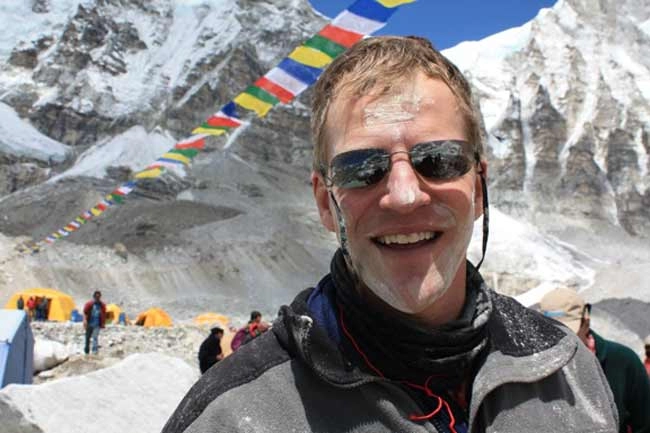
If all goes according to schedule, Scott Parazynski will reach the top of the world sometime over the next week or so.
Parazynski won't be the first person to reach the top of Mount Everest, the highest mountain on Earth; Edmund Hillary and Tenzing Norgay have held that record since 1953. He won't even be in the first 1,000; more than 1,400 have summited over the past 56 years.
But should Parazynski reach the top, he will be the first person to do so having first had the opportunity to see Everest from as much as 40 times higher than its 29,000 foot peak.
Going where no astronaut has gone before
Separating Parazynski from the climbers that preceded him is his former profession: astronaut. A veteran of five space shuttle missions, Parazynski left NASA in March, just before departing to Everest.
"The timing of this expedition, it is a very nice transition event," Parazynski told collectSPACE.com prior to leaving for the mountain, adding that the decision to retire from the space agency was "mostly separate" from the excursion.
That said, Parazynski sees parallels between the climb and the seven spacewalks he made during his career in orbit.
"The workload of carrying your body out along the summit ridge of Everest or any major mountain is enormous, so the metabolic workload is much tougher mountaineering, but I think there are a lot of similarities in terms of the actual technique. You're working with fixed lines, you're wearing big heavy mitts similar to EVA gloves, you've got oxygen on, you've got a very limited field of view, you've got a down suit on and a hood on with goggles, so it is similar in many regards to the [spacesuit helmet's] visor," he explained. "And your focus and intensity going out and doing that is very similar."
During his last spacewalk in November 2007, Parazynski was tasked with repairing a torn solar array, riding at the end of a long boom attached to a robot arm. Soaring over the International Space Station, his view of the Earth and outpost below was unique to past EVAs, which tended to stay closer to the station's structure.
"The summit of Everest will have a hard time competing with the view from the boom!" radioed Mission Control in Houston. They were not however, referring to this current climb; rather, they were foreshadowing Parazynski's then upcoming first attempt at Everest.
Parazynski almost became the first astronaut to summit Everest one year ago this month when he ruptured a disc in his back.
"I was within a day of topping out. I could see the route," he described. "Up to that point, I had been climbing so well, very strong, one of the fastest Westerners climbing on the hill."
So close to the peak, Parazynski made the tough choice not to push through the pain and descended. "By the time I arrived at base camp, I already knew that I had to come back."
The only other astronaut to attempt Everest was not as fortunate to have a second chance. On October 5, 1993, Karl Henize died of respiratory and heart failure while attempting to summit the north face of the mount. Buried at 22,000 feet, Henize had flown one shuttle mission and earlier served on the support crew for the fourth manned lunar landing. He was 67.
Surgery having mended his back, Parazynski hopes that taking additional care will allow him to not only reach the summit for himself, but also deliver a replica of the patch that Henize wore in space, as well as Tibetan prayer flags for the astronauts and cosmonauts who were lost during the pursuit of space exploration.
Continue reading at collectSPACE.com how Parazynski's payload will seek out new life on Everest.
Learn more about Scott Parazynski's summit attempt at OnOrbit.com and follow him at @SPOTScott on Twitter.
- Image Gallery: Expedition Everest
- Astronaut Biography: Scott. E. Parazynski
- Complete Space Shuttle Mission Coverage