


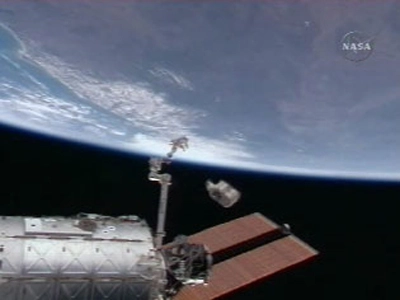
A piece ofspace trash the size of a refrigerator plunged into the Earth?s atmosphere lateSunday to burn up over the southern Pacific Ocean, more than a year after anastronaut tossed it off the International Space Station, NASA officials saidtoday.
Spacestation program manager Mike Suffredini told reporters the orbitaltrash, a 1,400-pound (635-kg) tankof toxic ammonia coolant, slammed into the Earth?s atmosphere at analtitude of about 50 miles (80 km) as it flew above the ocean just south of Tasmania.
?Whatdebris may have been still together after re-entry, it fell into the oceanbetween Australia and New Zealand,? Suffredini said during a NASA briefing. ?Iknow a lot of folks were wondering what the end result of that was.?
NASAexpected up to 15 pieces of the tank to survive the fiery plunge, ranging insize from about 1.4 ounces (40 grams) to nearly 40 pounds (17.5 kg). The largestpieces, if they survived, may have hit the ocean at speeds of up to 100 mph(164 kph).
The U.S.Space Surveillance Network kept a close watch on the ammonia tank for NASA aspart of its ongoing effort to monitor the thousands of piecesof orbital debris circling Earth.
Known as anEarly Ammonia Servicer (EAS), the coolant tank was the largest piece of trashever disposed of by hand from the space station. NASA astronaut ClaytonAnderson junked the tank while wearing a spacesuit and standing at the tip ofthe station?s Canadian-built robotic arm during a July 23, 2007 spacewalk.
?We?rereally fortunate to be able to track objects to a fairly small size,?Suffredini told SPACE.com before the ammonia tank re-entered, addingthat the ammonia tank was rather large and easy to track.
NASA takesgreat care to ensure that any trashtossed overboard from the space station does not endanger other spacecraftor people on Earth, he added.
Theobsolete tank had served as a spare reservoir of ammonia coolant for the spacestation in case of leaks since 2001, but was no longer required afterastronauts activated the outpost?s main cooling system in early 2007. Butbecause the tank was so old, engineers were worried its structural integritywouldn?t hold during a return to Earth aboard a NASA shuttle.
Insteadthey asked Anderson to toss it during a spacewalk dedicated to discarding oldequipment. He also jettisoned a 212-pound (96-kilogram) video camera stand, butthat item burned up in Earth?s atmosphere earlier this year.
?I justlike it when they?ve re-entered and it?s not a problem,? Suffredini said."One of the big concerns for any orbiting pressurized spacecraft isorbital debris.?
- Video - The Fiery Demise of Europe's Jules Verne Spaceship
- Video - Suborbital Rocket Test Explodes
- 10 Most Memorable Pieces of Space Debris
