





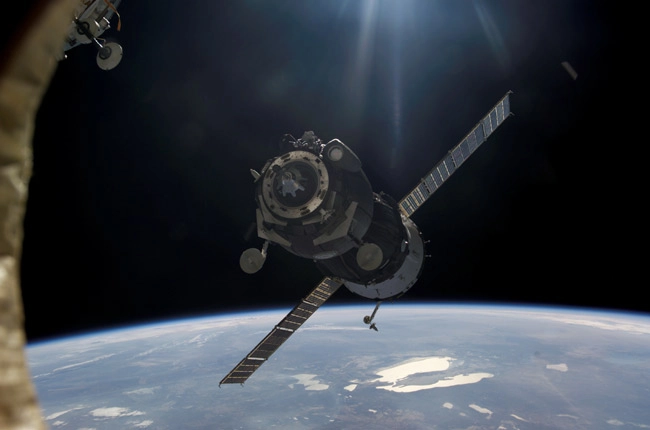
WASHINGTON — NASA now has the legal ability to conclude anew deal with Russia for the three-person Soyuz vehicles it will need to ensureU.S., Canadian, European and Japanese astronauts can fly to the International SpaceStation beyond 2011.
The permission to move ahead with a new deal with Russia was included in a massive temporary spending measure U.S. President GeorgeW. Bush signed into law Sept. 30 to keep the government operating at currentspending levels until March.
NASAhas been prevented from negotiating anew Soyuz deal by a 2000 weapons proliferation law that bars buying spacestation-related goods and services from Russia so long as its aerospacecompanies continue to aid Iran.
Whilethe U.S. Congress granted NASA temporary relief from the Iran-North Korea-SyriaNonproliferation Act (INKSNA) in 2005, that only cleared the way for NASA toconclude a $700 million-plus deal with Russia for periodic Soyuz and unmannedProgress re-supply flights to the International Space Station through 2011.
Withthe U.S. space shuttle due to retire in 2010 and its NASA-designed successor,the OrionCrew Exploration Vehicle and Ares I rocket due to enter service before2015, NASA officials have been pressing U.S. lawmakers all year to grant a newwaiver.
Attemptsto amend INKSNA through a stand-alone bill that would have limited NASA'spost-2011 Russian spacecraft purchases to crewed Soyuz vehicles faltered afterRussia invaded neighboring Georgia in August. Shortly after the invasion, thebill's main congressional proponent, U.S. Sen. Bill Nelson (D-Fla.) declaredchances of passage all but dead.
Aseries of last minute developments, however, combined to help win NASA theSoyuz waiver agency officials arguedit desperately needed if the United States wished to continue to use the$100 billion space station beyond 2011. On Sept. 22, the INKSNA issue was givennew prominence when Democratic presidential candidate Barack Obama, a senatorfrom Illinois, wrote House and Senate leadership urging passage. The next day,the Senate Foreign Relations Committee, normally chaired by Obama's runningmate Sen. Joseph Biden of Delaware, approved the International Space StationPayment Act of 2008 (S. 3103), clearing the bill for the full Senate'sapproval.
Thatparticular bill, which would have limited NASA's authority to buy Soyuzvehicles, went no further. Instead a simple extension of the current waiver wasincluded in a massive temporary spending measure, known as a continuingresolution, that the House of Representatives passed Sept. 24 by a vote of370-58. The Senate followed suit Sept. 27, clearing the way for theConsolidated Security, Disaster Assistance and Continuing Appropriations Actfor 2009 (H.R. 2638) to be signed into law by Bush.
Inaddition to permitting NASA to buy Soyuz and Progress spacecraft through 2016,the bill also keeps most federal agencies funded at their 2008 levels for thefirst five months of the new budget year, which began Oct. 1.
NASAofficials have been bracing for months for having to get buy without a budgetincrease for all or part of 2009. NASA's 2008 budget was $17.3 billion.
- NASA's Space Shuttle: The Final Missions
- Video - NASA's Constellation Journey Begins: Part 1, Part 2
- Video - Back to the Moon with NASA's Constellation