


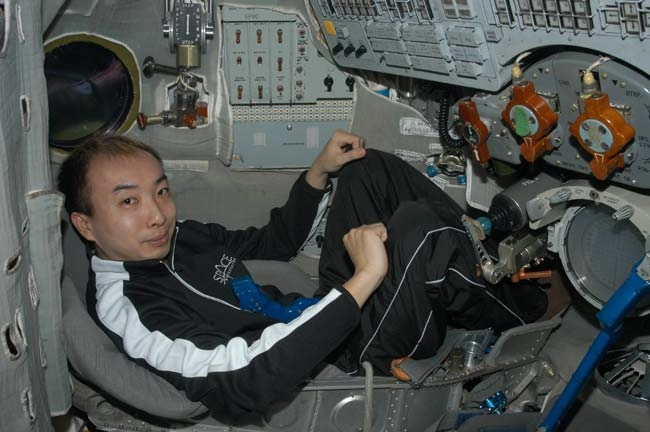
A $21 million dispute over a space tourism trip that neverhappened is set for a Nov. 21 hearing in U.S. District Court in Alexandria, Va.
Japanese businessman Daisuke Enomoto is suing Vienna,Va.-based Space Adventures to recoup $21 million he paid for a flight to theInternational Space Station before he was medicallydisqualified because of kidney stones. Space Adventures commercially marketsspaceflights on Russian-built Soyuz spacecraft in partnership with the RussianSpace Agency.
Three weeks before Enomoto was scheduled to lift off aboarda Soyuz, a Russian medical team said he was not qualified for spaceflight,despite being cleared two weeks earlier, according to his lawsuit.
The lawsuit implies Enomoto was replaced by a Space Adventuresinvestor because he refused to commit to future investments and demanded arefund for money he spent on a spacewalk before changing his mind.
Space Adventures denies Enomoto?s accusations, saying he isa successful businessman who should have understood the contract onlyguaranteed a refund if Space Adventures or the Russian Space Agency failed toproduce a spaceflight or defaulted on the contract. The company could not haveforeseen a reoccurrence of kidney stones, and Enomoto also knew about hismedical condition, Space Adventures attorneys said in their motion to dismissthe lawsuit.
In a written statement, the company said there are noguarantees in the risky business of spaceflight. ?Because withdrawal fromflight at the last moment might mean Space Adventures would lose theopportunity to resell the seat, or have to sell it at a very low price, aClient is not entitled to a refund, and is liable for the full amount of thecontract once he has reached a specified point in the process,? the statementsaid. ?A Client cannot simply circumvent this provision by medicaldisqualification, whether self-induced by failure to follow a medical regimenor not. Medical status is a risk that is borne by the Client in this type ofcontract.?
Enomoto paid $14 million of the $20 million agreement forthe spaceflight and an additional $7 million for aspacewalk he said was critical to his decision to continue with the spacemission. Enomoto argues Space Adventures misled him early on about thelikelihood of a spacewalk and pressed him to make payments that locked him intothe $20 million contract despite known problems with kidney stones dating backto 2004.
The lawsuit also says Space Adventures took the unusual stepof namingAmerican entrepreneur Anousheh Ansari to be his backup after her family invested in SpaceAdventures, and notes the timing was in tandem with collapsing negotiationsover the spacewalk. Ansari replaced Enomoto when he was disqualified for theSeptember 2006 mission.
Space Adventures, in the prepared statement, said Enomotoaccepted monthsof specialized training and made payments on the contract with fullunderstanding of the terms.
?He is not entitled to any refund and he must be held to payfor the flight he did not take,? the statement said.
Enomoto was to be the fourth space tourist to travel to theInternational Space Station on a Russian-built Soyuz. He signed an agreementwith Space Adventures in November 2004 for the flight, and a NASA physician atJohnson Space Center in Houston who evaluated him the same month identified hiskidney stones and a soft tissue mass at the base of his neck, his lawsuit says.
Doctors for the Russian Space Agency, physiciansrepresenting five international space station partners and specialists inMoscow, England and Japan continued to evaluate Enomoto during the next 21months. Doctors said a benign brain mass posed no risk and treated him for thekidney stones, according to the lawsuit.
Eric Anderson, president and chief executive of SpaceAdventures, told Enomoto that doctors had reported Enomoto was not adhering tosubscribed treatment, according to Enomoto?s lawsuit.
Enomoto alleges Space Adventures knew kidney stones woulddisqualify him for a trip to the international space station, but ?deceptivelyand fraudulently? convinced him to continue making payments. Under terms of thecontract, Enomoto paid a $2 million nonrefundable down payment and was to makethree $6 million installments. Upon the first $6 million payment, the fullamount of the $20 million contract became nonrefundable.
Enomoto, however, charges that Space Adventures led him tobelieve he would be able to conduct a spacewalk during his international spacestation mission for an additional $10 million but produced three versions of acontract addendum that he refused to sign. Enomoto objected to wording thatsaid the $10 million was nonrefundable and left the spacewalk decision entirelyto the Russian Space Agency. He believed the $7 million he paid for thespacewalk should have been applied to the remaining $6 million he owed for thespacewalk, according to the lawsuit.
- Images - First Female Space Tourist Prepares for Launch
- Video - Space Station Acrobatics
- Anousheh Ansari: First Female Private Spaceflyer Visits ISS