


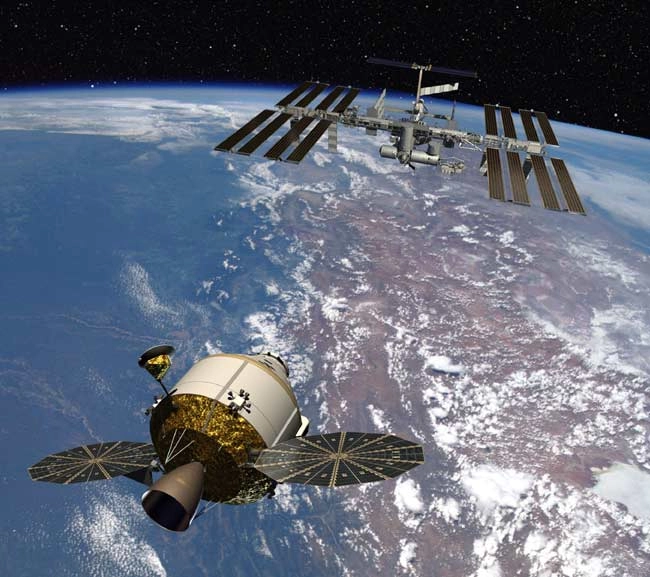
NASAAdministrator Mike Griffin told a Senate panel Thursday that the United States could field the Orion Crew Exploration Vehicle and its Ares I launcher withinthree years of the space shuttle's retirement, but meeting that earlierdelivery date would require an extra $2 billion over the next couple of years.
"WhenI came on board it would have been possible, given the necessary budgetaryresources, to retire the shuttle at the end of 2010 and deploy Orionin 2012. Time has passed and that is no longer possible. The earliest wecould technically to do it today is September of 2013 ? absent crash efforts," Griffin told the Senate Commerce space and aeronautics subcommittee. Thetwo-hour hearing was devoted to the issues facing the U.S. space program after the shuttle's retirement.
NASA ispreparing to retire its three remaining space shuttle orbiters in late 2010after completing on-orbit assemblyof the International Space Station and sending up two dedicatedshuttle-loads of critical spare parts. After that, the United States could lacka home-grown means of reaching the space station until Orion and Ares arebrought on line in March 2015, the earliest date NASA says it reasonably canguarantee despite budgeting nearly $23 billion for the Constellation effortover the next five years on top of the roughly $5 billion it has spent so far.
Hoping tobridge that gap by buying space transportation services from U.S. firms, Griffin explained that NASA is spending $500 million over the next couple of years tosubsidize development of new commercial cargo- and crew-delivery systems.
But with noguarantee that any of the commercial ventures will pan out, NASA is paying Russia to transport U.S. astronauts and their supplies to the station during the gap and is preparedto pay the European and Japanese space agencies to make additional cargo runsif needed.
Griffin also reminded the subcommittee thatthe only reason NASA is permitted to buy Progress andSoyuz rides from Russia is because Congress granted the space agencytemporary relief from the Iran-Syria Non-Proliferation Act, which restrictsNASA's purchase of space station-related goods and services from Russia. Unless Congress renews the relief it granted in 2005, NASA will not be allowed tobuy Russian rides after 2011. If U.S. firms are not ready to transportastronauts to the station between 2012 and Orion's debut in 2015, Griffin said, NASA either would have to seek permission to buy more Soyuz or keep itsastronauts on the ground for a few years.
The twostaunch human spaceflight supporters who presided over the hearing, Sens. BillNelson (D-Fla.) and Kay Bailey Hutchison (R-Texas) were not pleased with Griffin's assessments. Nelson called NASA's reliance on Russia especially "perilous"in light of the chilling relationship between Washington and Moscow.
"Cananybody in America predict the geopolitics of Russia in 2012 particularly givenwhat we see are the actions of Vladimir Putin right now?" Nelson said.
"Andhere we have a plan set up by NASA that is going to rely on us paying forRussian vehicles at the same time that we are laying off maybe 5,000 people atthe Kennedy Space Center," Nelson said, adding that there is no guaranteeRussia will sell the United States Soyuz vehicles at any price in 2012 giventhe unpredictable and worrisome turns that nation is taking.
'I don'twant to leave this committee with the impression that we are in a goodposition. We are not," Griffin said, adding he finds it "unseemly inthe extreme" that the United States very soon could find itself dependenton another nation for putting its astronauts in orbit. But, Griffin said, NASAis doing the best it can within its existing $16.5 billion annual budget.
He alsochallenged Nelson's assertion that 5,000 of the roughly 15,000 civil servantsand contractors that work at Florida's Kennedy Space Center would lose theirjobs once the shuttle retires, calling the estimate "on the high side."
Still, heacknowledged that there would be layoffs and said NASA is identifying new rolesand responsibilities for Kennedy to blunt the impact of losing the shuttleprogram.
Turning thetopic to money, Hutchison asked how much NASA would need to reduce the gap betweenthe last flight of the shuttle and the first flight of Orion and Ares.
RichardGilbrech, NASA associate administrator for exploration systems, told thesubcommittee that shaving 18 months off Orion and Ares' development is stilltechnically achievable but would cost an extra $1 billion in 2009 and again in2010. Bringing the delivery date back inside 2014, Gilbrech said, would requirean extra $350 million in 2009 and $400 million in 2010 – roughly the budget oftwo moderately-priced space science missions.
Hutchison,a member of the Senate Appropriations Committee, said she was interested infinding NASA the extra money it would need to narrow the gap and would bewilling to examine a combination of new money and cuts to other parts of theagency's budget to get the job done.
"Iwould like to look at that, because it's a worthy goal," Hutchinson said. "Iwould think this would be a priority the president and the American peoplewould think would be a worthy goal."
ButHutchison also disclosed during the hearing how tough finding extra money canbe.
Hutchison,along with Sen. Barbara Mikulski (D-Md) and several other co-sponsors, managedto get a spending bill through the Senate this year that would increase NASA's2008 budget by nearly $2 billion over current levels, including a one-time $1billion cash infusion to help the agency financially recover from the 2003Space Shuttle Columbia Accident.
Hutchison,however, said the extra $1 billion does not look like it will survivelegislative conference with the House, which passed its own NASA spending billover the summer.
"Youknow that I along with Sen. Mikulski tried to put $1 billion into this year'sappropriation, which at this point does not appear to be successful in theconference committee," Hutchison said.
- VIDEO:A New Era of Exploration with NASA's Orion and Ares
- IMAGES:NASA's Next Spaceship
- NASA's SpaceShuttle Successor Could Fly in 2013, Officials Say