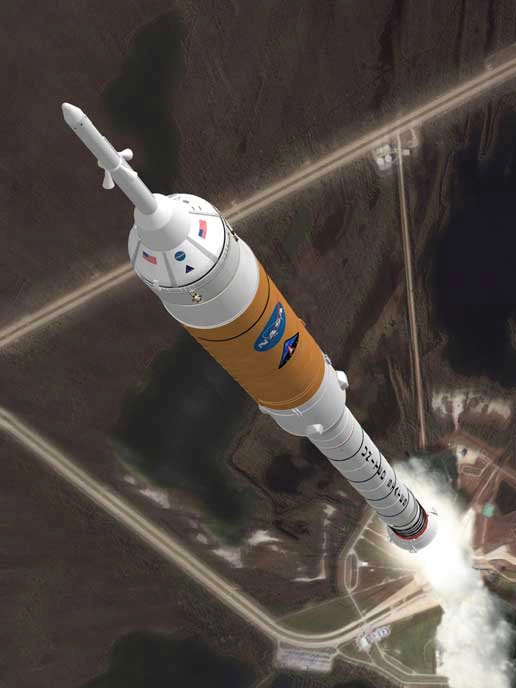
WASHINGTON-- NASA and Alliant Techsystems (ATK) have finalized a no-bid contract worth$1.8 billion to design and develop the main stage of the Ares I rocket thatwill boost the agency?s planned Orion Crew Exploration Vehicle into orbit fortrips to the international space station and eventually the Moon.
The firststage of the Ares Irocket, currently under development at NASA?s Marshall Space Flight Centerin Huntsville, Ala., is a five-segment version of the solid-rocket boostersthat ATK builds for the space shuttle.
Measuring164 feet (50 meters) in height and 13 feet (four meters) in diameter,the Ares I first stage will tip the scales at 1,288,912 pounds (630,000kilograms), with nearly 90 percent of that weight coming from the rubber-likesolid propellant that runs up the center of the booster. Taller and morepowerful than the twin boosters that helped lift space shuttle Endeavour on itsAug.8 mission to the International Space Station, Ares I?s five-segment boosterwill produce 3.6 million pounds of thrust, accelerating the rocket to 4,473miles (7,200 kilometers) per hour in just 2 minutes before the rocket?s J-2X-poweredupper stage takes over to carry Orion the rest of the way to orbit.

Thecost-plus contract runs through 2013 and calls for ATK Launch Systems ofBrigham City, Utah, to build eight boosters: five that will be used in groundtests starting in 2009 and three that will be used in flight tests beginning in2012, according to Tom Williams, NASA?s deputy program manager for the Ares Imain stage.
Inaddition, Williams said, ATK will provide two partial boosters for vibrationtesting and will support an early flight test ? dubbed Ares I-X ? of afour-segment space shuttle solid-rocket booster topped with an inert fifthsegment.
After AresI-X in April 2009, NASA plans to fly its first five-segment Ares I booster inSeptember 2012 on a suborbital trajectory. Approximately six months later, AresI will conduct its first orbital test flight, carrying an unpiloted Orioncapsule into space. The first crewed test flight of Ares and Orion is slated forSeptember 2013. Steve Cooke, director of Marshall?s Exploration LaunchProjects office, said Orion would visit the space station during that plannedtwo-week shakeout flight.
ATK was selectedto build the Ares I first stage in December 2005 and had been working sincethen under a provisional contract. NASA and ATK finalized negotiations onlong-term contract July 13 and signed the deal Aug. 10 at the U.S. space agency?s headquarters here, NASA officials said.
Productionof Ares I main-stage boosters needed for flights beyond the test program willbe covered under a separate contract that NASA and ATK will not begin to negotiateuntil 2009 or 2010, Cooke said. ?That?s down the road a bit,? he said.
Once inservice, Ares I is expected to launch twice a year to deliver Orion and itssix-person crews to the space station.
NASA alsointends to use the five-segment boosters in pairs to help lift Ares V, themassive rocket being planned to launch the lunar landers and other hardwareneeded to sendastronauts to the Moon starting around 2020.
Once thosetwice-a-year lunar sorties begin, NASA anticipates buying around six flightboosters a year: two for each Ares V mission and one for each Ares I that liftsoff. While such lunar missions are still a ways off, Jeff Hanley, NASA?sConstellation program director, said the work NASA is doing on Ares I is layingimportant ground work for the future.
?Theinvestments we are making today are investments in the program to sendastronauts back to the Moon. We are building parts of the Ares V vehicle now,in fact some of the most important parts,? Hanley said. ?So it's part of along-term set of choices we are making to get us on the path to getting back tothe Moon.?
In additionto the solid boosters, the Aries V also will incorporate the J-2X upper-stageengine, which is being developed by Pratt & Whitney Rocketdyne of CanogaPark, Calif.
Meanwhile,ATK expects to learn by the end of August it will have a major role indeveloping the Ares I upper stage. ATK is teamed with Lockheed Martin SpaceSystems of Denver and Pratt & Whitney Rocketdyne for the contract; thecompeting team is led by Boeing NASA Systems of Houston.
Thatcontract, which requires the winning team to use the Michoud Assembly Facilityin New Orleans to build the upper-stage hardware, is expected to be wortharound $900 million.
- VIDEO: A New Era of Exploration with NASA's Orion and Ares
- IMAGES: NASA's Next Spaceship
- NASA's Space Shuttle Successor Could Fly in 2013, Officials Say