


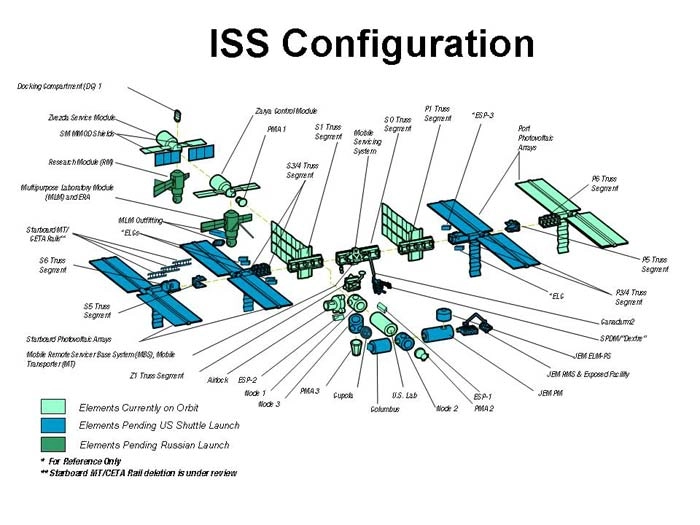
NASA and itspartner agencies have set a new plan to complete the International Space Station(ISS) by 2010, delaying science utilization to make way for 16 shuttle flightsto piece together the orbital laboratory.
Assembly ofthe $100 billion spacestation is expected to resume in late August during NASA's STS-115 missionaboard the Atlantis orbiter. But that spaceflight depends on the results of the spaceagency's STS-121return to flight mission expected to launchin May, NASA chief Michael Griffin told reporters Thursday.
"We arelargely deferring utilization and we are paring logistics to the bone," Griffinsaid during a press conference at NASA's Kennedy Space Center in CapeCanaveral, Florida. "We don't like that. But confronted with a choice betweenhaving a high confidence to complete the assembly of the station...or utilizingit heavily as we built it and possibly not finishing, we chose the formercourse."
NASA hasuntil the end of the fiscal year in 2010 - when its three remaining shuttlesare due for retirement - to complete its role in the ISS assembly plan. Majorconstruction has been sidelinedsince the 2003 Columbiaaccident.
A 17thshuttle flight could servicethe Hubble Space Telescope in orbit in early 2008, Griffin said.


Earlierlab launches
Among the largerrevisions for ISS assembly are earlier flights for the large station modulesbuilt for Japan and Europe. [NASA's complete ISS assembly manifest is availablehere].
NASA nowplans to launch the European Space Agency's (ESA) billion-dollarColumbus laboratory on the seventh shuttle flight, ESA officials said.
"Weappreciate the priority that all the partners, and especially NASA, have put onthe Columbus module," ESA director-general Jean-Jacques Dordain said.
The firstof three components for the JapaneseExperiment Module (JEM) - or Kibo - are slated for 2007, one flight earlier,during the eighth scheduled orbiter mission, said Keiji Tachikawa, head of the JapanAerospace Exploration Agency (JAXA). The remaining two components are set forthe ninth and twelfth shuttle missions, he added.
The station'screw size - limited to two astronauts since the Columbia accident - is expectedto return to a standard three-person complement with the arrival of ESA astronautThomasReiter during the STS-121 flight this summer, Griffin said. By 2009, thestation should be ready to support its intended crew of six astronauts, headded.
The new ISSassembly plan also anticipates the arrival of unmanned cargo shipments aboardRussia's Progress vehicles, ESA's AutomatedTransfer Vehicle - the first of which is slated for 2007 - and Japan'sunmanned HTV supply ship.
Resumingconstruction
NASA's threespace shuttles - Atlantis, Discovery and Endeavour - are the only vehiclescapable of delivering major components to the ISS, including the requiredtrusses, solar arrays and modules that make up the orbital laboratory.
Somecomponents have been dropped from the launch manifest, among them, aRussian-built solar power platform and centrifuge module built for NASA by JAXA, though much of the station's intended hardware will fly.
"It's thesame space station [as envisioned], the hardware all goes up," Griffin said. "Ourearly plans, which were better plans frankly, allowed us to utilize it while wewere building it."
During the two-and one-half years NASA spent recovering from the 2003 Columbia accident,Russia's Federal Space Agency supported the ISS with a lifeline of unmannedProgress cargo ships and steady launches of crew-carrying Soyuz spacecraft.
The nextISS crew, Expedition13 commander Pavel Vinogradov and flight engineer Jeffrey Williams, is setto launch toward the station on March 29 EST with Brazil'sfirst astronaut Marcos Pontes. The current crew, Expedition12's Bill McArthur and flight engineer Valery Tokarev, will jettison a usedProgress19 cargo ship early Friday, NASA officials said.
"I haveproposed to make a stock of...Soyuz and Progress vehicles," Russia's space agencychief Anatolii Perminov said.
ISS 2015and beyond
Perminovsaid Russia's Federal Space Agency has agreed to draw on the station's U.S.-builtpower system for some components through 2015 - in lieu of its solar powerplatform - and has proposed plans to continue ISS operations into 2016 andbeyond.
"If NASAdecides to leave the [ISS] program after 2015, and if all the modules andsystems are in place, technically it will be feasible to continue the spacestation," Perminov said, adding that all focus is currently on the upcomingSTS-121 mission.
Griffin saidthat it was too early to speculate what NASA and the ISS program will do in2016, adding that if the U.S. space agency holds to its present course, and nomajor problems arise, there should be ample time to complete the station beforethe shuttle fleet's 2010 retirement.
"We havesubstantial schedule slack, in fact almost a full year, to complete thestation," Griffin said.
