


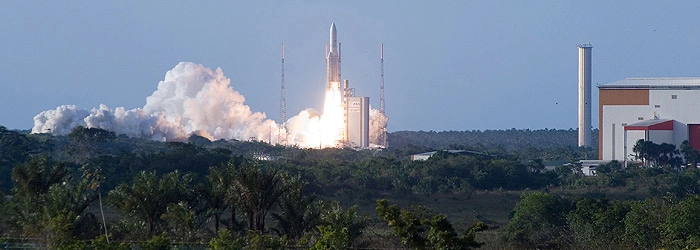
Europe's workhorse Ariane 5 rocket took off from a SouthAmerican space base Thursday on its third launch in barely two months, thistime with Japanese and U.S. television broadcasting satellites.
The rare daytime launch occurred at 2044 GMT (4:44 p.m. EDT)from the GuianaSpace Center along the northeast coast of South America.
Officials were greeted with "Chamber of Commerce"weather at the launch site, and the rocket darted through a clear blue skybefore shedding its two solid rocket booster casings and disappearing fromview.
The Ariane 5's cryogenic first and second stages propelledthe mission's payloads into an elliptical geosynchronous transfer orbitstretching from a low point of 155 miles to a high point of about 22,277 miles.The orbital inclination was targeted for two degrees, slightly lower thantypical Ariane transfer orbits to reduce payload fuel consumption, according toArianespace.
The rocket unleashed the 10,626-pound Japanese Superbird 7satellite about 26 minutes after liftoff. After jettisoning a dual payloadadapter, the stage released the smaller AMC 21 to complete the Ariane 5's fifthmission of the year.
"I think it is a perfect illustration of the fact thathigh performance, reliability and increase of pace can go hand-in-hand,"said Jean-Yves Le Gall, Arianespace chairman and CEO.
Le Gall said Thursday's flight was the ninth for the Ariane5 in the past 12 months. Two more launches are planned in October and Decemberto complete the year.
"I feel a great sense of relief now that it's off theground and we got both satellites separated," said Rick Starkovs, vicepresident and general manager of space systems and operations for SESEngineering, a unit of AMC 21's operating company.
AMC 21 will enter service next month to begin a missionprojected to last up to 15 years. The satellite will introduce Ku-bandcommunications coverage to a new SESAMERICOM operating base at 125 degrees west longitude in geosynchronousorbit.
The spacecraft carries 24 active Ku-band transponders andtwo reflector antennas to beam television broadcasts across the United States, Canada, Mexico, Central America and the Caribbean. AMC 21 will be the new home of thePublic Broadcasting Service, in addition to other networks, according tosatellite officials.
The AMC 21 communications payload was built by Thales AleniaSpace. Orbital Sciences Corp. provided the satellite's Star 2 bus in a contractwith Thales, also the craft's prime contractor.
AMC 21 joins 15 other satellites in SES AMERICOM's fleetcovering the Americas.
"We're adding more besides this one," said DennisHuyler, AMC 21 launch program manager for SES Engineering. "We have twomore launches later this year and a few more next year."
Superbird 7 will next boost itself to a circulargeosynchronous orbit along the equator at 144 degrees east longitude. Thesatellite will begin operational service for Space Communications Corp. of Japan after about two months of testing.
The spacecraft will be renamed Superbird C2 at the beginningof its 15-year lifetime.
Superbird 7 will replace Superbird C, an 11-year-oldsatellite nearing the end of its design life. The new craft includes 28 Ku-bandtransponders to provide broadband Internet connections and high-definitioncable and direct television broadcasts to customers in Japan, East Asia and the Pacific Ocean.
Superbird 7 is the first satellite to be launched by a Japaneseoperator since the country's three leading satellite communications companies- Sky Perfect Communications, JSAT Corp. and SCC - merged to form Sky PerfectJSAT Corp.
"The success of the Superbird 7 launch is veryimportant for the new integrated company as a basis to accelerate the growth ofglobal satellite communications (in Japan)," said Yukata Nagai, SCCpresident and CEO.
Based on the DS 2000 platform by Mitsubishi Electric Corp.,Superbird 7 is the first Japanese-owned commercial satellite to be manufacturedby a Japanese contractor. Earlier satellites for Japanese operators were builtby U.S. companies, officials said.
"I hope such made-in-Japan satellites will be morewidely accepted in the world satellite market from this success on," Nagaisaid.
- Video Player: Japan?s First Space Module
- Video Player: "Jules" heads to the ISS
- Space Shuttle Mission Loaded with 'Hope'