





When it comes to long life, NASA's Mars rover Opportunity takes after its robotic twin Spirit.
Today Opportunity officially hit the one-year mark in its mission to explore Mars and send home data about the red planet's conditions and its history of water. The longevity of the two rovers -- Spirit celebrated its own one-year anniversary on Jan. 3 -- has been a stunning success for rover scientists and engineers, who originally planned for just a 90-day mission.
"This whole mission has surpassed all of our expectations," said Steven Squyres, principal investigator for the rover mission at Cornell University.
Opportunity landed at Meridiani Planum at 12:05 a.m. EST (0505 a.m. GMT) on Jan. 25, 2004, though it was still late Jan. 24 at NASA's Jet Propulsion Laboratory (JPL) in Pasadena, California where the mission was being managed. Squyres said the entire rover team, including managers, engineers and scientists, planned a one-year celebration Monday night during a two-day mission science meeting at JPL.
But while Squyres said he looked forward to anniversary party, he is still waiting for Jan. 31. It was on that day in 2004 that Opportunity rolled off its landing platform and planted six wheels in Martian soil, he told SPACE.com.
"I've always felt that we had six terrifying events in this mission; two launches, two landings and two egresses," Squyres said. "And it wasn't until both [rovers] were in their native environments on Mars, for me, that I could really feel like I could breathe a sigh of relief."
Only a few major glitches have plagued Opportunity, including a stuck heater, which was a glutton for power early in the mission but circumvented later by the addition of a "deep sleep" mode during a software update. The rover's rear hazard-identification camera has also suffered some minor mottling in images due to dust picked up during recent investigations of its heat shield, JPL officials said.
A flood of science
Both Spirit and Opportunity have returned a wealth of data back to Earth, but rover scientists concur that Opportunity has made the lion's share of Mars science discoveries.
"When you look at the most important accomplishments of the mission, a lot of them were due to Opportunity," Squyres said. "It was the one that found the really powerful evidence for a habitable environment in Mars' past. It's sort have been the good luck rover for this whole thing."
It was Opportunity's studies at its initial landing site Eagle Crater that gave scientists conclusive proof that the region had once been drenched in liquid water. Scientists now believe that Opportunity's Meridiani Planum landing zone supported a habitable environment and possibly a salty sea.
Matt Golombek, a rover scientist at JPL, spent years working to pinpoint Opportunity's landing site.
"There, we have been extraordinary," Golombek said in a telephone interview. "But we've only been able to look at a section of rock maybe 10 meters thick, and we want to know how do these rocks relate to what's above and beneath them."
Mars rocks have not been the only target for Opportunity's panoramic sights. The rover has also been able to swing by its own heat shield, which it cast off during the fiery entry into Mars' atmosphere. Opportunity's images and data taken of the scorched and twisted debris may help engineers develop better heat shields for future missions, NASA officials said.
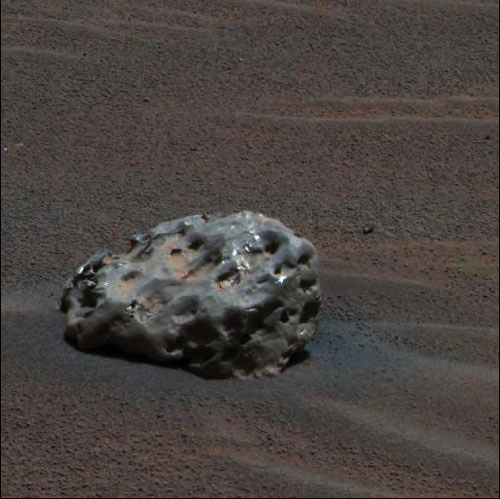
The rover has also stumbled upon an iron meteorite, the first ever found on another world, which has galvanized rover and non-mission scientists alike to discuss its importance to their understanding of Mars. But for Squyres, just the fact that Opportunity has managed to move from Eagle Crater, to Endurance, to its heat shield and the meteorite is impressive.
"The value of mobility can't be overstated," he said of both Opportunity and Spirit. "We keep finding new stuff with both vehicles, and now this completely new and different-looking rock. No matter when this mission ends, there will still be something out there...that's one of the things I've had to come to terms with."
More exploration ahead
NASA officials have said the Mars rover mission is currently funded through March, with an average cost of about $3 million a month. But Spirit and Opportunity are in their second lifetime extension since the close of their respective 90-day mission in April 2004, and the prospect of another extension seems good so long as they continue to send home good data.
"There is certainly talk of getting another extension," Squyres said.
Rover handlers said that Opportunity, like its twin Spirit - which is busy crawling over hills at its Gusev Crater landing site, still has much to do. To date the rover has driven 1.3 miles (2.3 kilometers) and engineers plan to send the rover toward a circular feature dubbed "Vostok." A longer term goal for the rover is the vast Victoria Crater, six times larger than Endurance, which lies across what researchers call "etched terrain" -- a region they're not sure Opportunity will be able to pass through.
"It's a very exciting time for Opportunity," Golombek said.
- Mars Exploration Rovers: Complete Coverage
- That's the Spirit! One Year of Science on Mars
Best of the Rover Images
