Can you imagine picking up a lucky penny on Mars?
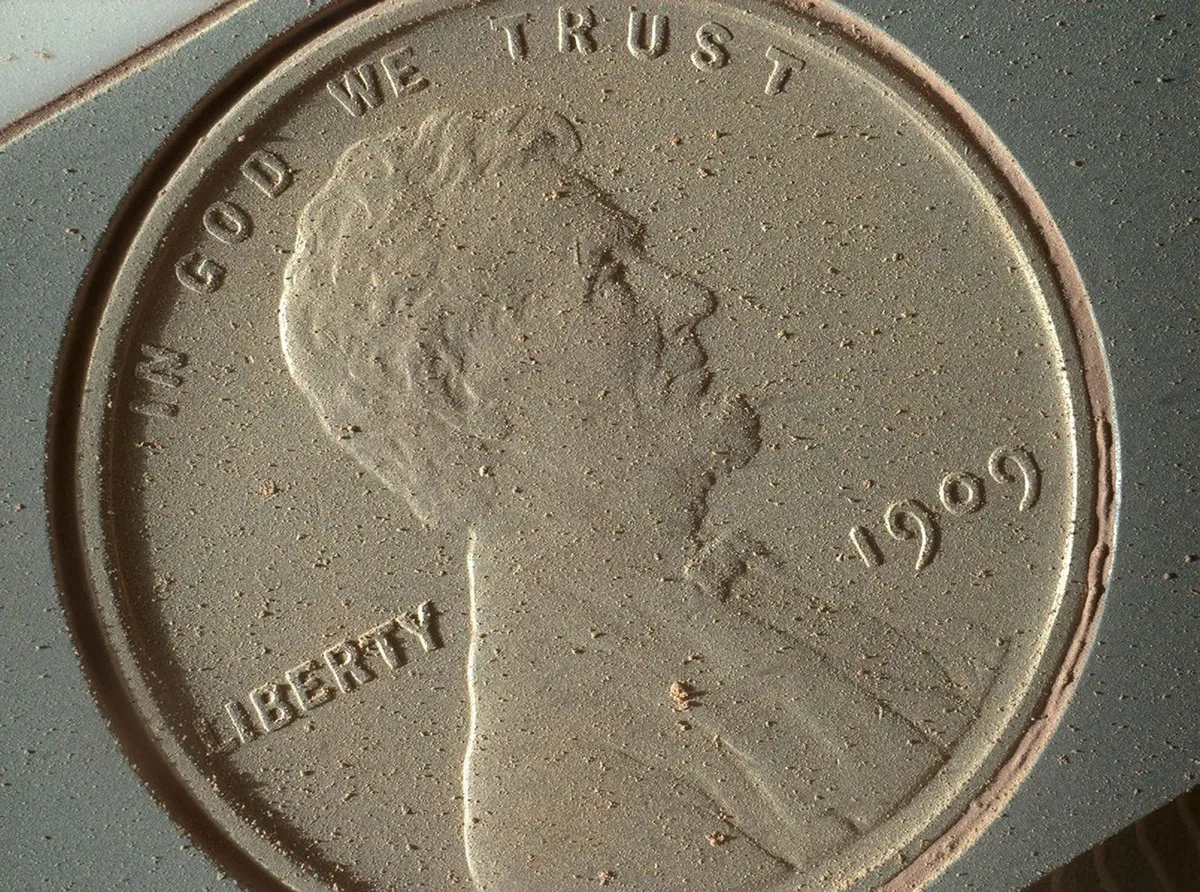
One rover already has. In this snapshot from the Red Planet, Martian dust covers a penny that has traveled farther than any human (so far).
What is it?
NASA's Curiosity rover captured a surprisingly Earthly image on the surface of Mars. With its Mars Hand Lens Imager (MHLI), the rover snapped a close-up image of a penny. (To clarify: The penny wasn't found there by accident; it traveled to Mars with the rover.)
This image was captured on Oct. 2, 2013 on the 411th sol, or Mars day, of the Curiosity rover's mission on the planet. On the penny's surface, reddish Martian dust has collected over the 14 months that the mission had already been on Mars by that point.
Why is it incredible?
It's neat to see a penny on another planet. It's a (now endangered) relic from our own world minted over 100 years ago, in 1909, feeling the Martian wind dragging dusty debris across its surface millions of miles away.
But this penny serves a surprisingly important purpose: scale. In photographs, it can sometimes be difficult to tell how big or small something is without an object of known size, like a penny or a banana, in frame for scale.
"When a geologist takes pictures of rock outcrops she is studying, she wants an object of known scale in the photographs," MAHLI Principal Investigator Ken Edgett said in a statement in which NASA refers to the coin as a "lucky penny on Mars."
"If it is a whole cliff face, she'll ask a person to stand in the shot. If it is a view from a meter or so away, she might use a rock hammer. If it is a close-up, as the MAHLI can take, she might pull something small out of her pocket. Like a penny."