


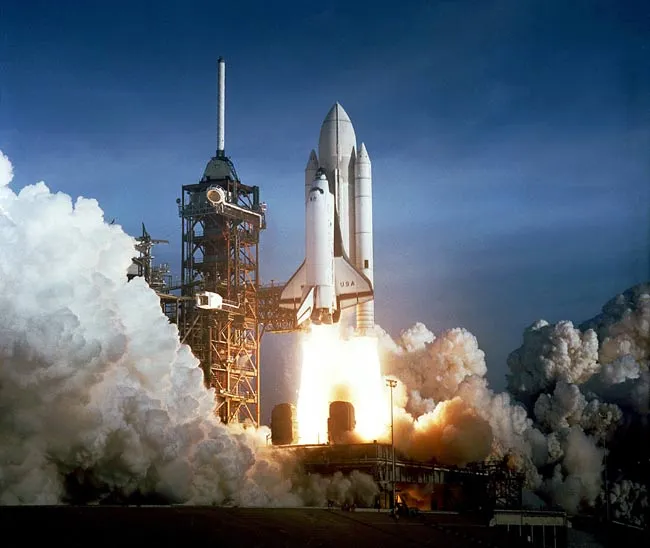
NASA's space shuttle was the world's first reusable spacecraft. It launched like a rocket and returned to Earth like a glider, landing like an airplane on a long concrete runway. It was designed to carry large payloads — such as satellites — into orbit and bring them back, if necessary, for repairs.
Following test flights using the shuttle Enterprise (which did not go into space), the first space shuttle mission, STS-1, launched on April 12, 1981, aboard the orbiter Columbia. The last shuttle to fly was Atlantis on the STS-135 mission in July 2011. The space shuttle suffered two major disasters — on Jan. 28, 1986 (Challenger) and Feb. 1, 2003 (Columbia); 14 astronauts died on the two missions.
The space shuttle's largest contribution was building the International Space Station, which remains in orbit today to conduct hundreds of science experiments annually on human health, engineering and other matters. The program is also remembered for launching and servicing the Hubble Space Telescope, visiting the Russian space station Mir, launching numerous satellites and probes, and performing thousands upon thousands of hours of basic science experiments.

Space shuttle elements and launch
The space shuttle, officially called the Space Transportation System, was made up of three main components [Infographic: NASA's Space Shuttle — From Top to Bottom]:
- Two solid rocket boosters, which provided most of the shuttle's thrust during launch
- The huge rust-colored external tank, which fed fuel to the three main engines during launch
- The orbiter, which contained the crew cabin, payload bay, and three main engines.
The solid rocket boosters (SRBs) operated for the first two minutes of flight to provide additional thrust needed to get the shuttle into orbit. About 24 miles (45 kilometers) up, the boosters separated from the external tank and descended on parachutes into the Atlantic Ocean. Ships recovered them, and they were refurbished for reuse.
Each booster contained a solid propellant motor — the largest ever developed for space flight. Each motor contained more than 1 million lbs. (450,000 kilograms) of a propellant, a solid mixture of ammonium perchlorate and aluminum, as well as an iron oxide catalyst to aid the burning reaction and a "binder" material to hold all the components together, according to the American Chemistry Council. The entire mixture has the consistency of a pencil eraser. Ammonium perchlorate is also used by the U.S. military in rockets, explosives, flares and ammunition.
The 15-story, rust-colored external tank was the only shuttle component that was not reused. It fed more than 500,000 gallons of fuel — liquid oxygen and liquid hydrogen — to the shuttle's main engines during launch. The tank was also the "backbone" of the space shuttle structure. It provided support for the rocket boosters and orbiter.

After the solid rocket boosters separated, the orbiter carried the external tank to about 70 miles (113 km) above the Earth. With its fuel spent, the tank separated and fell along a planned trajectory. Most of it burned up in the atmosphere, and the rest fell into the ocean.
The orbiter is the component most people think of as "the shuttle." It was the heart and brains of the system and the actual ship that took people to space and brought them back. The orbiter was about the same size as a DC-9 aircraft. It was 122 feet (37 meters) long and had a wingspan of 78 feet (23 m). The crew compartment, located in the forward fuselage, normally carried crews of seven astronauts, but occasionally carried fewer people. The largest crew size for a shuttle mission was eight astronauts.
The mid-fuselage housed a 60-foot (18-meter) payload bay and robotic arm. The bay could hold satellites, modules containing whole laboratories, and construction materials for the International Space Station. The aft fuselage held the orbital maneuvering system, main engines and vertical tail. Smaller thrusters located at the shuttle's nose and aft fuselage were used for small flight adjustments.
Brief development history
The space shuttle grew out of several efforts to develop reusable spacecraft. The X-15 program in the 1950s tested the idea of flying a space plane. The U.S. Air Force also conducted studies on semi-reusable spacecraft in the 1960s. NASA began work on an Integrated Launch and Re-entry Vehicle (ILRV) in 1968, and by 1969 the space shuttle's development received approval from then-President Richard Nixon.
The original vision of the space shuttle program was to develop a vehicle that would launch into space very frequently (several times a month) to deploy and repair satellites as required. The military was also an active participant in the development, and the shuttle's payload bay (which carried equipment into satellites into space) was enlarged in the design phase to accommodate larger military satellites.
Specifically, the National Reconnaissance Office asked that the payload bay be enlarged and that the shuttle eventually run polar missions, which are suitable for satellites to see the entire Earth's surface below. The Air Force constructed a launch pad in Vandenberg, Calif., for polar-orbiting missions, but the idea was abandoned after the Challenger disaster of 1986. Although several shuttle military missions ran in the 1980s, the practice dwindled down and ceased after Challenger's explosion.
Related: Classified Shuttle Missions: Secrets in Space
Space shuttle activities
In the early days of the space shuttle program, mission tasks included bringing up civilians to manage experiments, and deploying satellites – both civilian and military. Astronauts tested daring equipment such as the Manned Maneuvering Unit, a sort of jet backpack that would allow crew members to leave the shuttle untethered and pick up satellites for repair. Other satellites were captured and/or deployed using the Canadarm, a robotic arm.
These activities greatly lessened (and then ceased) after the Challenger space shuttle explosion of 1986, when it became clear that space shuttles could only launch a few times a year instead of many. There was a concern that the astronauts were doing risky spacewalks. As well, military satellites were gradually moved to single-use rockets, providing more frequent launch opportunities at a lower cost.
What didn't change on space shuttle missions, however, was performing experiments. Over the 30 years of the space shuttle program, some 355 individual cosmonauts and astronauts used the space shuttle for launching, landing or both.. They collectively put in thousands upon thousands of hours of work in space investigating all sorts of science, ranging from human health to engineering to astronomy to animal studies.
Related: NASA's Space Shuttle By the Numbers: 30 Years of a Spaceflight Icon
The space shuttle flew 11 times to the Russian space station Mir between 1994 and 1998, with seven American astronauts doing extended stays on the space station. This was the first major in-space cooperation between Russia and the United States since the Apollo-Soyuz mission of 1975, when Americans and cosmonauts from the Soviet Union docked for a few brief days in space. After the Soviet Union collapse in 1991, NASA agreed to cooperation with the Russians that began with shuttle-Mir and continued with the International Space Station program.
Perhaps the most famous task that the shuttle undertook was bringing up astronauts, pieces and equipment to build the International Space Station. Completing the space station took 13 years and dozens of shuttle missions; the number of shuttle missions total that docked at the station was 37, or more than one-third of the shuttle's total count of 135 missions.
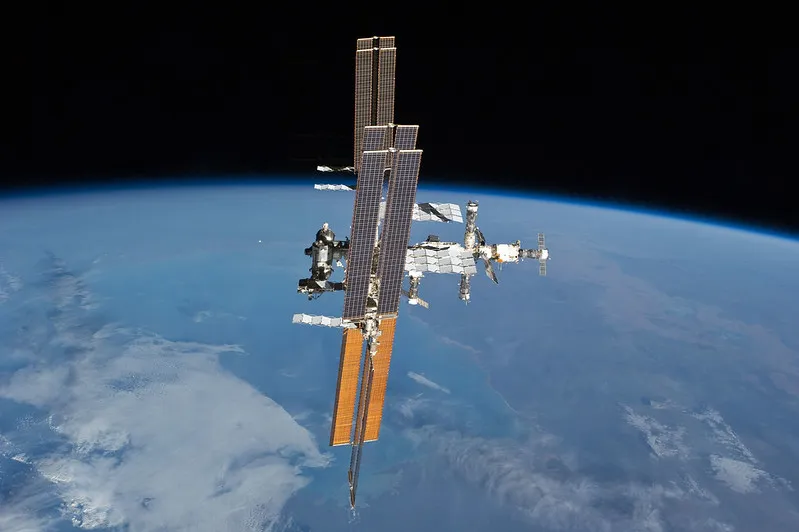
Besides hundreds of hours of astronaut spacewalks, some of the main components that the space shuttle itself contributed included the European Columbus laboratory, the Harmony node, the Tranquility node, the Japanese Kibo laboratory, solar panels, airlocks and the Canadarm2 robotic arm used for spacecraft berthing. The space shuttle also carried vital equipment needed for the interior, with some examples including exercise equipment, science racks, toilets and of course, fresh food.
The space shuttle is also well known for its repeated successful servicing of the Hubble Space Telescope. The telescope was deployed on April 25, 1990, during space shuttle Discovery mission STS-31. Unfortunately, a flaw in the telescope's mirror was discovered, which greatly compromised its ability to do astronomical observations. NASA deployed a follow-up servicing mission, STS-61, in December 1993. The astronauts installed several instruments — including a focus correction system — to complete success, garnering worldwide acclaim after the embarrassment of the initial Hubble launch.
NASA subsequently did servicing missions in 1997 (STS-82), 1999 (STS-103) and 2002 (STS-109). The last servicing mission was initially canceled in 2003 following concerns for astronaut safety after the Columbia disaster; since Hubble is on a different orbit from the International Space Station, the crew could not shelter at the station in case the shuttle was damaged.
Astronomers worried that there would be too big of a gap between the end of Hubble's lifetime and the beginning of the work of the James Webb Space Telescope, which initially was supposed to launch in 2010-11 but is expected to launch in 2021. After an outcry from scientists, the public and Congress, NASA administrator Sean O'Keefe said in 2004 that he would review the decision. A new administrator, Michael Griffin, arrived in 2005 and authorized a servicing mission for 2008. The servicing mission was delayed until 2009 (STS-125) to add a data-handling unit, replacing one that failed on orbit. The mission was executed to great success and international attention, and Hubble remains in good health as of 2018.
The space shuttles
The shuttle program had five space shuttles, as wellas the test orbiter Enterprise. Here are some notable facts about each one.
While the shuttle program was mostly conducted in space, Enterprise was constructed for drop-and-landing tests in 1977, furthering previous NASA and military work on flying-wing space vehicles. Enterprise successfully did a series of rigorous tests, starting with taxi work and culminating in several free flights and touchdowns.. Enterprise was deployed on goodwill tours to several countries, and then became the property of the Smithsonian Institution. It temporarily was displayed at the Stephen F. Udvar-Hazy airport annex of the Smithsonian National Air and Space Museum in Fairfax, Va., and then moved permanently in 2012 to the Intrepid Sea, Air and Space Museum in New York City.
Columbia (1981-2003): This was the first space shuttle to fly in space. It conducted several test flights, which dealt with early problems with the heat shield and with the automatic landing systems. Operational missions began in 1982. Some of its major mission activities included Spacelab, deploying the Chandra X-Ray Observatory and servicing the Hubble Space Telescope. The last mission, STS-107, ended catastrophically on Feb. 1, 2003, during landing when the shuttle broke up in the atmosphere, killing its seven-person crew. The cause was traced to a foam piece falling off of the external tank during takeoff and smashing into the wing, causing a hole. Several design changes were made to the space shuttle program after Columbia's demise, and a new inspection procedures to look at tiles after launch (while the astronauts were in space) were devised.
Challenger (1983-1986): Challenger was originally constructed as a test vehicle and then was upgraded for spaceflight. Its major mission milestones included launching the first Tracking and Data Relay Satellite (which the shuttles used to stay in touch with Mission Control), flying the first American female astronaut (Sally Ride), flying the first African-American (Guion Bluford) and the first astronaut repair of a satellite (the Solar Maximum Mission satellite). The shuttle exploded on Jan. 28, 1986, during liftoff of mission STS-51L, killing all seven astronauts on board. The technical cause was traced to an external booster rocket seal failing, but managerial causes were also blamed – including extensive pressure on the shuttle program to launch frequently. The disaster prompted design changes, a safety review (and changes) of the shuttle program, and a permanent slowdown of shuttle launch frequency.
Discovery (1984-2011): Discovery's first mission, STS-41D in 1984, underwent a pad abort due to a fuel valve issue, but the mission launched safely a few weeks later and released three communications satellites. It flew 39 missions — the most of any shuttle — and some of the major payloads it released included the Hubble Space Telescope, the sun-bound Ulysses spacecraft and the Upper Atmosphere Research Satellite. It even flew Mercury astronaut John Glenn at age 77, making him the oldest person to fly in space to date. Discovery was also the first shuttle to fly "return to flight" missions after both the Challenger and Columbia disasters. It was decommissioned after its last flight in 2011 and is now displayed at the Stephen F. Udvar-Hazy airport annex of the Smithsonian National Air and Space Museum in Fairfax, Va.
Atlantis (1985-2011): The first mission of this shuttle was a secret military mission in 1985, for which few details are known even today. Some of its other activities included lobbing three communication satellites into orbit in one mission, launching the Magellan spacecraft toward Venus, launching the Galileo probe toward Jupiter, flying most of the missions of the shuttle-Mir program, and flying the last space shuttle mission (STS-135 in 2011). The shuttle was decommissioned and is currently on display at the Kennedy Space Center Visitor Complex near the Kennedy Space Center in Cape Canaveral, Fla.
Endeavour (1992-2011): Endeavour was constructed out of spare parts from other space shuttles, as a replacement for the Challenger space shuttle that exploded in 1986. During Endeavour's first mission, STS-49 in 1992, crewmembers performed the first three-person spacewalk to bring the hard-to-grasp Intelsat VI satellite into the payload bay for repairs. Endeavour performed several scientifically oriented missions and was the first shuttle to participate in assembly of the International Space Station. After its last mission in 2011, Endeavour was decommissioned and is now on display at the California Science Center.
Additional reporting by Elizabeth Howell, Space.com contributor. This article was updated on Jan. 26, 2021 by Space.com Reference Editor Vicky Stein.
