





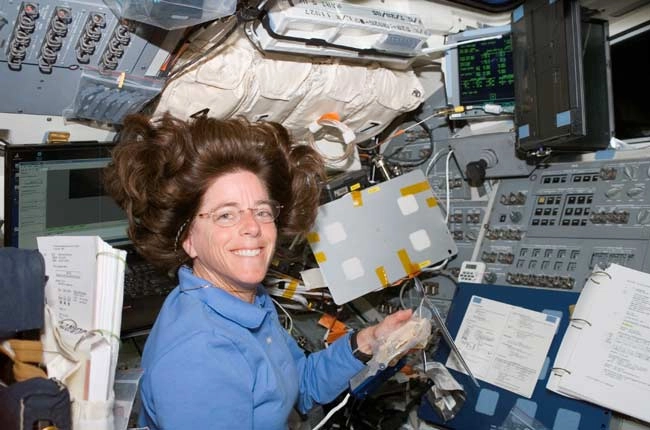
A quarter century ago, NASA's plan to send the first teacher to space was thwarted when Christa McAuliffe and her six crewmates were killed when the space shuttle Challenger was destroyed just after liftoff. McAuliffe's backup, Barbara Morgan, later became the first educator astronaut to reach orbit when she flew on the STS-118 flight of the shuttle Endeavour in August 2007.
Morgan left the astronaut corps in 2008 to become a Distinguished Educator in Residence at Idaho's Boise State University.
SPACE.com spoke to Morgan about the upcoming 25th anniversary of the Challenger tragedy, and her work to carry on McAuliffe's mission. Here are her thoughts on the loss of Challenger and its crew:
SPACE.com: What do you hope people remember about Challenger at this time?
Barbara Morgan: The Challenger crew was doing something wonderful for all of us, and it has to do with education and it has to do with opening doors for our young people and for all of us for the future. What I'm really proud of is all the great work that the Challenger families and many people all over the country and beyond do to carry on the mission of the Challenger crew. [Gallery - Remembering Challenger: NASA's 1st Shuttle Tragedy ]
There's so much that people are doing to carry forward the mission of the Challenger crew. Including all of our teachers who, some are in risky situations, go into that classroom every day to work with children, and they believe in the kids and believe that they have a bright future and are there to help them get there.
One particular program I wanted to mention is the Challenger Center for Space Science Education, and the tremendous work that they're doing that really provides a wonderful opportunity for our young people to experience the joy of working in a team and exploring and discovering together and engaging in our wonderful world of science, technology, engineering and mathematics.
I'm proud of what they're doing.
SPACE.com: Obviously, this tragedy was devastating for everyone, but how would you describe the impact of the Challenger accident on the education community?
Morgan: Christa was a great representative of the teaching profession, and Christa reminded everybody, at a time when education was being lambasted, that our country is full of good teachers who are working really hard in the classroom to do the best they can to help our young people have a bright future.
Christa's saying was, "I touch the future, I teach."
SPACE.com: Do you think the tragedy was discouraging to students who dreamed of going into space?
Morgan: Well, it was devastating, for students and teachers and everyone else in the country.
We had so many students after that wanting to be teachers, it was phenomenal, it was beautiful. And students and others who really sat up and thought, "What is it that I want to do in my future, and I have the capability to do it."
So actually [it gave students] great confidence in what they can do in their own lives and what we can do as a country.
SPACE.com: In the wake of the accident, did you ever consider changing your plans to go to space?
Morgan: After the Challenger accident, NASA asked if I would continue on, and at that time we had students all over the country and all over the world watching adults in a horrible, horrible situation. It was such a sad time. And this was on national TV and all that stuff.
I thought it was really important that our young people see adults doing the right thing. And that is figuring out what went wrong, figuring out what we did wrong, and doing all we could to fix it and make it better and make the future open for them.
SPACE.com: Do you think space exploration is worth the risk, and the human cost?
Morgan: If we put our head in the sand and don't accept any risk at all, we're not going anywhere.
We can never predict the future, but we can help shape the future. And if we want that future to be bright and open-ended and be one of lifelong learning, we've got to keep reaching for the stars.
There is so much that we don't know, and space and space exploration just provides so much. It truly motivates our young people and it’s exploration, it's discovery, it's experimentation — it's all those things that make humans, humans. And it's all the things that help us gain more knowledge and help make the world a better place.
And it's also important that we show our young people that there are risks that should be taken.
As teachers, we're always working with children in our class to risk trying something that they may fail at. To risk offering an opinion or a new idea, to risk asking a question, even though a lot of people are embarrassed to ask questions to show that they might not know something. Those are really important risks. And people need to see adults taking risks for the right reasons.
SPACE.com: While you were an astronaut, did you always know you wanted to go back to teaching?
Morgan: Yes. Because education is so important. Just like exploration. And you know they are very much the same. It's about learning, it's about exploring, it's about discovering, it's about sharing, and building a future. You do it with both.
You can follow SPACE.com senior writer Clara Moskowitz on Twitter @ClaraMoskowitz.
