


Thisstory was updated at 9:50 p.m. EDT.
The remainsof a Soviet-era satellite pose no threat to the International Space Station andwon?t force the massive orbiting lab to move aside before the Tuesday arrivalof NASA's shuttle Discovery.
NASA?sMission Control told station commander Michael Fincke that they won?t have tofire up the outpost?s Russian thrusters to push it clear of apiece of space trash that will zip by early tomorrow.
Discoveryand itsseven-astronaut crew are due to dock at the space station Tuesday at 5:13p.m. EDT (2113 GMT), with the spaceflyers spending the bulk of their day todayconducting a standard heat shield inspection. The space debris nearing thestation also posed no risk to Discovery or its crew, mission managers said.
?We don?thave any threat from this object or any other objects, currently, that we haveout there,? LeRoy Cain, NASA?s deputy shuttle program manager, told reportersin an afternoon briefing.
Morespace trash
The spacedebris is the second chunk of orbital trash tobuzz the station in less than a week, and is due to fly by early Tuesday atabout 3:14 a.m. EDT (1714 GMT). It is the leftover remnant of a Soviet militarynavigation satellite called Cosmos 1275 and not related to last week?s spacedebris event or the recent increase in orbital trash from a satellite collisionlast month, NASA said.
?I think itis a random occurrence,? Cain said.
NASAengineers tracked the object throughout the day and determined it would not flywithin an imaginary box around the space station that serves as a safetyperimeter.
The boxabout extends 2,400 feet (732 meters) above and below the space station, aswell as 15 miles (24 km) to either side of the outpost. The Cosmos 1275 debriswas initially expected to glide past within about 2,600 feet (793 meters) ofthe station, and later found to be outside the perimeter box.
Cain saidthat the Cosmos 1275 remnant was thought to be relatively similar in size tothe debris from a spent satellite rocket motor that flew within three miles(4.8 km) of the space station last Thursday.
That pieceof space trash was about 5 inches (13 cm) wide and was flying at about 19,800mph (31,865 kph). The space station orbits the Earth at about 17,500 mph(28,163 kph).
Notice ofthe object?s trajectory came too late to move the space station, so Fincke andhis crew had to take shelter inside their docked Soyuz spacecraft in case thedebris struck the station and forced them to evacuate. The space debris,however, zipped past the space station without incident.
?Spacedebris is an issue for us,? Cain said. ?There are objects, small and large thatwe have to contend with so we have to be mindful of the things that are beingtracked.?
The amountof space trash has increased in recent months after the Feb. 10 collisionof a U.S. and a different Russian satellite, which spewed two debris cloudsafter the two spacecraft crashed into each other 490 miles (790 km) aboveSiberia. The new debris has increased the damage risk to NASA?s space shuttleand station flights by about 6 percent, or 1-in-318, NASA officials have said.
?It?s a littlebit like traffic on the freeway, sometimes it?s bad sometimes it?s not,? said shuttleflight director Paul Dye, adding that there seems to have been debris eventsmore often lately. ?And sometimes you can figure out why, and sometimes you'renot sure where it came from.?
Shuttlein good shape
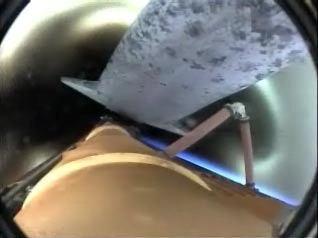
Whileengineers on Earth tracked the Cosmos 1275 debris, Discovery astronauts werehard at work scanning their heat shield for damage. The inspection, which usesa sensor-tipped extension of the shuttle?s robotic arm, has been a standardpost-launch activity since the 2003 loss of the Columbia orbiter and sevenastronauts due to heat shield damage.
At firstlook, Discovery?s heat shield appears to be in good health, mission managerssaid. Two more inspections - a photographic survey before tomorrow?s docking atthe space station and a later scan similar to today?s - will also be performedduring the mission.
?There?s noindication of anything of concern so far,? Cain said.
Dye saidthe only noticeable glitch has popped up in Discovery?s exercise bike, which hasjammed. Discovery carries extra exercise gear, including bungee-like resistancebands, which the shuttle astronauts can use, he added. They will also be ableto use gear on the space station once they arrive tomorrow.
Discoveryis carrying a $298 million set of U.S. solar arrays and a new crewmember,Japanese astronaut Koichi Wakata, to the space station. The new solar arraysand a final segment of the station?s backbone-like main truss will be installedduring three spacewalks planned for Discovery?s flight.
Wakata willreplace NASA astronaut Sandra Magnus as a station flight engineer. He isJapan?s first long-duration astronaut and due to return to Earth later thisyear.
SPACE.comis providing continuous coverage of STS-119 with reporter Clara Moskowitz andsenior editor Tariq Malik in New York. Click here for missionupdates and SPACE.com's live NASA TV video feed.
- New Video - Discovery?s STS-119 Night Launch
- Video - Fragmentation: The Expanding Danger of Space Debris
- Video: How the Iridium/Cosmos Satellite Crash Happened
