Editor?s Note: This story was updated at 7:00p.m EDT.
Astronauts aboard NASA?s space shuttle Discovery took afirst look at their spacecraft?s heat shield today even though they lack avital tool to hunt for any damage to the vehicle from its Saturday afternoonlaunch.
Discoverylaunched toward the International Space Station (ISS) yesterday at 5:02p.m. EDT (2102 GMT) to deliver Japan?s massive Kibo research module to theorbiting laboratory. But the new orbital room is so large, the shuttle had tofly without its laser-tipped sensor boom, a required tool for now-standard heatshield inspections on all NASA shuttle flights.

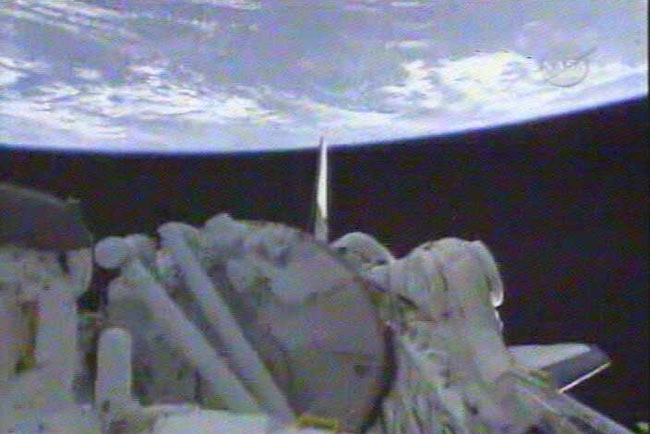
Instead, Discovery?s seven-astronaut crew conducted alimited survey today using a camera at the tip of the shuttle?s 50-foot(15-meter) robotic arm.
?That sort of gives us a good idea of the situation we?rein before we go on to docking,? Discovery shuttle pilot Ken Ham said beforelaunch. ?It?s a pretty well thought out plan.?
Discovery is set to dock at the space station on Mondayat 1:54 p.m. EDT (1754 GMT). But before the shuttle arrives, astronauts aboardthe orbiting lab will take high-resolution photographs of its heat shield -also a standard safety measure since the 2003 Columbia tragedy - so engineers cansearch for any dings in the thousands of heat-resistant tiles coating its noseand underbelly.
The shuttle astronauts are also slated to also perform afull heat shield inspection later in theirplanned 14-day mission using a 50-foot (15-meter) inspection boom leftoutside the space station by a previous shuttle crew.
Commanded by veteran shuttle flyer Mark Kelly,Discovery?s STS-124 astronauts plan to install the Kibo lab and relocate itsstorage module during three spacewalks, as well as swap out one member of thespace station?s three-man crew. They are also hauling a spare toilet pump tofix the station's balky Russian-built commode.
About the size of a large tour bus, the $1 billion Kibolab module is 37 feet (11 meters) long, weighs about 32,000 (14,514 kg) and hastwo windows, a robotic arm and its own, small airlock. It is the second ofthree separate segments that make up Japan?sentire Kibo facility, and will join a small storage module already at thestation. A porch-like external platform for space exposure experiments isslated to launch next year.
Shuttle survey
Ham and his crewmates began today?s limited scan of theheat-resistant panels along Discovery?s wing edges just after 11 a.m. EDT (1500GMT). The survey ran about two and a half hours, but was limited by theDiscovery?s robotic arm reach, which is only about half that of combinedarm-inspection boom assembly.
?That means that we can?t really look too much underneaththe port wing,? shuttle flight director Matt Abbot said before flight, addingthat the upper portions of both wings should be visible.
NASA has kept a close watch on the heat shield integrityof its shuttle fleet since 2003, when a piece of foam insulation fell from theshuttle Columbia?s external tank and punched a hole in the carbon compositepanels on its left wing leading edge. The damage led to the loss of the orbiterand its seven-astronaut crew as they reentered the Earth?s atmosphere.
Since then, shuttle astronauts have used lasers andcameras at the end of their shuttle inspection boom to ensure their spacecraftis in good health. NASA also redesigned its shuttle fuel tanks to limit theamount of foam insulation shed during liftoff.
Discovery?sSTS-124 mission is the first shuttle flight to use a fuel tank built fromscratch with all the new modifications. Mission managers wanted to test the newtank before using another one to feed the shuttle Atlantis?s planned Octoberlaunch to the Hubble Space Telescope.
NASA space operations chief Bill Gerstenmaier saidSaturday that an initial survey of launch video footage found about five piecesof foam debris that popped free from Discovery?s external tank after liftoff.None of them are expected to pose a risk to the shuttle or its crew, he added.
One thin piece appeared to bounce off Discovery andremain intact, but all of the events occurred after first two minutes and 15seconds of flight, when debris cannot accelerate fast enough to cause seriousdamage to the orbiter?s heat shield, Gerstenmaier said.
?Ultimately, we would like to reduce the amount of foamthat comes off the tank,? Gerstenmaier said. ?I don?t think we?ll ever get itto zero, but if we can get it to where it occurs late like it did on thisflight than we?re in a good configuration.?
NASA is broadcasting the planned launch ofDiscovery's STS-124 mission live on NASA TV on Saturday. Click here for SPACE.com'sshuttle mission updates and NASA TV feed.
- New Video: STS-124 Mission Preview ? Delivering Kibo
- Video: STS-123 Mission Rewind: Launch to Kibo Attic Delivery
- Complete Space Shuttle Mission Coverage
