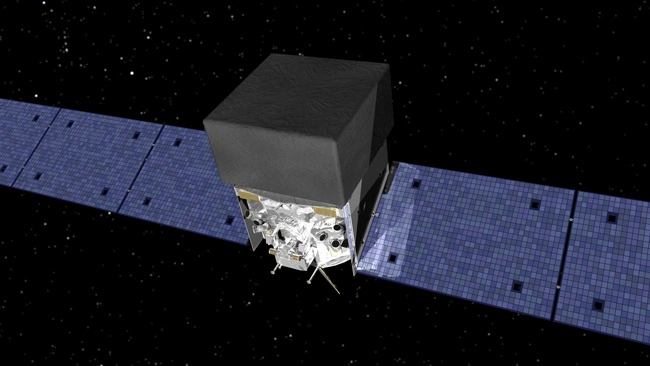
NASA?snewest space telescope is gearing up for a planned June 3 launch to hunt forthe most extreme and energetic objects in the universe.
The Gamma-rayLarge Area Space Telescope (GLAST) is poised to launch spaceward atop aDelta 2 rocket at 11:45 a.m. EDT (1545 GMT) next Tuesday from the CapeCanaveral Air Force Station in Florida.
Missionscientists hope the new $690 million gamma ray observatory will hunt down theorigins of cosmic rays and shed new light on the mysteries of dark matter,supermassive black holes and pulsars among others. The space telescope is alsobuilt to help track gamma raybursts - the most powerful explosions in the universe ? and, researchershope, help scientists test the laws of physics while seeking out new ones.

?We?regetting pretty excited about the launch next week,? said Peter Michelson,principal investigator for GLAST?s Large Area Telescope at Stanford University,in a Tuesday teleconference.
The9,487-pound (4,303-kg) spacetelescope was originally slated to lift off on May 16, but NASA was forcedto postpone the launch due to equipment damage caused during the installationof the second stage of GLAST?s Delta 2 rocket.
GLASTcarries two primary telescopes to scan the entire night sky every three hours inthe gamma ray range, a region of the spectrum beyond the visible range of thehuman eye. Its five-year mission will join NASA?s Swift gamma ray telescope andEurope?s Integral satellite in orbit, and follows the Compton Gamma RayObservatory, which de-orbited in 2000.
?The gammaray sky is incredibly variable,? said GLAST project scientist Steve Ritz ofNASA?s Goddard Space Flight Center in Greenbelt, Md. ?Things are changing allthe time.?
Theobservatory?s Large Area Telescope is designed to map gamma ray sources inunprecedented detail, which researchers hope will trace the origins of signalsdiscovered earlier by previous spacecraft.
A secondtool, the GLAST Burst Detector, is expected to serve as a gamma ray burstlookout. It should automatically alert researchers on Earth when an explosionis detected or swing the entire observatory around to aim its main telescope atthe event, mission scientists said.
But it isthe lure of the unknown finds that could stem from GLAST that has some missionscientists chomping at the bit.
?The mostimportant thing for us is the surprises that we expect to find,? Ritz said.
The GLASTobservatory has a nearly two-hour window to launch from the Air Force Stationnext Tuesday, but only if NASA?s space shuttle Discovery launches on time thisSaturday from agency?s nearby Kennedy Space Center. The Eastern launch rangethat includes the Air Force Station and KSC typically requires about 48 hoursbetween launches to reset for a new space shot.
Discoveryis poised to launch toward the International Space Station at 5:02 p.m. EDT(2102 GMT) on Saturday carrying Japan?smassive Kibo module, a new research laboratory the size of a large tourbus.
- Video: Searching for SuperStars
- Top 10 Star Mysteries
- The Strangest Things in Space
