This story was updated on Dec. 21.
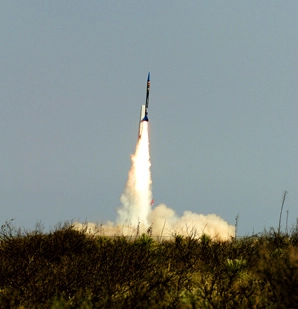
UP Aerospace launched a rocket from New Mexico's Spaceport America on Dec. 19, conducting a brief test shot that was bothnon-public and unannounced prior to the flight.
In a press statement, Jerry Larson, President ofUP Aerospace noted that the flight was carried out for an unspecified clientfor research and development purposes. The rocket reached a planned altitude of2,500 feet, he said.
The flight was announced by the New MexicoSpaceport Authority, noting that it was the second successful launch this yearfrom the SpaceportAmerica site near Las Cruces, New Mexico.
In April, the Connecticut-based UP Aerospaceflew from Spaceport America its SpaceLoft XL rocket, flying anarray of payloads, including the cremated remains of more than 200 peopleon a suborbital flight for the Houston, Texas-based Celestis, Inc.
UP Aerospace carried out the inauguralmission from Spaceport America in September 2006, but the rocket failed toreach its desired trajectory.
The New Mexico spaceport site is approximately70 square kilometers of open, generally level range land north of Las Cruces and east of Truth or Consequences. This location was favored for its lowpopulation density, uncongested airspace and high elevation.
Emergingrocket technologies
A few extradetails on the test shot were provided to SPACE.com from Eric Knight,co-founder of Up Aerospace, Inc.
“Theclient was a large aerospace company, but due to confidentiality, we can’trelease the name, Knight explained. The low-altitude flight was designed solelyfor research and development purposes, he said, meeting all its technicalobjectives.
“Itwas a successful test for our client,” Knight explained. “Theflight wasn't intended to be a space launch. It was specifically designedto test new and emerging rocket technologies.”
“Thisis an additional, exciting -- and rapidly growing -- business segment for ourcompany. It complements the commercial and educational space-launch payloadservices we provide via our SpaceLoft XL suborbital rocket vehicle,”Knight concluded.
- VIDEO: Moon 2.0: Join the Revolution
- IMAGES: Twenty Great Rocket Launches
- Future of Flight: Space Tourism, Investment and Technology