


This story was updated at 12:09 p.m. EDT.
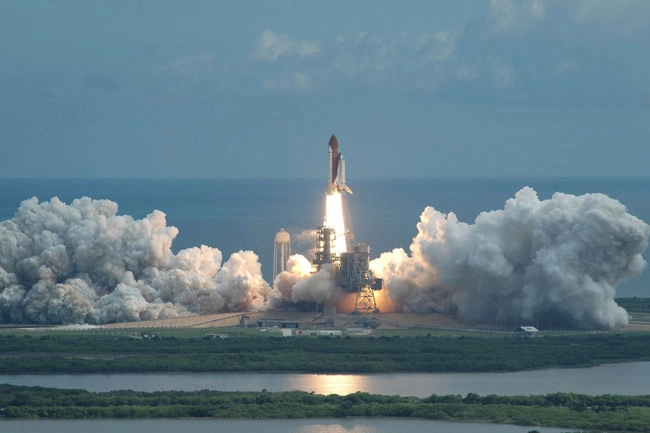
CAPE CANAVERAL, Fla. — NASA's shuttle Discovery and its seven-astronaut crew launched into orbit Tuesday with a thunderous roar on an ambitious mission to add a new orbital room to the International Space Station (ISS).
Commanded be veteran shuttle flyer Pamela Melroy, Discovery's STS-120 crew rocketed into space from NASA's Kennedy Space Center here at 11:38 a.m. EDT (1538 GMT), despite an iffy weather forecast of rain showers and ice build-up on the shuttle's external fuel tank. Tucked in the orbiter's payload bay was Harmony — a cylindrical module that will anchor future international laboratories to the space station.
"Liftoff of Discovery, hoisting Harmony to the heavens," launch commentator Mike Curie said as the shuttle climbed toward space.
Riding spaceward with Melroy were shuttle pilot George Zamka and mission specialists Scott Parazynski, Stephanie Wilson, Douglas Wheelock, Daniel Taniand Italian astronaut Paolo Nespoli of the European Space Agency. During their planned 14-day spaceflight, the astronauts will ferry a new crewmember to the ISS, relocate a massive solar power tower and install Harmony.
"We're doing a lot of big robotics as well as a lot of big things on the spacewalks," Melroy said before launch, describing the spaceflight as an astronaut's dream mission. "We just got lucky."
Making history
With the successful launch, two female commanders are now leading their spacecraft crews in Earth orbit for the first time: Melroy aboard Discovery, and U.S. astronaut Peggy Whitson aboard the ISS. The two female space commanders will meet on Thursday, when Discovery is scheduled to arrive at the space station at 8:35 a.m. EDT (1235 GMT).
"This is a real special event for us," Melroy said. "I think it's just indicative that there are enough women in the program that this can happen."
Melroy waved to cameras before boarding Discovery for today's spaceflight with her crewmates holding up signs for loved ones as the climbed inside the shuttle. Tani held up signs to his mother, wife Jane and daughters before stepping inside Discovery. He will stay aboard the ISS once Discovery departs to replace NASA astronaut Clayton Anderson, who wrapping up a five-month mission aboard the space station.
Anderson, Whitson and Russian cosmonaut Yuri Malenchenko — the space station's Expedition 16 crew — watched a live broadcast of Discovery's launch to their orbital home. Anderson spun a towel over his head and performed a weightless flip in apparent delight over the successful liftoff.
A small patch of clear ice, spotted on liquid hydrogen umbilical line near the aft end of Discovery and its fuel tank, did cause some concern for today's liftoff. Launch controllers were concerned that the ice could break off during launch and damage Discovery's fragile heat shield.
NASA has kept a close watch on fuel tank launch debris and the health of its shuttle heat shields since the 2003 Columbia accident.
Today's launch marked NASA's 120th shuttle flight to date and the third this year dedicated to space station construction. The successful liftoff kicked off Discovery's 34th spaceflight and NASA's 23rd shuttle mission to the ISS.
Busy mission begins
Discovery's STS-120 crew has a busy two weeks of orbital construction ahead highlighted by the planned Friday delivery of the Italian-built Harmony node to the ISS.
With its five attachment points, Harmony will serve as a hub to join the European Space Agency's Columbus module and Japan's Kibo laboratory to the ISS.
The node was named by students from six different classrooms, ranging from elementary grades to high school, across the U.S. in a NASA contest. About 150 of those students watched Discovery rocket spaceward from Banana Creek near Kennedy Space Center.
"I like the floaty part," eight-year-old Margaret Brackey, whose World Group Home School class spent five weeks building a Harmony module for the contest, told SPACE.com of her interest in spaceflight. "I bet most kids would say that too."
"Star Wars" director George Lucas was also on hand for the launch. Tucked amongst Discovery's cargo is an original prop lightsaber for Luke Skywalker, which rode to space as part of the 30th anniversary of the film's 1977 premiere.
Discovery's crew will also relocate a massive solar power tower, the 17.5-ton Port 6 truss segment, from its mast-like perch atop the station's Unity node to the outpost's port-most edge. The tricky maneuver will require a pair of spacewalks and complex coordination using robotic arms aboard the ISS and Discovery to complete.
Five spacewalks are planned for the STS-120 mission to continue ISS construction and test shuttle heat shield repair methods.
"Everyone's in full afterburner the whole flight," said Parazynski. "There's really nobody with a free moment to spare."
NASA is broadcasting Discovery's STS-120 launch and mission operations live on NASA. Click here for mission updates and NASA TV from SPACE.com.
