


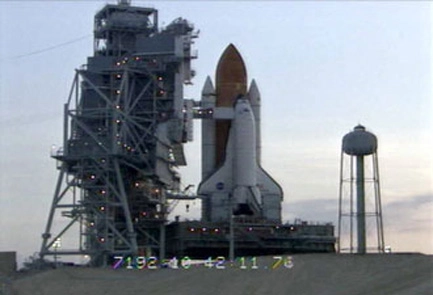
NASA?sspace shuttle Endeavour returned to the launch pad for the first time in nearlyfive years, making the overnight trek from its Florida hangar to prepare for aplanned Aug. 7 liftoff.
The shuttlereachedLaunch Pad 39A at NASA?s Kennedy Space Center in Cape Canaveral at about2:30 a.m. EDT (0630 GMT) after a just over six-hour journey to cover the3.4-mile (5.4-kilometer) stretch from the Florida spaceport?s cavernous VehicleAssembly Building.
NASA ispriming Endeavour for an Aug. 7 launch to continue assembly of theInternational Space Station (ISS) during an upto 14-day mission. The spaceflight will mark Endeavour?s first since late2002, after which NASA pulled the orbiter aside for a planned overhaul.
?Just thefact that this thing has been down for so long, they?ve had a chance to do awhole lot of good work on it,? STS-118 mission specialist Alvin Drew told SPACE.combefore the shuttle?s rollout. ?It?s, you know, the shuttle with that new carsmell again.?
Commandedby veteran shuttle flyer Scott Kelly, Endeavour?s STS-118 mission will deliver about5,000 pounds (2,267 kilograms) of cargo, a spare parts platform and new ISSgyroscope and a starboard-side spacer for the station?s main truss to the ISS.The shuttle?s cargo reached the Pad 39A Sunday, NASA said.
Endeavourwas slated to start rolling out to the launch pad late Tuesday at about 10:00p.m. EDT (020 July 11 GMT) after a one-day delay due to lightning, but wasactually able to begin the slow trip atop its massive crawler carrier vehicleat about 8:10 p.m. EDT (001 July 11 GMT), NASA spokesperson Bill Johnson saidat KSC.
The shuttle?sseven-astronaut STS-118 crew also includes educator-turned-spaceflyerBarbara Morgan, who first joined NASA?s ranks more than 20 years ago toserve as backup for schoolteacher Christa McAuliffe during NASA?s Teacher inSpace program. McAuliffe and her six crewmates died during NASA?s 1986Challenger accident.
?I?m reallyexcited about going up and doing our jobs and doing them well,? Morgan said ina NASA interview, adding that McAuliffe?s legacy will last well beyond theSTS-118 flight.
During its years-long systems overhaul, Endeavour received anew power transfer system that will allow the orbiter to draw on ISSsupplies--rather than its own limited stores--while docked at the orbitallaboratory. The new Station-Shuttle Power Transfer System could lengthenEndeavour?s initial 11-day flight by up to three days to allow an extraspacewalk to the three excursions already planned at the ISS, mission managers havesaid.
Endeavouralso sports a new avionics system, new windows and will be the first toactively use an advanced health monitoring system to watch over its three mainengines during liftoff, NASA said. Among other improvements, engineers replacedsome 2,500 of the orbiter?s heat-resistant tiles, and tested each of its 1,900thermal blankets to ensure they were secured tightly.
?This hasgot some great upgrades,? Matt Abbott, NASA?s lead STS-118 shuttle flightdirector said Tuesday during a briefing here at the Johnson Space Center. ?Butreally all the shuttles are fantastic flying machines.?
Endeavour?sSTS-118 mission will mark the second shuttle flight of the year following lastmonth?s successful STS-117 spaceflight, which ferried a new crewmember andstarboard solar arrays to the ISS aboard the Atlantis orbiter.
NASA hopesto launch up to four shuttle flights in 2007 to continue assembly of the ISS.The shuttle Discovery is slated to haul the new Harmonyconnecting node to the station in late October and be followed by aDecember flight of Atlantis to deliver the European-built Columbus laboratory.
?It?sexciting to see the hardware come together and to see all the planning cometogether for the launch next month,? Drew said, lauding the KSC shuttleworker?s efforts to update and prepare Endeavour. ?They?re ready to put it backinto space. And we?re ready to fly it too."
- NASA?s STS-118: Teaching the Future Through ISS Assembly
- SPACE.com Video Interplayer: Space Station Power Up with NASA?s STS-117 Mission
- Complete Shuttle Mission Coverage
