


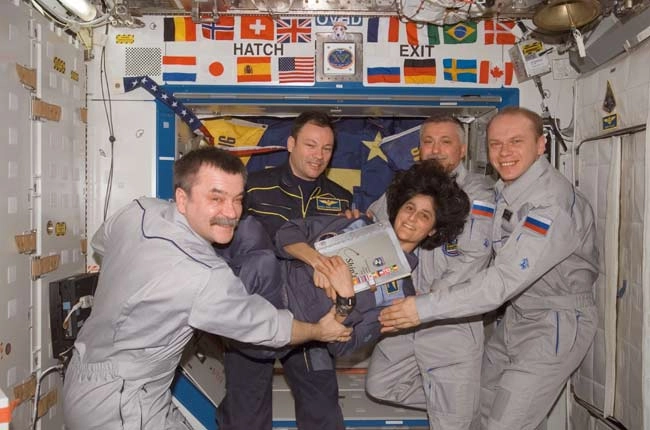
Americanastronaut Sunita Williams will return home from her mission to theInternational Space Station (ISS) a bit early this summer due to delays associated withNASA's next shuttle flight, the space agency announced Thursday.
Williams,an ISS Expedition 15 flight engineer, is now set to return to Earth in Juneaboard the space shuttle Atlantis following an 11-day assembly mission by theorbiter's STS-117 astronaut crew. Her replacement, NASA astronaut ClaytonAnderson, will join the STS-117 crew roster as a late addition, NASA officialssaid.
"Sincean earlier crew rotation was possible, NASA managers decided it would beprudent to return Williams and deliver Anderson sooner rather than later," thespace agency said Thursday.
Williams,41, first arrived at the ISS in December 2006 during its then-Expedition 14mission and stayed on this month for the beginning of Expedition 15. She andAnderson wereinitially expected to swap places during NASA's STS-118 shuttle flight aboardthe shuttle Endeavour in late June.
Butthat mission was rescheduled to no earlier than Aug. 9 following a string ofdelays caused by hail-spawned fuel tank damage that prevented an initial March15 launch of Atlantis' STS-117 mission. Atlantis is now setto launch towards the ISS no earlier than June 8.
AU.S. Navy commander making her first spaceflight, Williams has repeatedly saidthat she was prepared to return home early or late depending on what ISS missionmanagers saw as the best move for the station. Earlier today, she told reportersthat she and her family had weathered similar experiences during her longdeployments abroad with the Navy.
"Itcomes with the job, you just need to be flexible," Williams told USA TodayThursday in a space-to-ground video link. "It's an operational ship, and an operational station and wejust need to take care of it the right way and do the right things for theprogram."
While Williamsis returning to Earth on an earlier shuttle flight, she will be spending about thesame amount of time in space - just over six months - as originally planned, NASA spokesperson Kylie Clem told SPACE.com Thursday.
Missiontweaking
ReturningWilliams to Earth in June does add some additional complexity to an alreadytricky space station construction flight.
Commandedby veteran NASA shuttle flyer Rick Sturckow, Atlantis' now seven-astronaut STS-117crew willdeliver a 17.5-ton pair of new starboard trusses and solar arrays to the ISS.The mission was delayed to June 8 after a freak storm over Atlantis' launch padgouged thousands of dings into the orbiter's foam-covered external fuel tank inlate February, prompting repairs.
Addingthe ISS astronaut crew swap to the mission requires extra cargo - in the formof Anderson's supplies - and handover activities to an already busy flight.
"When yourotate a crewmember, there's a significant amount of upmass in addition to thatparticular crewmember," Kirk Shireman, NASA's deputy ISS program manager at theagency's Houston-based Johnson Space Center, said last month. "There's theirequipment, their [spacesuit], they have to have a special seat to fly home onthe Soyuz...adding that additional mass is a hit, and adding handover activitiesis a timeline hit."
Butafter a detailed review Thursday morning, ISS mission managers decided theycould in fact include the Expedition 15 astronaut crew swap during the STS-117mission with no impact to shuttle of station mission objectives, Clem said.
Clayton,a 48-year-old native of Omaha, Nebraska, will make his first spaceflight duringExpedition 15 and was slated to participate in the spacewalks planned for theSTS-118 mission.
"Hewill continue to train for that because he will still be on station," Clem said.
Female spaceflight records
Waitinguntil August's STS-118 mission would have extended Williams' spaceflight by atleast one month and given her the U.S. record for longest continuousspaceflight, which is currently held by her former crewmate - Expeditioncommander Michael Lopez-Alegria - whospent 215 days in orbit before returning to Earth on April 21.
Instead,Williams will return to Earth no earlier than June 19 after turning herExpedition 15 duties over to Anderson. Anderson, in turn, will be replaced byNASA astronaut Daniel Tani during the planned STS-120 shuttle mission to launchno earlier than Oct. 20. She currently holds the title for most spacewalks andspacewalking time - 29 hours and 17 minutes over four excursions - for a femaleastronaut.
Clemsaid Williams is now expected to spend about 192 days in space by her mission'send, which would set a new record for the longest single spaceflight by afemale astronaut.
Thecurrent single-mission record by a female spaceflyer is held by NASA astronautShannon Lucid, who spent 188 days in orbit during a 1996 mission to Russia'sSpace Station Mir.
- NASA Wrangles Plans for U.S. Astronaut's Earth Return
- STS-117 Power Play: Atlantis Shuttle Crew to Deliver ISS Solar Wings
- Complete International Space Station Mission Coverage
