


Two astronauts successfully freed a stuckcargo ship antenna and broke records outside the International Space Station(ISS) Thursday despite a late start and spacesuit glitches during the lastplanned spacewalk of their six-month spaceflight.
ISS Expedition14 commander MichaelLopez-Alegria and flight engineer MikhailTyurin spent more than six hours outside the station in the spacwalk,which was highlighted by a their spacecraft amputation work to cut loose aProgress 23 supply ship antenna [image].
"Itmay be a souvenir," Tyurin said of the antenna as it was cut free with a pairof spaceworthy bolt cutters and later tied to the Progress 23 vehicle's hull.
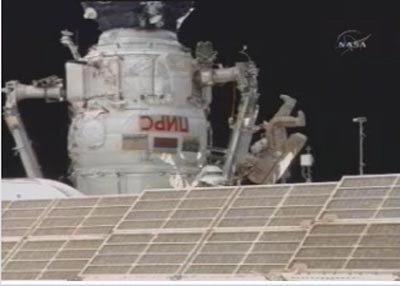
Thursday'sspacewalk began at 5:27 a.m. EST (1027 GMT), nearly a half-hour later thanplanned, and marked the fifth excursion for the Expedition 14 astronauts -- themost ever for an ISS mission and the finale in a dense seriesof excurisions for the station crew. Tyurin and Lopez-Alegria each donnedRussian-built Orlan spacesuits with red stripes [image].
"It'sreally absolutely beautiful, stunningly beautiful indeed," Tyurin said ashe stepped into space during the six-hour, 18-minute spacewalk. [VIDEO:Spacewalk overview.]
Lopez-Alegriamade his 10th career spacewalk during the activity, a new NASArecord, while Tyurin completed his fifth career spacewalk [image].
Expedition14 flight engineer SunitaWilliams helped her crewmates into their spacesuits, remained inside theISS to oversee the spacewalkers, exercise [image]and help better prepare the orbital laboratory for a planned March shuttlevisit by NASA'sSTS-117 astronauts.
Antenna ChopShop
Tyurin ledtoday's Russian spacewalk, which was primarily aimed at removing and stowingthe jammed Progress 23 navigation antenna [image].
[VIDEO:Progress 23 Antenna Details.]
Used by theProgress 23's automated Kurs navigation antenna for unpiloted dockings, thedevice failedto fold away against the vehicle's hull when the cargo ship arrivedat the ISS in October 2006. Subsequent inspection during a Novemberspacewalk found the antenna wedged against a station handrail near its berthat the aft end of the station's Zvezdaservice module.
Rick LaBrode,NASA lead Expedition 14 spacewalk flight director, said engineers wereconcerned that the stuck antenna could result in control problems with theProgress 23 spacecraft once it is jettisoned for disposal in April.
Afterefforts with a hammer and chisel provide fruitless, Tyurin and Lopez-Alegriacut a series of tent pole-like aluminum support struts using a generic U.S. bolt cutting tool. They then folded the antenna away and tied it down for safekeeping.
"We havethe result, the result is achieved," Tyurin said.
Spacesuitglitch, other tasks
But throughoutthe spacewalk Tyurin, who goes by the nickname Misha, suffered from a spacesuitcooling system glitch with his sublimator, a device designed to extract heatfrom water to maintain a comfortable working temperature.
"Misha,your sublimator is not operating nominally," Russian flight controllers toldTyurin. "If there is trouble, you will have to go back."
The problemled to some hot times for Tyurin inside his spacesuit [image],who kept a light mood, likening the feeling to a warm day at NASA's Johnson Space Center home in Houston. But his helmet suffered from chronic fogging that at timesmade it difficult to see.
"I don'tsee anything," Tyurin said. "I don't see space. I don't see the Earth. I justsee the guide here."
"Misha,this is not a joke, this is a recommendation," Russian flight controllers advisedat one point. "Try to rub off the fogging from the helmet glass with your nose."
But laterin the spacewalk, Lopez-Alegria brushed a layer of ice off of Tyurin'sspacesuit exterior that prompted the sublimator to work more effectively. Tyurinalso had difficulties with his spacesuit's cooling system during a Novemberspacewalk due to a kinked water tube.
The twospacewalkers were then able to complete the remainder of their tasks, whichincluded:
- Photographing rendezvous hardware for the European Space Agency's Automated Transfer Vehicle (due to make its first ISS cargo delivery in July).
- Photographic surveys of a German-built Rockviss robotic experiment and station global positioning system antenna.
- An inspection of a Russian Strela (or Arrow) hand-operated crane.
- The installation of a new briefcase-sized materials exposure experiment to the orbital laboratory's hull.
- Connecting utility lines for a solar flare particle experiment dubbed BTN Neutron.
With today'sexcursion under their belts, Tyurin now has a total of 25 hours and 40 minutesof spacewalking time while Lopez-Alegria -- the current U.S. champion -- has spent 67 hours and 40 minutes working outside the confines of aspacecraft.
Thursday's activitymarked the 81st spacewalk dedicated to ISS assembly and maintenance.It was the 53rd staged from the station itself and the 20thto begin at the Russian-built Pirs compartment.
- VIDEO: Expedition 14 Final Spacewalk Overview
- VIDEO: A Detailed Look at the Jammed Cargo Ship Antenna
- ISS Crew Prepares for Record Setting Spacewalks
- Complete Coverage: Expedition 14
