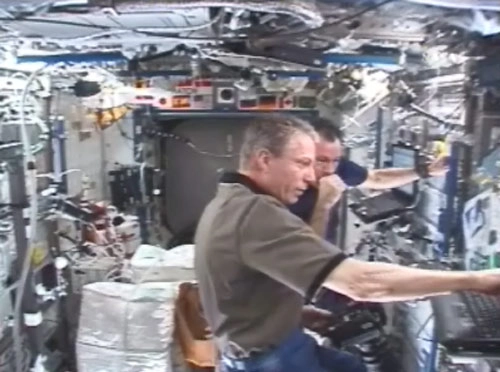
Seven astronauts aboard NASA's shuttle Discovery have a heartywelcome waiting aboard the International SpaceStation (ISS), where three veteran spaceflyers are preparing for their afternoonarrival.
Discovery'sSTS-116astronaut crew, commanded by veteran shuttle flyer MarkPolansky, is scheduled to dock at the ISS at about 5:05 p.m. EST (2105 GMT)after a two-day orbital trek.
"I thinkthat's going to be a really neat thing," said Polansky, who visited a muchsmaller ISS asthe pilot of NASA's STS-98mission in 2001, before launch. "I can only imagine how monstrous thisthing is going to look with the whole truss structure across it and the extrapair of [solar] arrays going out there."

Duringtheir 12-day spaceflight, Discovery's crew expects to install a new $11-millionaddition to the station's portside truss, rewire the outpost's electricalgrid and ferry STS-116 mission specialist Sunita"Suni" Williams to join the orbital laboratory's Expedition14 mission.
"I hope Sunilikes it," Expedition 14 commander Michael Lopez-Alegriasaid of Williams, a first-time spaceflyer, just after Discovery reached space Saturday."She's going to be there for awhile."
Williamswill relieve European Space Agency astronaut Thomas Reiteras an Expedition 14 crewmember, and will join Lopez-Alegria and Russiancosmonaut MikhailTyurin aboard the ISS. Reiter will return to Earth with the STS-116crew aboard Discovery at the end of the shuttle's 12-daymission.
Orbitalacrobatics ahead
Polanskywill guide Discovery through some orbital acrobatics before docking at the ISS.
At about4:04 p.m. EST (2104 GMT), the shuttle commander is expected to bring Discoveryto a point about 600 feet (182 meters) below the station, then put the 100-tonspacecraft through a nine-minute back flip that will allow the Expedition 14astronauts aboard the ISS to take high-resolution images of the orbiter'stile-lined belly [image].The procedure is know as a Rendezvous Pitch Maneuver [image].
"That'swhen I'll get my first really close-up view of it," first-time spaceflyer NicholasPatrick, who'll be sitting in Discovery's front seats during the shuttle'sbackflip, of the ISS. "I don't know what to expect."
Analysts onEarth will later review the tile photography for any signs of damage causedduring Discovery's Saturdaylaunch [image].The survey follows a detailed heat shield inspection of Discovery's nosecap,wing leading edges and other areas by Patrick and his crewmates using asensor-laden extension of the orbiter's 50-foot (15-meter) robotic arm [image].
NASAofficials saidlate Sunday that an early analysis of the heat shield survey found littlecause for concern, and were eagerly looking ahead to what promises to be achallenging ISS construction mission.
"I hope you'reenjoying this early Christmas present like all of us are," STS-116 lead shuttleflight director Tony Ceccacci said.
NASA is broadcasting theshuttle Discovery's mission to the International Space Station live on NASA TV.You are invited to follow along with the STS-116 and Expedition 14 crews using SPACE.com's NASATV feed, which is available by clicking here.
- Video: Mission Profile: STS-116 Heat Shield Inspection
- Images: Ready to Fly: STS-116 Training
- Images: Shuttle Discovery Poised for STS-116
- STS-116 Video: Major Tasks
- STS-116 Video: Power is Everything
- STS-116 Video: Back in Business
- STS-116 Video: Building Blocks
- Mission Discovery: The ISS Rewiring Job of NASA's STS-116
- Complete Space Shuttle Mission Coverage
- All About the Space Shuttle
