


This story was updated at 10:21 a.m. EDT
CAPE CANAVERAL,Fla. - It's been three long years since the loss of Columbia, but NASA's space shuttle fleet isback in action after six astronauts rode their 100-ton Discovery orbiter homesafely Monday.
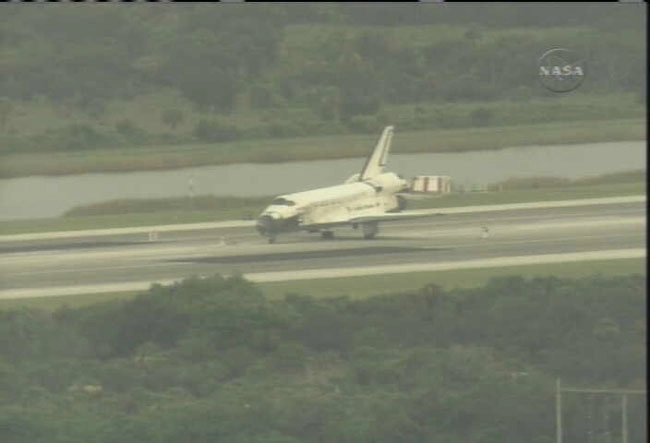
Discoveryand its STS-121 astronaut crew touched down here at NASA's Kennedy Space Center(KSC) at 9:14 a.m. EDT (1314 GMT), ending a successful 13-daymission and the last of two test flights following the 2003 Columbia tragedy. Theorbiter touched down after 202 trips around Earth.
"Itwas a fun entry, it was beautiful," Discovery's STS-121 commander StevenLindsey told flight controllers after landing.
Lindseysaid the superheated plasma encountered by the shuttle during reentry gave hiscrew quite a show.
"Wecould see the bright orange glow above and I could see the Earth moving below,"Lindsey said. "It was spectacular. We could actually see the Moon throughthe plasma."
Discovery rocketedinto space on July 4, a first-ever Independence Dayshuttle launch for NASA, almost one year after the agency's first post-Columbiamission returned its aging orbiter fleet to flight. Lindsey and his crew spent eightdays resupplying the International Space Station (ISS), making crucial repairsto the orbital laboratory and testing new heat shield inspection and repairtechniques.
"We feellike it's gone well," Lindsey said Sunday. "Everything we've hoped would happenhas happened."
Returningto Earth with Lindsey were shuttle pilot Mark Kellyand mission specialists LisaNowak, StephanieWilson, PiersSellers and MichaelFossum. The astronauts left a seventh STS-121 crewmember - European Space Agency(ESA) astronaut ThomasReiter - aboard the ISS, where he joined the station's Expedition13 crew.
NASA hasestimated its Columbiainvestigation and return to flight efforts have cost about $2.3 billion through2006.
"I thinkwe're back to space station assembly, to shuttle flights, but we're still goingto watch and we're still going to pay attention," Lindsey said earlier. "We'renever ever going to let our guard down."
Spotlessmission
By allaccounts from NASA mission managers, engineers and flight controllers,Discovery's STS-121 mission has been the cleanest ever seen in the agency's25-year history of shuttle flight.
"We'veinspected [the heat shield] more on STS-121 than on any other mission," saidSteve Stitch, NASA's reentry flight director, adding that analysts found nosign of troubling damage to the orbiter's heat-resistant tiles and carboncomposite panels.
That cleanbill of health comes after an intense engineering job to pull as much unneededfoam insulation as possible from the wrapping of Discovery's external tank,including a largeramp similar to one that shed a one-pound chunk of foam during theshuttle's STS-114 launch inJuly 2005.
A slightlylarger piece of foam about the size of a briefcase doomed Columbia and its crew when it fell from theorbiter's external tank and gouged a hole in the shuttle's left wing leadingedge during a Jan. 16, 2003launch. The damaged heat shield allowed searing hot atmospheric gases into Columbia's wing, leadingto its destruction.
But after amajor overhaul of shuttle external tanks - NASA shuttle chief Wayne Hale hascalled the new rampless design the largest aerodynamic change since the firstshuttle launch in 1981 - the space agency can claim an undeniable success.
The largest area of foam shed during launch was about thesame as that of a legal-sizesheet of paper, weighed less than one ounce and fell off in six separatepieces, NASA has said.
New camerasmounted to the orbiter's solid rocket boosters gave unprecedented- and stunning - views of Discovery's wing edges and tile-linedbelly during launch to track any foam debris loss, and an effort to keep peskyvultures away from the shuttle's launch site after one struck the orbiter'sSTS-114 external tank last year appears to have been successful.
"I hope ourlegacy was that we closed out our goals of the post-Columbia flights," Lindseytold reporters Sunday.
Discovery'sSTS-121 mission ferried about 7,400 pounds (3,356 kilograms) of cargo to theISS. Sellers and Fossum, the spacewalkers of STS-121, stepped outside theirspacecraft three times to restorethe station's railcar-like Mobile Transporter to full operations, test a100-foot (30-meter) robotic appendage as a heat shieldrepair platform and demonstrate wingleading edge crack repairs.
"There wasa lot to get done and we worked hard to make it all happen," Fossum said.
Among thecritical deliveries was German astronaut Thomas Reiter, who returned the ISS toits full three-person capacity for the first time since the Columbia accident.
Meanwhile,the entire crew worked together for meticulously choreographed inspections ofDiscovery's entire heat shield using a sensor-laden boom attached to the end ofthe orbiter's robotic arm.
"To me, themost amazing thing was watching the footage from launch, looking at the earlyinspection," said NASA astronaut Mark Polansky, commander of Discovery's nextflight - STS-116 to launch Dec. 14 - in an interview.
An ISSgate opens
Discovery'ssuccessful mission is the starting pistol for a marathon of ISS-bound shuttleflights to first build up the station's power and support systems, and theninstall new modules and laboratories that have been waiting for NASA's shuttlefleet to resume construction.
Up next isNASA's STS-115 shuttle mission, slated to launch between Aug. 28 and Sept. 5,to deliver a 17.5-ton solar array to the ISS and truss segment. A third shuttleorbiter flight slated for 2006, Polansky's STS-116 command, will install the newsolar array along with another truss segment.
"Everymission is the critical one," Polansky said. "Every mission depends upon thesuccessful completion of the previous one...I find it exciting."
WithDiscovery safely on Earth, NASA plans to host a post-landingnews conference at about 11:00 a.m. EDT (1500 GMT), followed by commentsfrom entry flight director Steve Stitch at 12:00 p.m. EDT (1600 GMT).
Shuttlecommander Steven Lindsey and possibly other members of the STS-121 crew aretentatively scheduled to comment on their flight on NASATV no earlier than 3:00 p.m. EDT (1900 GMT).
You areinvited to follow the progress of Discovery's STS-121 crew via SPACE.com's NASA TV feed, whichis available by click here.
- Gallery: Shuttle's First Flight
- Gallery: Rare Space Shuttle Images
- Shuttle Discovery: Complete Mission Coverage
- Great Space Quizzes: Space Shuttle Countdown
- Great Space Quizzes: The Space Shuttle
- Great Space Quizzes: Life in Orbit
