





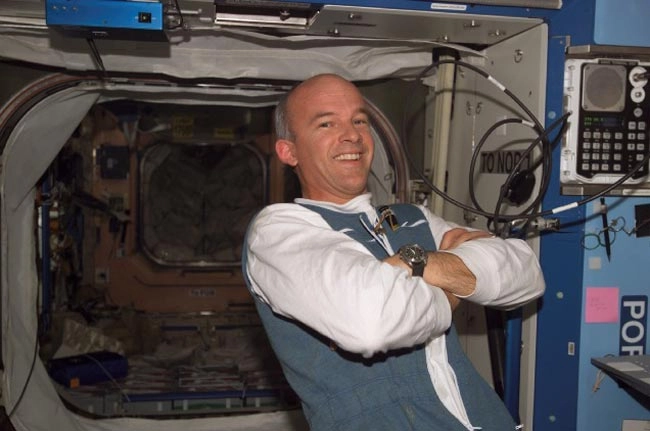
Twoastronauts in Earth orbit are settling into the International Space Station(ISS) for what they expect to be a busy six-month spaceflight.
ISS Expedition13 commander Pavel Vinogradov and flight engineer Jeffrey Williams arecompleting their first full week in charge of orbital laboratory since arrivingat the station on April 1. They relieved the station’s former tenants– Expedition12 commander Bill McArthur and flight engineer Valery Tokarev – whohad concluded their own six-month mission.
“We’resettling in very well,” Williams told SPACE.com Thursday during aspace-to-ground linkup. “We had a good handoverwith Bill and Valery, they left the station in very good shape.”
McArthurand Tokarev returnedto Earth on April 8 with Brazil’s first astronaut MarcosPontes, who launchedtoward the ISS with the Expedition 13 crew on March 29.
A quickmatch
While mostISS crews train together for years before launching into space, changes in crewrotation plans gave Williams – who originally trained to command astation flight and served as McArthur’s Expedition 12 backup – andVinogradov about seven months to mesh as a crew.
“Itwas a scramble,” said Williams, a U.S. Army colonel, from orbit last week during a videoexchange with U.S. Army officials. “Pavel and I did not know each othervery well.”
NASAofficials said Williams’ shift to Expedition 13 occurred after shuttlelaunch delays in Fall 2005 pushed the agency’s nextISS-bound orbiter flight well into 2006. The reassignment allowedfuture ISS crewmembers who have trained for specific ISS spacewalk or assemblytasks to be matched with their expected workload, NASA said.
Williamssaid he cut short his October vacation plans to train with Vinogradov andensure the success of Expedition 13.
“Likea good Army soldier, I think all of us in the program currently andhistorically are trained to stand up and do as we’re asked,” hesaid.
In themeantime, NASA’s Discovery shuttle is expected to visit the ISS duringthe STS-121orbiter flight in July. Williams and Vinogradov hope to then welcome anaddition to their mission, European Space Agency astronaut ThomasReiter, who will return the station crew complement to its regularthree-person crew size for the first time since the 2003 Columbia accident.
“We’revery much looking forward to his arrival,” Williams said Thursday ofReiter. “We’ve got a place on our patch where we can add his name,too.”
Twospacewalks and a second shuttle visit – STS-115 aboard Atlantis, whichincludes the installation of a new set of solar arrays outside the ISS –are also scheduled during the Expedition 13 mission.
Spacestation veteran
Despite thelate crew change, the Expedition 13 astronauts are both experienced spaceflyers.
That goesdouble for Vinogradov, who learned the art of pacing himself after 198 days inspace aboard Russia’s MirSpace Station during his Expedition 24 flight between August 1997 and February1998.
“In ashort duration flight, you can grin and bear it since it’s not that long,you can take it,” Vinogradov said before the Expedition 13 launch.“But in a long-term flight, things like fatigue and irritability arise.Knowing that beforehand and counteracting those things is where experiencecomes in.”
A native ofMagadan, Russia and father of a 12-year-old daughter, Vinogradov joined theFederal Space Agency’s cosmonaut ranks in 1992 after years of servicewith the country’s Head Design Bureau RSC Energia, where his wife alsoworks. But becoming a cosmonaut was not something he initially thoughtachievable.
“Atthe time, I thought that I was not worthy of becoming an astronaut becauseastronauts and cosmonauts had special qualities that I didn’t have,”Vinogradov, 52, said before his flight, adding that it was only after workingalongside actual space flyers that he gained confidence. “I saw that Icould do their job as good as them, potentially, and that gave me the courageto write up an application in 1982.”
The delaybetween his initial application at Energia and acceptance was prolonged byRussia’s Buranshuttle program, since officials wanted him to wait until the orbiter wasready to fly. It was only after the Buran program was scrapped that Vinogradovreached space.
A worthyendeavor
Vinogradovsaid Thursday that despite its complexity, human spaceflight is a worthyendeavor not just for individual nations, but the world at large.
“Todayit doesn’t really matter whose country sends their citizens intospace,” Vinogradov told SPACE.com. “It’s anachievement for all humankind.”
Not onlywas the Expedition 13 crew in orbit during Russia’s 45thanniversary of the first mannedspaceflight by cosmonaut Yuri Gargarin, but also the 25thanniversary of NASA’sfirst shuttle flight this week, Vinogradov said.
“It’svery symbolic that on the same day, roads have started that eventually mergedinto one road, and I believe this is the road we’re traveling now, theInternational Space Station,” he added.
AstronautArmy colonel
Williams,48, is making his second trip to space after a 10-day trip to the ISS in May2000 aboard NASA’s Atlantis orbiter during the STS-101mission.
“Theflight, I’ve concluded, is the easy part,” Williams said before launch,adding that the more than three years of spaceflight training has been thehardest challenge on himself, his wife Anna-Marie and family. “It’sa continually difficult thing to do. You’re continuously jetlagged andthere’s a feeling of isolation. It’s very challenging and stressfulon families, and I’ve learned a lot through the experience.”
A father oftwo grown sons, ages 24 and 21, Williams hails from the small town of Winter,Wisconsin – where his parents Lloyd and Eunice still reside – andtook a piece of home with him when he launched into orbit.
“Theyjust celebrated their 100th centennial year and they produced a little bookleton the town, I brought one of those booklets to fly and then return to thetown,” Williams said, adding that he also took photographs fromWinter’s early days that have ties to his own family.
Reading– and having – The Right Stuff
The seedthat grew into William’s astronaut career was planted while he was a U.S.Army cadet at West Point, where he learned the Army had pilots and joined thesport parachute team. But it was author Tom Wolfe’s spaceflight treatise TheRight Stuff that set Williams on the astronaut path.
“Idon’t know why, but I read that book and I learned about test flight andthe history of the astronaut program and that’s when I set it as alifetime goal,” Williams said. “I did not like the movie, but Iloved the book.”
Williamssaid he’s looking forward to the next six months in orbit, but for thenear-term will settle for making his own imprint on the space station.
“Whenyou move into a new place…there’s always some thing you want to doto tailor it for yourself,” he said Thursday. “That’s whatwe’ve been doing in our spare time.”
- STS-121 Shuttle Commander Confident in July Launch Target
- Russia's President Hails ISS Crew on Spaceflight Anniversary
- 45 Years Ago: Mankind's First Crewed Spaceflight
- Complete Coverage: ISS Expedition 13
