





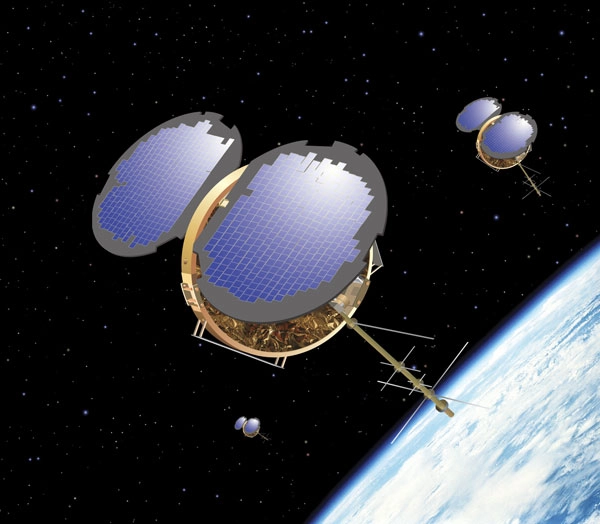
Despite arainy start and one countdown abort, six small satellites launched spacewardFriday on a mission to study the Earth's atmosphere and track climate change.
An OrbitalSciences-built Minotaur rocket shot the multi-satellite mission into orbit at 9:40p.m. EDT (0140 April 15 GMT) from California's Vandenberg Air Force Base, whererain and clouds reigned for most of the day. It was the second attempt to loftthe spacecraft Friday after a last-minute glitch prevented a liftoff almost 90minutes earlier.
A jointeffort between researchers in the U.S. and Taiwan, the $100 million COSMICmission - short for Constellation Observing System for Meteorology, Ionosphereand Climate - will use a network of six satellites and a method called radiooccultation to measure the Earth's atmosphere along thousands of data points.
Thespacecraft use a set of four global positioning system (GPS) antennas and a suiteof other instruments to track how GPS satellite signals are distorted bythe Earth's atmosphere.
From thatdistortion, researchers can track atmospheric conditions such as air density, temperature, moistureor electron density. Mission scientists hope the system, which is expected totake 2,500 occultation soundings all over the globe - included the Earth'soceans - every 24 hours, will provide a data boon for weather forecasters andatmospheric researchers.
"You guysdid a fantastic job," said William Kuo, director of the COSMIC office at the UniversityCorporation for Atmospheric Research (UCAR) in Boulder, Colorado, to launchcontrollers just after the sixth COSMIC satellite was deployed in orbit.
UCARdesigned the satellite system used for COSMIC's planned two-year mission, but about$80 million of the mission's cost was covered by Taiwan's National ScienceCouncil and National Space Organization.
The U.S.National Science Foundation and its partners - which included NASA, the U.S.Air Force Space Test Program, the Office of Naval Research and the NationalOceanic and Atmospheric Administration - covered the rest.
Each of thesix COSMIC satellites - known together as FORMOSAT 3 in Taiwan - is just a few inches wide and weighs about 137 pounds (62 kilograms). Originallydeveloped by Orbital Sciences for the ORBCOMM data communications network, the probeswere modified for the COSMIC mission and are expected to reach their finalcircular orbits - between 435 and 500 miles (700 and 800 kilometers) aboveEarth - in about 13 months.
The missionrelies on some radio occultation techniques and hardware developed by NASA'sJet Propulsion Laboratory (JPL) in Pasadena, California, the space agency said.
"COSMICis a prime example of transitioning NASA remote sensing technology intooperational weather forecasting," explained Tony Mannucci, supervisor ofJPL's Ionospheric and Atmospheric Remote Sensing Group, in a statement."The expected improvements in forecasting skill and COSMIC's contributionto long-term climate monitoring are a direct result of NASA's researchinvestments in radio occultation, a technology originally developed by JPL inthe 1960s for planetary atmospheric studies and later refined in the 1990s forEarth orbit use."
While thespacecrafts are expected to perform for two years, they carry enough fuel for afive-year study, Orbital officials said.
Friday'ssuccessful space shot marked the fifth launch of an Orbital-built Minotaurrocket since its debut in 2000.
- Launch Coverage for COSMIC Satellite Constellation
- Probing the Atmosphere: A 'COSMIC' Connection
