


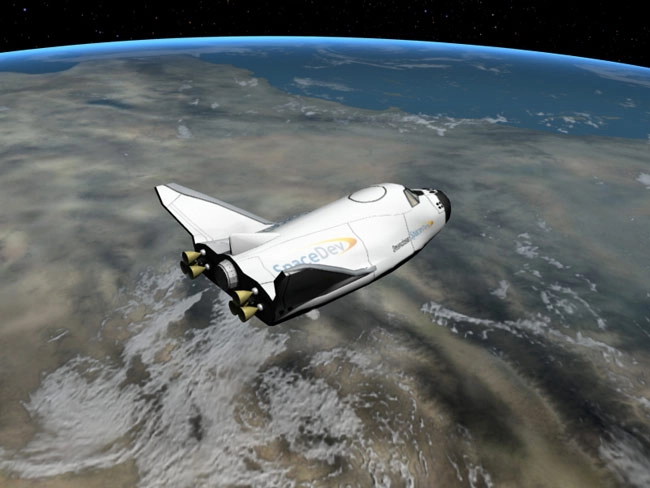
A privatespace firm with orbital aspirations has revamped its plans for a crew-carryingspacecraft.
Poway,California-based aerospace firm SpaceDev has a new design for its Dream Chaservehicle and hopes to offer suborbital rides within two years, with orbitalflights to follow.
Instead ofderiving a spacecraft from NASA's X-34space plane concept, the firm has opted for a blunt-nosed lifting bodyapproach to cut down on reentry heating stresses, SpaceDev chief Jim Bensonsaid in a telephone interview. The plans stem from work SpaceDev performedwith NASA's Ames Research Center to study the use of hybrid rocket propulsionfor spaceflight testbeds.
"Because ofthe X-34's pointed nature and sharp edges, the high temperatures would meet thelimits of our vehicle right at the ragged edge," Benson said, adding that thenew Dream Chaser design more closely resembles the Horizontal Landing-20(HL-20) model studied by NASA's Langley Research Center. "The HL-20 was a greatlittle vehicle and it's already designed."
Smallenough to fit inside the payload bay of a NASA shuttle with folded wings, theHL-20 Personnel Launch System was slated to carry 10 astronauts (two pilots andeight passengers) or small payloads into orbit, though funding for the programdried up in 1990.
SpaceDev'stake on the small spacecraft would be lighter, seat four people for asuborbital flight and up to six for an orbital trek. The space plane isenvisioned to launch atop a launch stack of hybridrocket engines - like those developed by SpaceDev as part of the SpaceShipOneAnsariX Prize entry - and make a runway landing back on Earth, according to itsdesigned flight profile.
"We don'tuse cryogenic liquids, so there's no ice or foam to worry about, and it'snon-explosive," Benson said of the current design.
Benson saidthat with $20 million or less and about two years, SpaceDev could have afour-person suborbital Dream Chaser vehicle ready for flight. Given three moreyears, as well as $100 million, and the firm could develop an orbital variant,he added.
SpaceDevhopes its design will enable the firm to participate in commercial cargo andother services to support the International Space Station (ISS), and could aidfuture Moonexpeditions as well. Last week, NASA chief Michael Griffin said private supplyships with their own launch services will be vital to deliver future cargoto the ISS.
"We'rekeenly interested in that," Benson said, adding that an orbital Dream Chaser couldhaul one ton of cargo - with limited crew - to the ISS. "Once we get intoorbit, you can really make use of it. It doesn't matter if it's going to thespace station, habitat modules or what...what we need is low-cost access to lowEarth orbit."
