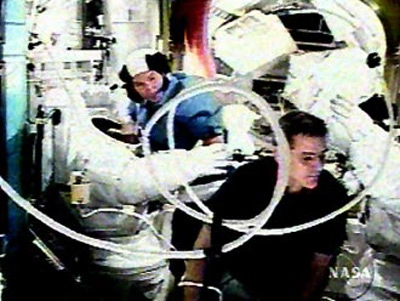
Twoastronauts aboard the International Space Station (ISS) stepped into theirU.S.-built spacesuits Thursday during a dress rehearsal for the first spacewalkof their six-month mission.
ISS Expedition12 commander Bill McArthur and flight engineer Valery Tokarev donned theirNASA spacesuits - called Extravehicular Mobility Units (EMUs) - during anexercise to prepare for a Nov. 7 spacewalk.
"[Itwas] exactly what we thought it would be like," McArthur said of the dress rehearsal.

Theupcoming spacewalk will mark the third extravehicular activity (EVA) forMcArthur and a first for Tokarev. It will also be the first time ISS astronautshave used U.S.-built spacesuits to venture outside their spacecraft since 2003due to glitches - since solved - with the station's Quest airlock and EMUs.Space station crews relied solely on Russia's Orlan spacesuits until the spaceshuttle Discovery's STS-114 crew - which conducted three spacewalks using EMUsduring their mission - delivereda fresh pair of U.S. spacesuits to the ISS in July.
The newU.S. spacesuits will allow McArthur and Tokarev - as well as future ISSspacewalkers - to depart the station at NASA's Quest airlock, which cannotcurrently be used with Orlan spacesuits, and cut down on travel time toworkstations on the orbital platform's U.S. segment, said Dale Roberts, head ofNASA's EVA increment group at Johnson Space Center (JSC), in a telephoneinterview.
"The Orlan,of course, is a good suit and a robust suit, but it is different from the EMU,"Roberts said. "[Russia's] system was designed around the Russian segment of thespace station."
Orlanspacesuits are filled to a higher pressure than EMUs - 5.8 psi as compared to4.3 psi - which makes them a bit stiffer than U.S.-built suits and can lead to additionalfatigue during long spacewalks, Roberts said. While Orlans are also designedspecifically to maintain the station's Russian-built segments, where many maintenanceprocedures can be performed from inside the station, EMUs are preferred on theU.S. segment because their additional glove dexterity is valuable when handlingthe multitude of connections and batteries on the exterior, he added.
Still, necessitycan be the mother of invention and, during 2004's Expedition 9spaceflight, ISS commander Gennady Padalka and flight engineer MichaelFincke provedthat Orlan spacesuits could be used for some maintenance on U.S.-built spacestation segments. They staged the EVA from the Russian-built Pirs dockingcompartment and traveled the furthest from their egress point than any otherISS crew at the time.
The Expedition9 crew's task, Roberts added, was rather straightforward.
"It wasabout as simple and basic as you can get with a spacewalk," he said, addingthat much effort was spent by EVA planners, astronauts and instructors to makeit that way. "It was not at all indicative of assembly tasks."
Having theU.S. spacesuits aboard the ISS not only give astronauts an additional optionfor spacewalk apparel, it fulfills established ISS requirements that requireRussian and NASA spacesuits be ready to perform two extra - or contingency -spacewalks on top of any planned EVAs if needed, Roberts said.
Duringtheir upcoming spacewalk, McArthur and Tokarev will attach Orlan spacesuitwrist mirrors to their EMU gloves in place of U.S.-built mirrors that were inadvertentlyshipped back to Earth aboard Discovery in August, NASA officials said, addingthat replacements will be packed aboard a resupply ship set to launch toward theISS in December.
It is notthe first time that parts have been interchanged between Russian and U.S.suits.
SinceExpedition 9's spacewalks - they completed four during their mission - ISS astronautshave preferred to mount EMU helmet lights to complement Orlan suit lightingduring EVAs, Roberts said. Drink bags and other EVA tools can also be swapped,he added.
McArthurand Tokarev are set to step outside the ISS at about 9:30 a.m. EST (1430 GMT)on Nov. 7. At least one other spacewalk, this one in Orlan spacesuits, isscheduled for their mission. A third spacewalk in U.S. spacesuits could beadded in February 2006 should the time be available, NASA officials have said.
- ISS Astronauts Settle in for Six Months in Orbit
- Complete Coverage: ISS Expedition 12
