This story was updated at 8:05 a.m.EDT.
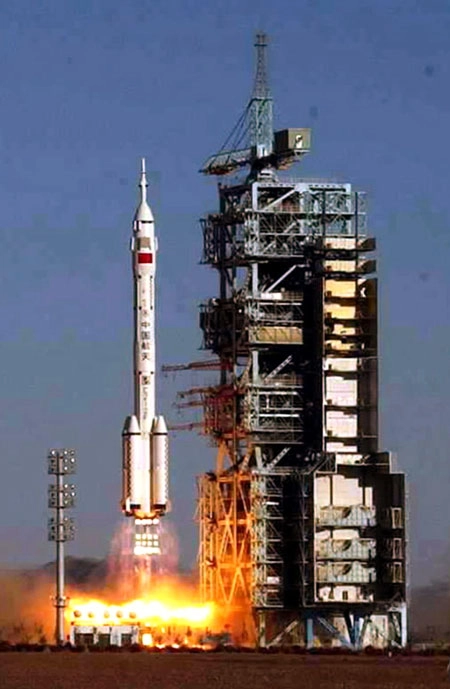
While somedetails of China'ssecond manned spaceflight have emerged, still others remain a mystery as theclock ticks down toward an Oct. 13 launch.
Two Chineseastronauts are expected to rocket into space aboard their Shenzhou6 spacecraft when their Long March 2F rocket lifts off, but who those pilotswill be is unclear.

"We stilldon't have a good sense as to who this new crop of astronauts are," said China space specialist Dean Cheng, with the CNACorp. in Arlington, Virginia, in an interview. "That is thebasis for Shenzhou 6's crew."
China has reportedly trained 14 fighterpilots, split into two-person teams, to serve as astronauts, though at leastone will not be making the next space trip.
"I will nottake this mission," said Chinese astronaut Yang Liwei - who flew aboard the country's first mannedspaceflight Shenzhou 5 - during a space exhibition inNanjing this month, China's Xinhua news agency reported.
Yangreportedly explained that he wanted to allow China's other astronauts - alsoknown as 'taikonauts' from the Chinese word 'taikong' - an opportunity to gain experience, but thepublic admission was not surprising, experts said.
"I think weknew for awhile that Yang Liwei will not be a part ofthe next mission," Cheng said.
Yang launchedinto space, and into Chinahistory books, on Oct. 15, 2003. Riding aboard Shenzhou5, Yang orbited the Earth 14 times in 21 ? hoursbefore returning safely. The astronaut - then a lieutenant colonel in China'sPeople's Liberation Army- was promotedto full colonel after his flight and is set to appear in a charity movie toraise funds for children in need.
The Shenzhou 6 mission is slated to last five days, or 119hours, and mark the first time Chinese astronauts leave their Shenzhou craft's flight module and enter itsexperiment-filled orbital module, state media has reported. According to theChinese newspaper People's Daily Online,Shenzhou 6 will launch between Oct. 13 and Oct. 17and the spacecraft has already arrived at China'sJiuquan LaunchCenter in the Gobi Desert.
While Yangwill not ride aboard that flight, whether or not his two Shenzhou5 alternates - Zhai Zhigangand Nie Haisheng, accordingto a Associated Press report- are still in the running is unclear. Days before Yang's launch aboard Shenzhou 5, Chinese space officials had winnowed the flightpool down to the three astronauts.
"When theytell us, as a matter of course, who's in the [astronaut] class, with a littlemore than a headshot and the comment that their ex-fighter pilots, that'll be asign of loosening up," Cheng said.
Yang said Shenzhou 6's flight will be noticeably more comfortablethan his, featuring heated food, sleeping bags and sanitary equipment to meetall crew needs.
"One of myquestions is how do they go to the bathroom [aboard Shenzhoucraft] and whether or not the Chinese came up with a different solutions thanthe Russians," Cheng said.
China's Shenzhou spacecraft arebased on Russia'sextremely successful Soyuz spacecraft, but carry extensive modifications andchanges by Chinese vehicle designers.
As moredetails of Shenzhou 6's flight are released, theflight's importance to the country and its China National Space Agency (CNSA)come to light.
According toearlier state media reports, Shenzhou 6 will launchin mid-October after China'sNational Day festivities which run from Oct.1-7. The flight's proximity to anational holiday highlights its importance, but CNSA limits the potentialdamage that a failure could inflict by waiting until after the festivities,Cheng said, adding that space officials would likely wait until after Oct. 10 -which is Taiwan'sNational Day - to launch Shenzhou 6.
"Launching andrecovering in and around National Day has some political potential, thoughthere is both an upside and a downside," he added. "This is a very prominentevent and is going to have lots of media coverage."
Last week,state news media reported that China Central Television (CCTV) will carry Shenzhou 6's launch live and was soliciting advertisers forthe upcoming space shot.
Commercialcosts for the new advertisement spots range from $316,420 (2.56 million yuan) for five-second slots up to $1.05 million (8.56million yuan) for a 30-secondslot, according to the Beijing Modern Commercial Daily.
China officials initially refusedto broadcast Shenzhou 5's launch live, though it was replayedafter liftoff.
"I hopethey do broadcast it live," Cheng said of the upcoming launch, adding that heexpects there will likely be a 15-second delay in the broadcast.
Meanwhile,reports of China'sconstruction of a new Shanghaispace center, lunar exploration plans and space station goals - Shenzhou orbital modules can remain in space for longerperiods than the flight modules - give shape to the country's futureexploration plans.
"I thinkthe larger program has become less tight-lipped," Cheng said. "We're actuallygetting a sense of a 10-year plan."
Chinesestate media reported this month that the country's first female astronautcandidates - 35 women between 17 and 20-years-old in age - have begun afour-year university program coupled with science and flight instruction toprepare them for spaceflight.
There havealso been some hints from Chinese space officials that by Shenzhou7, Chinese astronauts will conduct the country's first spacewalk, with adocking test slated for Shenzhou 8, Chen said.
"I thinkthat is a sign of willingness on the part of the CNSA to take a little bit ofrisk," Cheng said. "To say, 'Okay, we do need to build up a little of anexpectation here.'"
- China Just Weeks From Second Manned Spaceflight
- Making History: China Launches its First Piloted Spaceflight
